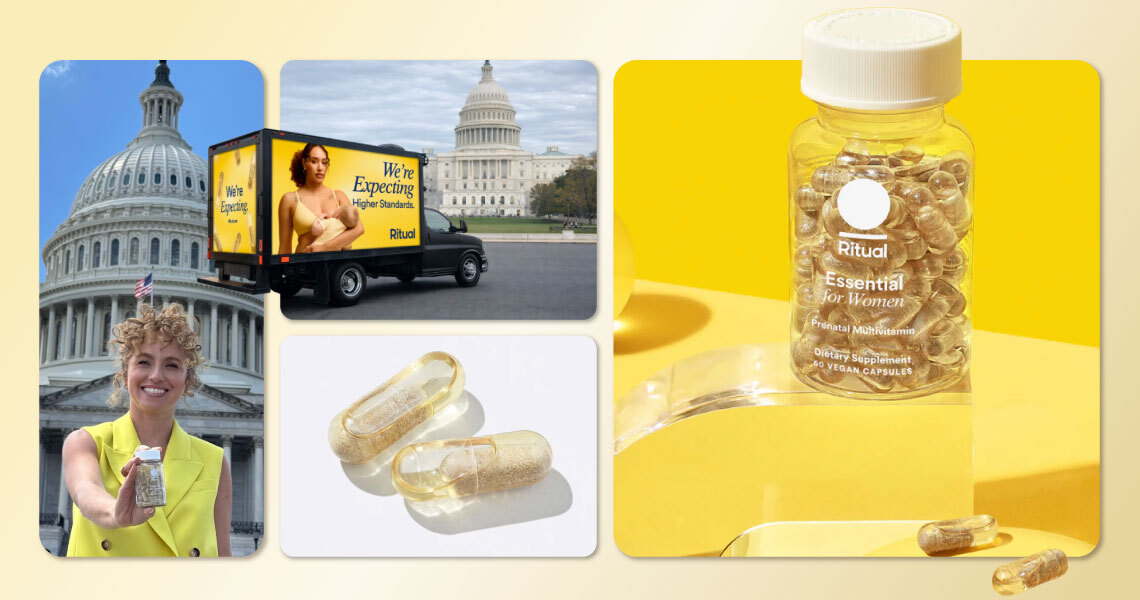
For the Wellness Briefing, Glossy spoke to Ritual CEO Kat Schneider and chief impact officer Lindsay Dahl about the company’s new “We’re expecting” campaign that calls on lawmakers and Ritual consumers to advocate for stricter regulation over heavy metal contamination and clinical testing claims within the growing supplement category.
Additionally, Garmin’s revenue jumps 14% YoY as its fitness watch sales surge, a French robotic skin cancer screening company lands funding, and Niagen Biosciences enters the telehealth sector to sell at-home NAD injection kits.
Ritual leans further into activism with campaign targeting supplement reform
Ritual, the 10-year-old supplement company built around a traceable supply chain and science-backed formulations, is betting on activism with its latest campaign.
“[The supplement marketplace] feels like it’s more exponential than ever, which I think is scary and exciting at the same time,” Kat Schneider, founder and CEO of Ritual, told Glossy. “It’s scary because there haven’t been major updates to federal regulation [since 1994]. So consumers are left with questions like, ‘Is this safe and effective? Is it gonna hurt me? Does it work?’.”
Today, the growing supplement space is regulated by a patchwork of state and federal regulations. The latter includes the Dietary Supplement Health and Education Act of 1994, also known as DSHEA [pronounced da-shay].
Ritual would like this piece of legislation updated or replaced to better regulate claims made by brands, including establishing a standard for the phrase “clinically studied” and requiring brands to test their products for heavy metal contamination, especially in protein powders and prenatal supplements.
Heavy metal contamination has become a hot-button issue after a January study by “Consumer Reports” found more than 60% of formulas studied include dangerous heavy metals. Heavy metals like lead and arsenic can naturally occur in ingredients harvested from nature since heavy metals can be found in soil and other environments. As part of its brand identity, Ritual tests its supplements and protein powders for contaminants, a practice it believes should be required of all companies.
Ritual’s newest campaign, named ‘We’re expecting,’ includes a 360-degree marketing strategy that includes digital, print, OOH and professional channels, accompanied by a Washington, D.C. lobbying trip with female medical providers last week.
Ritual’s team on the ground at Capitol Hill included Schneider and execs like Lindsay Dahl, author and chief impact officer for the brand, plus partnering female medical providers, including OB-GYN Dr. Andrea Alexander, midwife Jessica Diggs and doula Kaitlyn D. Wozniak.
The group met with U.S. senators Elizabeth Warren, Patty Murray, Dick Durbin, Alex Padilla, Richard Blumenthal, Adam Schiff and Raphael Warnock.
“We focused our meetings on the Senate side, where most of the action has been happening, and the response was really positive,” Dahl said. “It’s consistent with what we’ve been seeing over the last several years, which is that people care about this issue; [lawmakers] see it as a true consumer safety issue.”
Dahl is a lobbying and safety advocacy expert. Prior to joining Ritual in 2022, Dahl worked at Beautycounter where she led similar lobbying trips over a seven-year tenure and, prior, was deputy director for an environmental health coalition called Safer Chemicals, Healthy Families.
Ritual’s new ads feature a QR code that sends readers to a platform hosted by Quorum, an AI-powered public affairs software, that drafts and sends letters to legislators from interested consumers asking for the above, plus more funding for pregnancy research.
“A member of Congress needs [only 10] emails or calls into their office [about a specific subject], and then they appoint a member of their staff [to lead the issue],” Schneider said. “[It’s] a really powerful thing, how easy it is to get involved, that people don’t realize.”
At the end of the day, Ritual’s execs want the brand to be known for its safety and efficacy. To demonstrate this, the team published its latest clinical study on March 25 in the peer-reviewed medical journal “Frontiers of Nutrition.”
“What makes me really proud is the clinical rigor that we have; it’s not just a fluffy campaign, but it’s on the heels of just having published a peer-reviewed study [on our Essential Prenatal supplements] around methylated folate, something we’ve been talking about for a decade.”
“There isn’t a clear measure of success, and we’re OK with that,” Dahl told Glossy. “Success will happen, likely a few years down the road, when we see reform of our federal laws.” So far, the team has many successful blueprints, including SB 646, a California law Ritual lobbied for that mandates makers of prenatal vitamins to test for heavy metals. The law goes into effect in 2027.
“We’re here for the long haul,” Dahl said. “Especially in today’s world, there can be these flashy marketing moments, which this is not. This is part of our day-to-day work that we have been doing for years.”
Executive moves:
- Heather Jordan Fisher is the new global chief marketing officer of Australian body-care brand Uni. Her CV includes Kendo brands and Bare Essentials.
- Shelby Oliver is the new seasonal marketing manager at CVS Health. She joins the team after a decade at Hasbro toy and games company.
News to know:
- Garmin, the Swiss maker of “wellness watches” that compete with health tracker rings, apps and fitness watches, reported a 14% year-over-year increase in sales for its Q1 2026 on April 29. Garmin also sells GPS, home and recreation equipment. However, this quarter’s growth was driven by a 42% surge in its fitness segment, specifically its luxury watches. Garmin offers dozens of watch models for kids and adults that track health, priced from $89-$1,900 depending on size and specs.
- Sauna studio leader Perspire has opened its 100th location. The 16-year-old business, which offers red-light therapy, contrast therapy and its signature infrared sauna sessions, opened in 2010 and began franchising the business in 2018. It has sold 280 franchise licenses and has locations in 27 states. “In an often chaotic and fast-paced world, people are craving time to disconnect and feel good again,” Lee Braun, founder and CEO of Perspire Sauna Studio, said in a statement. “We’re proud to offer a space where wellness isn’t complicated, offering a simple habit that people can build into their everyday lives.”
- More at-home NAD injection kits are rolling out to consumers. Niagen Biosciences, the California-based maker of category-leading oral nicotinamide riboside brand Tru Niagen, has launched a new telehealth arm to sell Niagen injection kits direct to consumers for at-home use. The announcement on May 5 comes just a few weeks after Remedy Place launched NAD smart pens for at-home injection. “This is not a casual direct-to-consumer purchase,” Niagen Bioscience advisor Dr. Chris Meletis said in a statement. It is a clinician-directed telehealth program designed to evaluate eligibility and, when appropriate, provide prescription access to pharmaceutical-grade Niagen in an at-home format.”
- SquareMind, a skin health startup based in France, has taken on $18 million in funding led by California-based Sonder Capital. SquareMind offers AI-powered, robotic skin cancer screenings using a machine called Swan that photographs and analyzes the skin, then tracks changes at each visit. The company will use the funding to expand in the U.S. and Europe.
- Pickleball Inc., a newly formed group dedicated to managing the sport’s growth, has raised $225 million in investment from Apollo Sports Capital. The new group was formed after the merging of two pickleball industry leaders: Major League Pickleball and the Carvana PPA Tour. Pickleball Inc. will use the funding to scale its media, retail, software and infrastructure sectors to serve the roughly 24 million Americans who play pickleball today.
Stat of the week:
More than 80% of physicians now use AI tools professionally, according to a survey released by the American Medical Association in March. This stat has doubled from 2023, “showing how physicians’ comfort with this technology has grown rapidly as the tools have become more sophisticated,” according to the professional organization. Use cases for AI include summaries of medical research, used by 39% of survey participants, while around 30% use AI for the creation of discharge instructions, care plans or progress notes, and 17% use AI for assistive diagnosis.
In the headlines:
Winx Health has tripled its retail revenue in the last three months. Now, it’s launching into Walmart [Modern Retail]. Gatorade makes major investment in women’s health [ATN]. The leggings that promise to fix your knees [McGill]. Does my baby need a spa day? [Vogue]. Looking to regrow hair? New options are on the horizon [WSJ]. Noise is an overlooked longevity factor [SuperAge]. Mel Robbins’ Pure Genius protein shots land nationwide retail deal with Target [WWD].
Listen in:
L’Oréal Paris is betting on “The Devil Wears Prada 2” through an official partnership that spans TV ads, OOH advertising, social campaigns, consumer eventing and product placement in the film. “We have an entire ecosystem built around [the film],” L’Oréal Paris president Laura Branik told Glossy on this week’s episode of The Glossy Beauty Podcast.
Need a Glossy recap?
Hypothesis used NIH grants to develop a proprietary acne ingredient for new skin-care range. Prediction markets like Kalshi and Polymarket are coming for the fashion industry. How Urban Outfitters co-creates campaigns with Gen Z. How Wrangler used Spotify and out-of-home advertising to show up at Stagecoach. Welcome to the golden age of thrifting. Can Kering’s comprehensive plan really turn things around? The Estée Lauder Companies will reduce department store footprint as it focuses on ‘high-growth’ online channels. ‘The Devil Wears Prada 2’ reflects a vastly changed fashion landscape. Why Refy handed creators full control — no approvals — for its latest launch campaign.