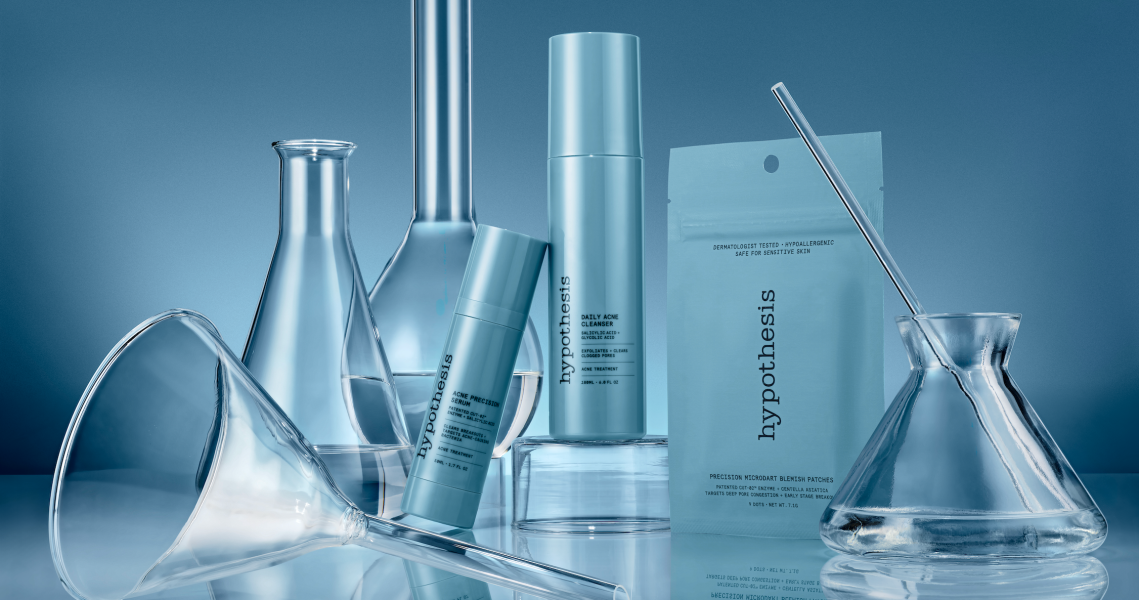
California-based Hypothesis, the 7-month-old eczema skin-care brand selling through Ulta Beauty, is targeting the acne market with the debut of a new proprietary acne ingredient and product launch.
“Over the past 15-20 years, the tools that we have to study and characterize the skin microbiome have improved dramatically,” said Oliver Liu, CEO and co-founder at Topaz Biosciences, maker of Hypothesis. “But if you look at the products that we have to address eczema and acne, we’re still using the same ingredients that have been around for 40-50 years.”
For acne, this includes benzoyl peroxide, salicylic acid, sulfur, adapalene and, in some cases, antibiotics, all of which “either don’t really address the skin microbiome, or they do try to target that causal bacteria, but they’re broad spectrum, so they wipe out all the bacteria in the microbiome, including good bacterias,” Liu said.
While helpful for some consumers, these common acne ingredients can create a cascade of undesired side effects like dryness, flaking, redness and irritation that often perpetuate breakouts. Similar to the gut, the body’s natural systems on the skin work best with a balance of “good” and “bad” bacterias that make up one’s complex skin barrier.
“We now understand how a single species of bacteria can take over the population of the skin microbiome to drive and exacerbate these skin conditions,” Liu said. “We felt like there had to be a better way [to treat common skin conditions].”
Liu and three other scientists co-founded Hypothesis in 2022 to develop new ingredients for acne and eczema through precision biotechnology.
Acne is the most common skin condition in the U.S. with more than 50 million people affected annually, according to the American Academy of Dermatology. Meanwhile, eczema impacts more than 30 million people in the U.S. annually.
Liu’s resume includes Amyris, the Bay Area biotech company that launched JVN Hair from Jonathan Van Ness in 2021 and Stripes Beauty by Naomi Watts in 2022, plus NorCal-based biotech companies like Slingshot Biosciences, Zymergen and Radiant Genomics.
For its part, acne is often caused by overgrowth of a bacteria called cutibacterium acnes, or C. acne for short. Eczema, on the other hand, is caused by staphylococcus aureus, better known as S. aureus or “staph.” However, the cost of research and development has limited new ingredient development targeting these everyday bacterias.
Liu and his co-founders took on a $500,000 round of private funding, to start, then Liu focused on grants from the National Institute of Health. As the medical research arm of the U.S. Department of Health and Human Services, the NIH has an annual budget of $48 billion, 80% of which is awarded for medical research that benefits the American people, according to the agency.
Grants come with a rigorous application and approval process – known as “grant writing” – and do not need to be paid back. But they are competitive and time-consuming, and only about 10% get funded, Liu said. “You’re not giving equity, they’re non-dilutive, and they are not contingent on having the exact perfect results,” Liu said. “Acne definitely needs new, targeted approaches, but there just haven’t been a huge amount of development and new acne treatments, so I think that’s what got the NIH excited [about us].”
The team was awarded an initial $300,000 in early funding from NIH, called phase one, to pursue the idea and prove it’s possible, then another $2.1 million over two years to scale the science into a commercially viable brand that can benefit consumers. In total, the team took on $2.5 million in VC funding and $2.7 million in grants.
The team’s research is based on everyday enzymes that destroy these bacterias. “[This class of enzymes] can bind to bacteria cell walls and chew them up really rapidly, and it causes the cell to burst and die,” said Liu. “But what’s really interesting is they have the potential for specificity down to a single species of bacteria within a community of bacteria, while leaving all the other bacteria alone.”
It took more than a year to isolate the company’s final two enzymes — one for its debut eczema launch in October called TPZ-01 and one for the acne launch this week called CUT-02 — which were then scaled through fermentation. In total, the team spent four years developing the brand and products.
The foundation of CUT-02 came from an enzyme Liu’s team discovered in soil. “It’s estimated over 99.9% of the bacteria within the soil have never really been studied,” Liu said. “[In most cases] nature has found the solution [to the problem already], it’s just kind of leveraging what nature has already created.”
To develop the formulations, brand identity, operations and marketing strategy, Liu tapped longtime beauty execs Caroline Hadfield and Crystal Rivera as fractional team leads.
The brand landed on three eczema products, launched in October DTC and through Ulta Beauty, and three acne products, launched on May 4. For the latter, 90% of clinical trial participants showed 90% improvement in acne symptoms in eight weeks.
The Hypothesis team has been lean, and many execs work as fractional employees. Hadfield’s CV also includes Amyris, where she helmed the launch and expansion of its consumer brands like Biossance, Pipette, JVN Hair and Stripes, among others, plus exec roles at LVMH, Sephora and The Body Shop. Meanwhile, Rivera’s CV includes Kendo brands and Tatcha skin care, plus eight years across Gap and Banana Republic.
“The community that we’re serving is very educated, even more so than your standard consumer,” Rivera told Glossy. “What’s exciting for us is that there’s definitely an appetite for the story behind the formula and the science.”
Rivera employed a multi-prong marketing approach, including school campus tours across Bay Area universities and community colleges, popping up at dermatology conferences, and building a private online community where consumers could get free samples to provide reviews and feedback, both before and after launch.
The brand launches on May 4 with the first three products in the new acne range: Daily Acne Cleanser, Acne Precision Serum and Micro-Dart. They’re priced under $40 per SKU.
“Our goal is to make this brand grow,” Liu said. “At some point in the future, we could be thinking about selling [our] enzymes as ingredients [to other companies], but for now, we’re really focused on making our brand a success.”