About a month ago, Refy launched its latest product, the Skin Base Skin Tint, with a smattering of paid creator posts, as many brands do. But it also did something different: It did not ask to approve the content it paid 12 creators to post.
Even as brands have become looser with briefs, understanding that creators know their audiences best, asking for final approval on content remains the norm in influencer marketing.
Charlotte Geoghegan, Refy’s head of brand, said the brand had previously considered giving creators full control on prior campaigns. As the team discussed the brand’s skin tint launch, they struggled to nail down a messaging framework for creators, as different team members had different things they liked about the product.
“I think that comes down to the formula, because it’s made to be adaptable,” Geoghegan said. The $40 skin tint, which has a gel-like texture, contains hyaluronic acid and a patented ingredient called Inclusium, which is an alfalfa extract meant to support hydration, radiance and smoothness.
Geoghegan said she was open to giving creators control as she was fairly certain she had considered all potential criticisms of the product: For one, its unique packaging, designed with accessibility in mind, may present a learning curve — the tint dispenses onto a sort of self-contained palette and is meant to be used alongside the brand’s $26 dual-ended Complexion Brush. There was also the product’s lightweight, buildable coverage. But, she theorized, people know what they are getting into when they choose to purchase a skin tint — it’s not a full-coverage foundation. Plus, she decided, “if there was something that a creator maybe didn’t enjoy, they could [potentially] educate on what it could be used for instead.”
What’s more, the brand was simply very confident in the launch.
“We don’t whitelist formulas, we don’t whitelist packaging,” Geoghegan said. “We develop everything ourselves, with our partners,” and this product had been two years in the making. “We’d all been using it for so long and testing [it] for so long, I was like, ‘I think we should put our money where our mouth is and just see what happens with it.’ So that’s where we landed.” Some employees felt it was risky, she said. But she decided that if there was ever a product to try such a strategy with, this was it.
And, finally, the Refy team felt the need to shake things up. “Creator marketing has all become very similar,” Geoghegan said. “TikTok used to be a place for such creativity, and [now] there’s this kind of cookie-cutter formula.”
Of course, in giving creators the freedom to avoid the approval process, Refy also gave them something unique to talk about. “From a video structure and algorithm perspective, I think it is a good hook,” Geoghegan said.
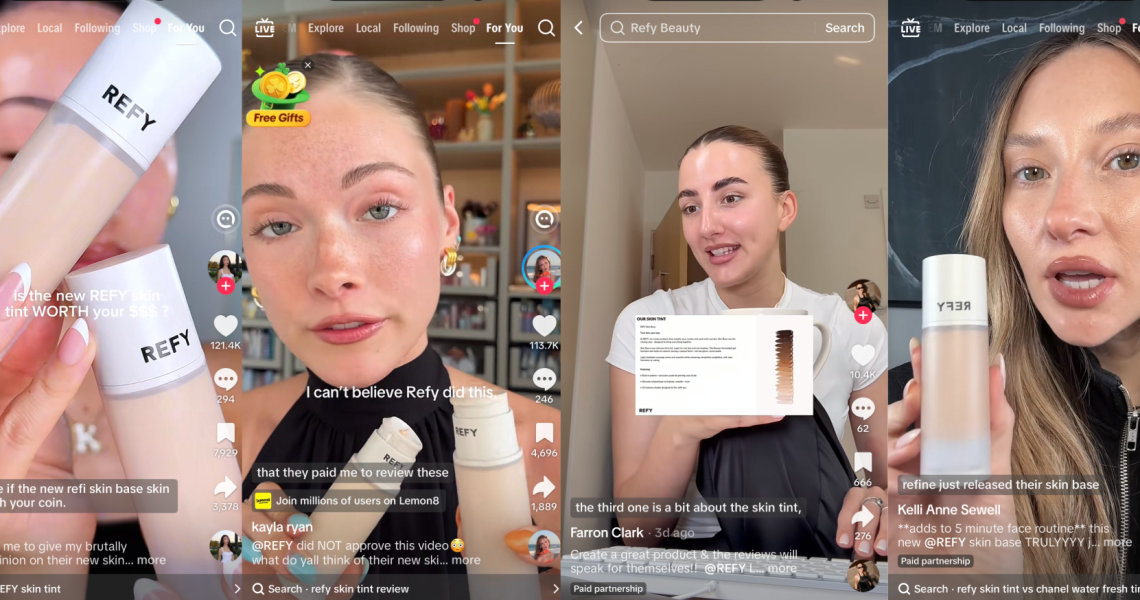
There was also the opportunity to gain creator trust and build a positive association. In a March 3 video posted by Kayla Ryan (1.3 million TikTok followers), Ryan said, “Refy is so confident in their new skin tints that they paid me to review these, and they said, ‘Don’t even show us. We don’t have to approve it. Just post.’ Hello!? I have never had a brand do that with me before, especially because Refy knows how honest I am. Let’s see how this goes.”
Geoghegan noted that Ryan had previously given a Refy brush and its lipstick negative reviews. “We were like, ‘She’s going to give a God-honest review.’ We tried to pick people who were going to give a genuine, honest review, and I think that’s why it all came together so well,” she said.
Similarly, creator Kelly Huang (820,000 TikTok followers) started her video with, “Umm, I’m not gonna let you waste your money in this economy, so let’s see if the new Refy skin tint is worth your coin. And you wanna know what’s crazy? They actually emailed me and said, ‘We will pay you for your 100% honest opinion. Don’t need to see the video. Just go and post it,’ because they’re confident I’m gonna love it. That’s a bold claim. So let’s see if that’s true.”
“Refy is known for being quite smart with their marketing,” said Lauren Spearman, a brand consultant who previously worked in social media at brands like Benefit Cosmetics and Trinny London. And giving creators the green light to post without approval casts the brand in a more positive light, she said, adding that creators would be likely to post about the lack of an approval process. No one said anything explicitly negative.
In fact, Geoghegan said she wished more of the creators had spotlighted the unique setup of the brief — just two of the 12 mentioned it. “If I had had some control, I would have probably had more of them be a bit more [vocal about it], because I think a couple of girls didn’t even mention that that was how the brief was set up.” To wit, of the 12 paid posts I reviewed, four of them featured creators simply applying makeup set to music, with no speaking at all. Others simply didn’t mention the unique setup.
Still, word spread. On March 24, creator Farron Clark (183,000 TikTok followers) organically posted about the brand’s strategy. Posts theorizing about brand marketing have become a genre unto themselves in today’s social media landscape.
In the video, she said, “I’ve got nobody I can speak to about Refy’s most recent influencer marketing campaign, so I’m going to speak to you girls about it, because it screams product confidence, and it screams putting your money where your mouth is. … Usually what an influencer campaign would look like is a brand would reach out to a creator. … [The creator would then] send it back to the brand. And this just basically ensures that the creator doesn’t create a piece of content that the brand thinks is completely off-brand or not aligning with the campaign. … This part of the influencer relationship … is where the brand can really assess, ‘OK, have we got our money’s worth in this piece of content?’ Because, usually, content that influencers do usually has ad spend behind it and usage. So it’s like, if this is an ad, are we going to see a return on investment? … I’m sold on the product, I’m sold on the brand, I would like a skin tint. And that is a successful influencer marketing campaign,” Clark said. That video has seen over 500,000 views.
Refy saw this content and decided to reach out to Clark. Then, they took it a step further and sent her the exact brief sent to the creators involved in the original campaign, and paid her to post about that, too — alongside her own review of the product. In that video, posted on Monday, Clark summarized the brief: “The third [page] is a bit about skin tint. The fourth one is [about] how to use it. The fifth one is the ingredients and claims. OK, so it says, ‘We want you to create a TikTok around the new Refy Skin Base. We want you to create content that your audience loves, how you would talk about the product organically. We’re so confident that you will love this product that we want you to post it without our approval.'”
Others organically created content about the launch, taking note of Refy’s creator strategy. For example, creator Kelsey Krystin (11,000 TikTok followers) said in a March 28 post, “Refy was so confident in their latest launch, this Skin Base, that they didn’t even want to approve the influencers’ videos who were part of the launch campaign before they were posted. Now, I am not one of those influencers, guys. I purchased this with my own money, because I am a skin tint aficionado.”
Spearman posited that if the brand had worked with creators it had previously worked with, that would mean less risk. In this case, Geoghegan confirmed, seven out of the 12 creators had previously worked with the brand. “If there’s a pre-existing relationship there, then there’s a safety net that they’ve built up over time to be able to give them the confidence to go, ‘We don’t need that approval.’ And, I think that’s a testament to how much effort they’ve put into their relationship building, which is so key with creators,” Spearman said.
Furthermore, Spearman pointed out, if creators choose to accept a paid deal, they’d be better off turning down a partnership than giving a relationship-ending scathing review. “There is an understanding, right? If you want to build a long-term relationship with a brand, there’s an unspoken rule that you’re not going to go in and absolutely annihilate the product. [It would be better to simply turn down that deal] or to be creative or respectful in how you talk about it,” she said. So, Refy’s strategy was, perhaps, a win-win.
Ultimately, Geoghegan agreed. “I think they would have given honest negative reviews [if they didn’t like the product], because we gave them the space to do that. But I do wonder, looking back on it, if, because we gave them that trust, they would have been tinged with a tiny bit more kindness, even if the reviews were negative,” she said. She noted that she Refy likely has a leg-up in working with and understanding creators, having been co-founded by Jess Hunt (1.6 million Instagram followers; 188,000 TikTok followers).
The brand’s launch marketing appears to have been successful. While it’s still early days, the Skin Tint was “above forecast by 200%, in terms of how much Skin Base we were selling,” Geoghegan said.
Week in review
- Kenneth Cole teamed with Larroudé on a seven-piece capsule collection of shoes, including wooden-heeled, summer-ready platforms. Making it more than just another collaboration, 20% of proceeds will benefit the Mental Health Coalition, which works to expand access to mental health resources and reduce stigma.
- Ring Concierge partnered with Aureum Collective on a capsule collection borrowing inspiration from the hardware on Aureum’s belts and bringing it to diamond-studded rings, bracelets and earrings, as well as exclusive color ways of Aureum belts and bags.
- Jones Road teamed with baby formula brand Bobbie on a kit dubbed “The Sleepless Nights Kit,” aimed at tired moms. It includes a $25 Bobbie voucher, a compact mirror, Jones Road’s hero Miracle Balm and two previews of unreleased Jones Road products: the TUnder Eye Brightener, which is a tinted under-eye balm to combat dark circles, and the Lip Restore Overnight Mask.
- Biologique Recherche introduced the Sérum Spectral, designed to strengthen the skin’s ability to resist and adapt to daily light exposure, with ingredients like lingonberry, schisandra berry and indirubin.
- NYC’s embroiderer of choice Abbode has launched a month-long pop-up with C.O. Bigelow at Abbode’s Nolita location, where shoppers can customize Abbode’s signature pouches while picking up the Carolyn Bessette Kennedy-approved headbands that have been drawing crowds to the downtown pharmacy.
Inside our coverage
Exclusive: Swan Beauty CEO on the @acquiredstyle bachelorette party that broke the internet
Inside Thayers’ TikToker-led product development strategy, with Nina Pool and Shelby Ann Bell
Beauty Briefing: The rise of the micro influencer
Reading list
Sol de Janeiro promotes Jordan Saxemard to CEO
Ashley Tisdale’s growing wellness empire Being Frenshe exceeds $250M in sales