This story is part of our week-long editorial series on how major retailers, fashion conglomerates, beauty brands and CPG startups are leveraging this year’s biggest-ever FIFA World Cup to their advantage.
On June 16, Lionel Messi will appear at Kansas City’s Arrowhead Stadium to begin his sixth and potentially final World Cup campaign. Four years ago, the living soccer legend led Argentina to victory at the 2022 FIFA World Cup in Qatar. Now, Argentina will play its opening game in the 2026 North America-based edition of the international soccer tournament against Algeria, with the 38-year-old Messi still the undisputed star of the South American squad.
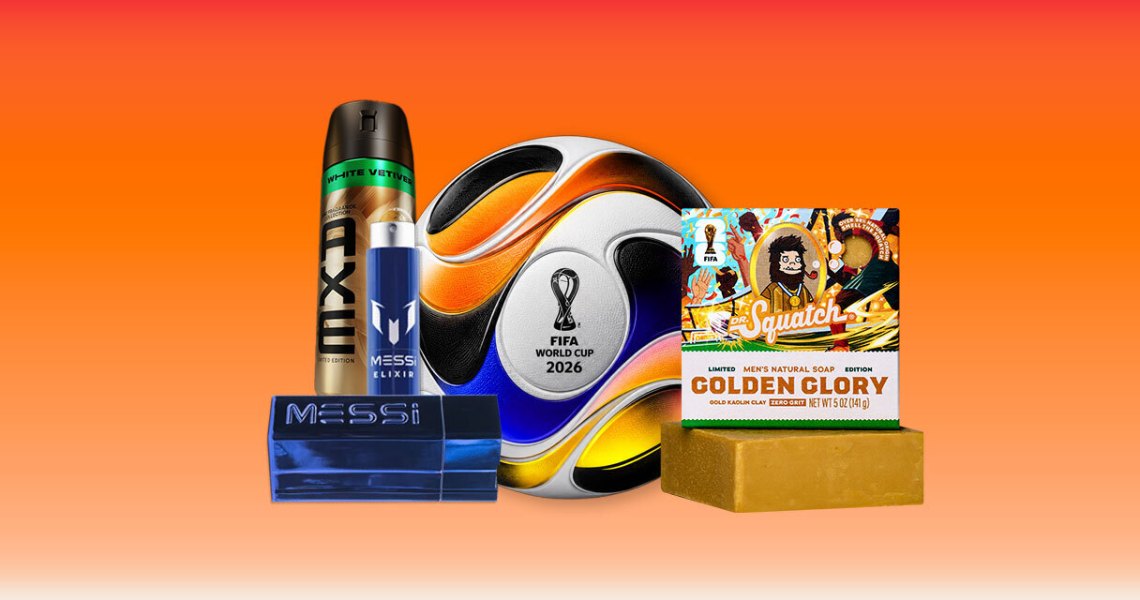
Messi will also be appearing at a Kansas Ulta Beauty store — sort of. On Friday, the soccer star’s namesake fragrance brand will host a giveaway for the launch of the Messi Elixir fragrance, where select attendees will be able to snag Messi fragrance swag and sign up for a chance to win a signed Messi jersey.
“There’s no one more famous, more energetic, who pulls in people more than Messi does,” said Christine Blau, svp of brand and retail strategy at fragrance distributor Sheralven. Sheralven launched the original Messi fragrance in 2024 at JCPenney. With the 2026 World Cup on the horizon, the brand expanded to Ulta Beauty with the launch of the Messi Elixir Parfum Intense in May. “He’s got 500 million followers on Instagram alone. So we said, we would be extremely foolish to not capitalize off of that.”
The quadrennial men’s World Cup is one of the biggest sporting events in the world, giving global soccer players and fans a once-in-a-lifetime chance to see their team take home the prize. And with billions of viewers tuning in from around the world, it is also a rare opportunity for brands to make their products synonymous with the passion and loyalty soccer inspires.
Four years after Qatar, that now includes grooming brands looking to use the power of soccer to reach the evolving male beauty consumer base.
“The World Cup is like 50 Super Bowls all in one, over the course of a month,” said Steven Koss, president and CEO of Sheralven.
Getting in on the excitement is Unilever. The personal care and beauty giant will be the official personal care sponsor of the men’s edition of the FIFA World Cup for the first time in 2026. Its brands, including Dr. Squatch and Dove, will launch limited-edition products and marketing campaigns around the tournament.
For Unilever brand Axe, known as Lynx in the U.K., the tournament is a chance to connect with young male fans looking to engage in the “scentmaxxing” trend. The fragrance and grooming brand will launch three limited-edition scents in packaging modeled after the World Cup trophy, including the on-trend Marshmallow Smoke, and host an influencer space in Mexico for local content creators to film throughout the tournament.
“We need to embed the brands into culture. It’s always looking at how you’re going to engage the audience in the most relevant way, but at scale,” said Caroline Gregory, global brand director of Axe/Lynx. “We’re a big global brand, and so the FIFA World Cup really enables you to do that at a scale that lots of other things don’t.”
To further engage fans, Axe partnered with Panini, the Italian company behind the coveted collectible sticker albums of World Cup players, on a scratch-and-sniff sticker featuring its limited-edition scent. Axe is hoping fragrance fans will approach the exclusive World Cup scents with the same collecting fervor they take to their stickers.
“We call it FOMO. It’s like getting a design where young kids want that on their bathroom shelf,” said Gregory.
Not all brands have the backing of a multinational corporation or one of the world’s most famous athletes in order to break through the noise at the World Cup. Australian hair stylists Joey Scandizzo and Aaron Chan are taking what they call a “guerrilla marketing” approach as they use the World Cup fervor to launch their men’s hair-styling brand, Kings Domain Melbourne, stateside.
The Australian brand will host pop-up styling sessions in New York City during the first three days of play, where customers can choose from hairstyles inspired by the sport’s top players, like Argentina’s Julián Alvarez and Norway’s Martin Ødegaard. Scandizzo and Chan first launched their brand in Australia in 2022, with products like curl cream and volumizing powders intended to meet young men’s expectations for high-quality hair-styling products.
“The male consumers come savvy now. He’s a savvy buyer, and he wants the right thing, and he wants to be part of a brand now,” said Scandizzo. “They’re following what women have been doing for many, many years.”
Global soccer stars have helped break those barriers around men’s grooming. England’s David Beckham set off a global frenzy when he shaved his head in 2000, and Brazil’s Ronaldo Nazário made headlines when he showed up to the 2002 World Cup with what appeared to be a giant soul patch on his forehead. (Brazil went on to win the trophy, with Ronaldo the tournament’s top scorer.)
Even with those players retired, those iconic images — and their hairstyles — have kept them relevant to generations of fans.
“[My kids] know who Beckham is, and they weren’t even born when Beckham was around. … Beckham was iconic for the hairstyles. Every World Cup, he had a new hairstyle,” said Scandizzo. “Soccer is the world game. It is the world stage; it is the most-watched sport globally. So I think that’s why [its influence] is so strong.”
According to FIFA, Qatar 2022 drew 5 billion fans to watch 32 teams play throughout the tournament, including a record 1.5 billion viewers for the final between France and Argentina. The 2026 edition is primed to reach even more eyeballs, with an expanded format of 48 teams competing across three nations.
But the 2026 World Cup has also already proved contentious as players, officials and fans from around the world confront President Trump’s strict border policies upon arriving in the U.S. Somali referee Omar Abdulkadir Artan was denied entry into the U.S. when he flew into Miami International Airport ahead of the tournament. Dozens of Moroccan ticket holders were denied visas to enter the country, and Iraq’s star player, Aymen Hussein, was held for questioning for hours at Chicago O’Hare International Airport. While Canada, Mexico and the United States are sharing hosting duties, the majority of games will take place in the U.S.
Those tensions remain unresolved as the tournament gets underway. But the World Cup has been no stranger to geopolitical controversies throughout its history. One thing has been certain at every tournament: Fans will be watching.
“There’s a bit of noise about the World Cup, but I think once it starts in the U.S., it’s going to be huge. You’re already starting to see all the advertising; things are starting to happen,” said Scandizzo. “The U.S. wants to put this on center stage and blow it out of the park.”