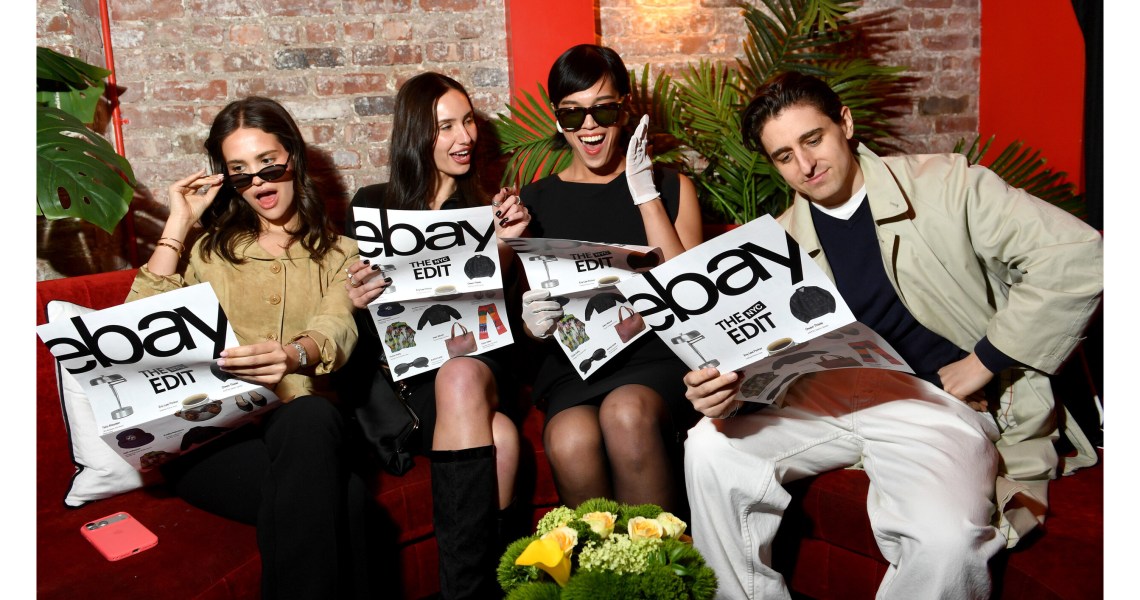
At eBay’s recent New York activation, shoppers couldn’t enter unless they listed an item for resale.
The three-day event, which ran April 17–19, required attendees to upload something from their own closet before they could browse a selection curated by tastemakers, including New York Times writer Emilia Petrarca.
The premise reflects how people are increasingly approaching fashion purchases. Listing, reselling and browsing secondhand options are becoming part of the same process, often happening before a shopper ever considers buying new.
That behavior is driven as much by economics as by aesthetics. And in practice, it spans both thrift and resale. Thrifting often happens in physical stores like Savers or Goodwill, while shopping resale often occurs on platforms like eBay or ThredUp. For shoppers, the distinction matters less than the outcome: finding something they love at a lower price point than buying new.
On Savers Value Village’s February earnings call, CEO Mark Walsh said the company’s U.S. business grew 20.6% in the fourth quarter, with comparable sales up 8.8%, driven by “accelerating consumer adoption of thrift” that remains “broad-based across categories and regions.” Around 40% of the company’s current U.S. shoppers are under 45, and roughly 45% have household incomes above $100,000.
Walsh tied the momentum to pricing dynamics. As new clothing and footwear prices continue to rise, he said the company is seeing a widening “value gap” that is pulling in both value-focused shoppers and higher-income consumers who are trading down. Third-party data reflects that trend. According to Placer.ai, visits to thrift stores rose 25.6% between late 2022 and late 2025, outperforming both traditional apparel retail, where visits declined, and luxury, where growth was marginal.
At the same time, price alone doesn’t explain the behavior.
Jules Wettreich, a creator (@styledbyjules, 26,700 followers on Instagram, 434,100 on TikTok) who has built an audience by filming her thrifting trips and styling secondhand looks, describes the experience in different terms. “I feel like it’s enjoyable because you never know what you’re going to get; it’s an adventure,” she said. Some of her videos, which follow her building outfits in real time, have reached more than 15 million views.
That unpredictability is central to the format. “It’s cooler to go into a store and look around,” she said. “You end up finding a much more creative outfit than something I’ve already picked out ahead of time.” Her content often focuses on styling clients like singer Gracie Lawrence or actress Jessica Vosk, or reworking pieces they already own. And there are many creators offering similar styling services based on Pinterest boards, for example.
For shoppers like Petrarca, those two motivations — price and access — sit side by side. She tracks runway pieces she first sees on Vogue and waits for them to reappear on resale platforms. “The new stuff is too expensive,” she said. “People like me are turning to resale platforms like eBay to be able to participate.”
Instead of moving directly to retail, more consumers are starting with what already exists by browsing thrift stores, scrolling resale platforms or looking to creators for direction before deciding whether to buy new at all.
For brands, the implication is straightforward: They no longer control the start of the shopping journey. Thrift and resale are increasingly setting price expectations, surfacing demand and extending product life cycles. As Savers CEO Mark Walsh put it, rising new-product prices are widening the value gap and “creating an opportunity for us to gain share.” At the same time, The RealReal’s Rati Levesque said on the company’s recent earnings call that nearly half of consumers now factor resale value into purchase decisions, turning every product into a future asset rather than just a one-time sale.
That creates a different set of pressures for platforms and retailers. Supply is becoming as important as demand. On ThredUp’s March earnings call, CEO James Reinhart pointed to “high-quality supply” as a key focus, alongside customer acquisition and product improvements. The company has been investing in new ways to bring in inventory, from offering cleanout kits to enabling direct listings, as it tries to capture more of what is already sitting in consumers’ closets.
Other businesses are trying to offer a more curated supply. Vya, a platform launched in March, aggregates inventory from more than 30 vintage sellers across markets including New York and London. “Everything is one of one,” founder Hana Elster said. “Once you sell one thing, it’s gone.” That scarcity drives demand, but it also minimizes opportunity for discovery.
Overall, discovery is now happening across more touchpoints. According to ThredUp, nearly half of resale discovery now happens off-platform, across social feeds, creators and in-person browsing. Wettreich’s process reflects that reality. When sourcing for clients, she pulls from thrift stores, resale platforms and a network of vintage sellers she has built relationships with over time. Mixing those pieces with new items creates something more distinct. “It’s not the same thing people are pulling from the lookbooks over and over again,” she said.
That desire for individuality is helping to fuel thrift’s popularity.
Earlier this month, ThriftCon’s Miami iteration, which was positioned as “more than a market”, drew more than 8,000 attendees and over 150 vendors, combining vintage retail with panels, curated sections and brand activations. The event has steadily grown in scale and visibility, according to its organizers.
At Coachella, attendees described choosing secondhand pieces less as a way to save money and more as a way to stand out. “I like to be different. A lot of people are going to be wearing maybe the same thing, and I don’t like that,” said a singer and festival-goer who goes by “Victor” (@mxvmg; 11,000 followers). Geovanni Lemus, a surf instructor who attended alongside him, pointed to the appeal of “one-of-one pieces that no one else will have.”
No Single Use Fashion, a sustainability initiative by Black Pearl, headed up by Samata Pattinson, encourages festival-goers at festivals like Coachella to wear pre-loved, DIY or reworked outfits rather than buying something new for a single event.
At the same time, technology is reshaping how people find both new and secondhand products. Tools like Google Lens and AI-powered try-on — recently featured in a “Devil Wears Prada” campaign — make it possible to identify and buy similar items within seconds. Platforms like Phia are doing the same for secondhand, pulling comparable listings across marketplaces into one place. The result is a faster, more efficient search process. But it also cuts into what has traditionally defined secondhand shopping: the unpredictability.
And so what hasn’t changed is the reason people keep coming back to retail resale environments like the eBay event and thrifting at companies like Savers. “You never know what you’re going to get,” Wettreich said. And the companies in the space are leaning into the moment. “Our mission is to make secondhand second nature,” Walsh said. For brands, that means competing not just with each other, but with their own old products long after they’ve left the store.