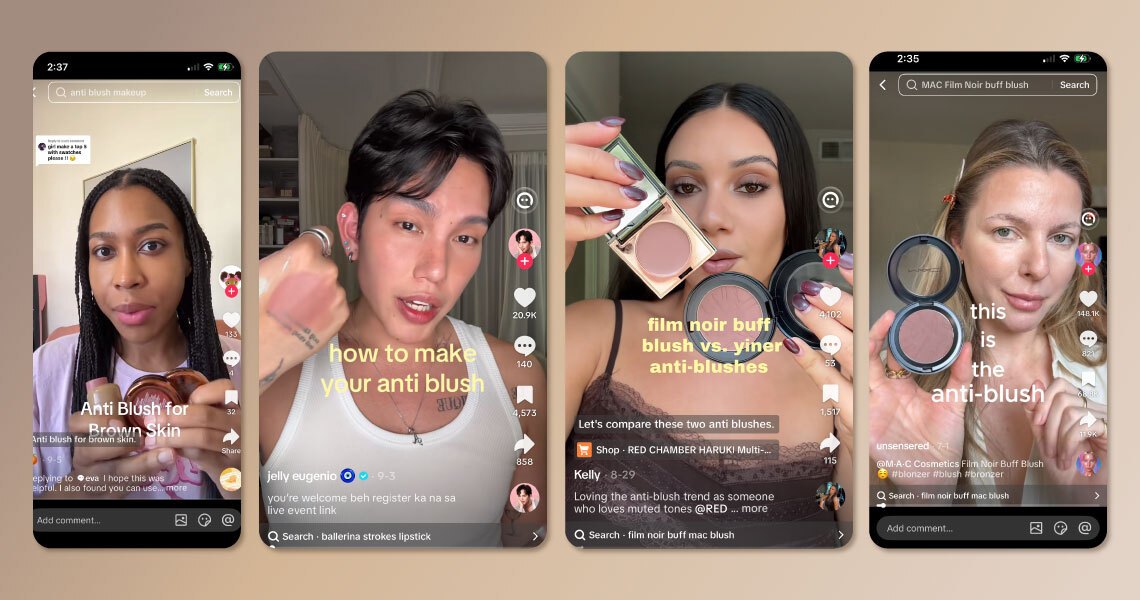
When filming a video on MAC’s Film Noir Buff blush, Kim Senser was looking for a phrase to encapsulate just what made the rosy brown shade so appealing to her.
“I was saying at first, ‘This is the most interesting blush I’ve ever used.’ And I thought, ‘I don’t know, would that stop someone in a video?’” said Senser, an LA-based actor and content creator. “I was thinking for a second and just said, ‘This is the anti-blush,’ and then I knew in that moment, this is what I’m going to go with.”
The term worked: Her video deeming Film Noir Buff the “anti-blush” has racked up over 2 million views on TikTok and 1 million on Instagram since going live in July.
In the following two months, the term “anti-blush” has achieved a reach far beyond Senser’s roughly 30,000 followers, however. Mega creators like Aditya Madiraju and Melissa Murdick have weighed in on the trend; users have offered anti-blush recommendations for deeper skin tones and olive undertones; and international fashion publications from Vogue Adria to Harper’s Bazaar Singapore have covered the craze for neutral, muted blushes. As of publication, MAC’s Film Noir Buff blush is sold out at both Ulta and Sephora.
But for a trend promoting a neutral look, the anti-blush phenomenon has also stirred up strong feelings around see-sawing makeup trends and who deserves credit when a term or idea suddenly goes viral.
Anti-blush has surged in popularity in part because blush as a whole has been one of beauty’s biggest growth drivers in recent years, with brands like Rhode and Rare Beauty fueling demand for saturated statement blushes. According to Circana, U.S. prestige beauty sales of blushes and bronzers posted double-digit gains in the first half of 2026, despite just a 3% overall increase in sales in the prestige makeup segment.
“[Blush] just makes you look full and fresh, and it never looks like too much, or it doesn’t look muddy,” said Katie Jane Hughes, makeup artist and founder of KJH Brand, of blush’s long-standing appeal. “Blush is an easy one to really create that glowy look.”
But after years of bright, flushed cheeks dominating makeup styles, the anti-blush look offers a more neutral alternative to consumers who don’t want to suffer from a case of “blush blindness.” According to September data from trend forecasters Spate, beige blush’s popularity across Google search and social platforms has grown 274.9% compared to last year.
The term “anti-blush” may be new, but makeup artists have long since employed neutral blushes to round out a look.
“I think the anti-blush thing is coming from a place of, like, the Gabbriettes and these girls with this super, kind of, ‘90s, slightly beautifully tired, little bit grungy, less kind of coverage under their eyes,” said Hughes of the rising popularity of neutral blush. “I think that it is just a trend with a new nickname. I think that’s what most of the trends are, right?”
The new nickname is seemingly driving much of the conversation around desaturated and neutral blushes. Many social media users credit its origins to Senser’s July video, although the term has grown far beyond her account. Even MAC used the term to promote its blushes in an August post on its official Instagram account.
Despite anti-blush’s popularity, not all the comments on MAC’s post are positive. Some have criticized the brand for failing to showcase the blushes on deeper skin tones, and numerous commenters have tagged Senser and asked MAC to credit her for originating the term.
Senser said she appreciates the support from her fellow creators, but she has not heard anything from MAC since posting her anti-blush video, which she said she shared with the brand via DM. In September, she posted a playful follow-up video on the trend’s explosion and referenced how Lemme treated content creator Christina Kirkman with a trip to Coachella after her video promoting its sleep gummies went viral.
“Anyone in the world can use ‘anti-blush.’ I more so wanted to let the main company know, like, ‘Hey, if you didn’t see my original video, I am the one that started this,’” said Senser. “I think a lot of people did buy it from this huge trend out there, and if they did want to say hi or give me any credit or anything like that, I’d be open to it. But alas, that I don’t think is going to happen.”
In response to Glossy’s request for comment, MAC shared that it is seeing momentum for more “sculptural” approaches to blush and that the Skinfinish Colourstruck Blush in Film Noir Buff “overperformed launch plans by 4x.”
“This is exactly how beauty should move: creatively, collectively and without rules. Consumers come to MAC when they want permission to play — to try on a trend, make it their own and find products that flex with their mood, style and self-expression,” a MAC spokesperson said in a statement shared via email. “With a blush portfolio that spans bright, bold shades alongside softer, neutral-toned options, MAC continues to be a destination for artistry and experimentation — and we’ve seen that in action from the blush trio that surged around our Painted By Esther x Olandria MACzine cover to Kim Senser’s anti-blush movement.”
The anti-blush phenomenon isn’t the first time social media users have raised the alarm about who deserves credit for a trend. In May, Patrick Ta’s “Transition Blush” launch led many consumers to criticize the brand for taking credit for a technique associated with makeup artist Ngozi Esther Edeme, better known as Painted By Esther.
But posting a product recommendation and tagging a brand in the hopes they might reshare a video or offer a paid partnership is par for the course for many influencers, particularly emerging creators who don’t yet have the platform to attract official brand deals. At Glossy’s POP NYC event in September, aspiring content creators referred to the practice as “flirting” with brands.
In some cases, a creator’s initial organic endorsement does lead to a longer-term payout: In March, Vaseline flew influencers Jen Chae and Lauren Luke to Thailand to promote its new Vaseline Originals collection and shared a portion of the sales with the creators, who first posted about using Vaseline as a beauty hack back in 2008.
There is no guarantee, however, that brands or even fellow users will credit a creator for coining a certain trend. And as evolving social media algorithms mean even the smallest of creators can suddenly go viral, brands don’t necessarily need to rely on professionalized creators with managers and agencies negotiating paid partnership deals to promote their products.
“It’s definitely a learning experience,” said Senser. “Once again, [MAC] doesn’t owe me anything. It’s not like I trademarked anything. People in the comments were like, ‘I would sue.’ I’m like, ‘I never thought about any of that.’”
And with the trend crossing over into official brand channels, some users on forums like Reddit have expressed fatigue at seeing yet another trending makeup look. Hughes, who herself has 1.3 million followers on TikTok, agreed that social media’s accelerated trend cycle can encourage impulse buys, but noted that the anti-blush look can often be achieved with existing products in your makeup bag.
“You could literally take a bronzer, and you could add a tiny, tiny bit of lipstick,” she said. “You could take a lipstick that’s a nude and then use it as a cheek color.”
Senser herself hasn’t given up on the anti-blush look. But she said she isn’t reaching for Film Noir Buff as frequently these days.
“I think I feel a little some type of way whenever I see the color in my bag. I look at it like a lover that treated me bad,” she said with a laugh. “Currently, my mission is to find a good dupe and just continue getting back into my normal posting.”