For the Wellness Briefing, Glossy checked in with Dr. Jessica Shepherd, MD, an obstetrician, gynecologist and chief medical officer of Hers, to learn about Peptides+, a new longevity-focused offering from the 9-year-old telehealth provider. Additionally, Noom plans to launch a custom wearable, Thorne released a new consumer survey, and luxury hotel leader Āman Group announced a wellness-focused hotel franchise launching in Miami.
Hers wants to be the go-to injectable peptide provider with new Peptides+ rollout
The injectable research peptide market is heating up yet again.
“There is a lot of knowledge about the word [peptide], but there’s not a lot of knowledge about what it is,” Dr. Jessica Shepherd, MD, an obstetrician and gynecologist, and the chief medical officer of Hers, told Glossy. “We’ve gone from [peptides] being something that you hear about to something that’s trending on social media and a very popular conversation, especially when you start to see it on the news.”
Awareness and popularity of injectable research peptides have grown exponentially over the past few years. According to a survey commissioned by Hims & Hers from Culture Co-op in October 2026, 55% of U.S. adults surveyed say they are interested in or curious about peptide therapies, while just 9% say they currently use peptides.
Despite this growth in awareness, sourcing popular peptides like BPC-157 and Sermorelin is still a gray market, with the Food and Drug Administration only recently announcing its plans to roll back regulation on certain peptides.
“There is a very big trust gap, [while] people’s appetite for, and curiosity about, it is very big,” Dr. Shepherd said. “And that’s what we want to be able to [do]: help the consumer understand that the safety and data behind it, and where you get it, [can and should be] somewhere reputable, and somewhere that we have control over what’s made and how it’s made.”
Industry-wide, it’s a meaningful step forward for female-focused care. “Peptides, if you think of it, typically have been in the bro world, right?” Dr. Shepherd told Glossy. “When women want something, they want something that’s reputable; they want something [from somewhere] where they can get their questions answered, [which is] very important for a female consumer, and especially when it comes to peptides.”
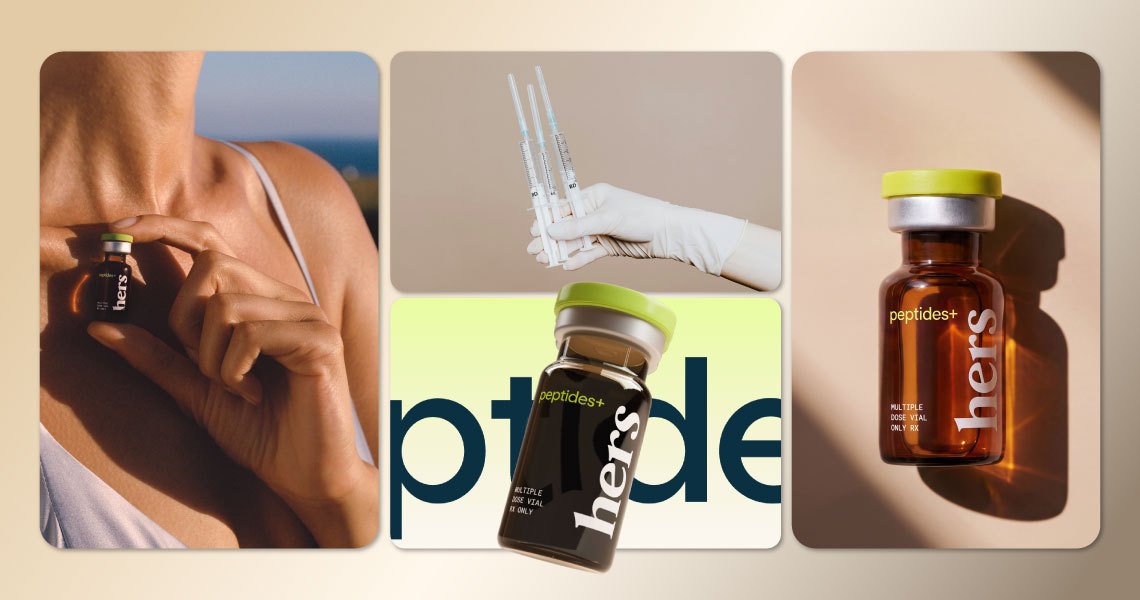
Launched on Wednesday, Hers will now offer prescriptions and patient support for a range of longevity-focused offerings with a vertical called Peptides+, a new area of care for the 9-year-old telehealth provider.
Upon launch, the new platform will be available to all Hers patients with five treatments on Wednesday: the peptides sermorelin and glutathione, plus buzzy co-enzyme NAD+, as well as L-Carnitine and vitamin B12, which are said to impact metabolic health and energy, respectively.
The company told Glossy it will add BPC-157 and TB-500 as soon as regulations allow.
The company teased the launch during its August investor call. “We are currently developing a best-in-class peptides experience, including U.S. manufactured products, clinical-led guidance and ongoing [patient] blood testing,” Hims & Hers CEO and co-founder Andrew Dudum said during the earnings call. “We’ve developed the infrastructure to succeed in higher complexity categories, over 1 million square feet of pharmacy and lab testing facilities, deep expertise in sterile compounding, and a global reach.”
There are certainly other peptide sellers looking to win this race for consumer trust. This includes well-funded telehealth platforms like CeliaRX, Midi Health, Atro Health, Immortals, Hone Health and RegenMD, among many others.
“Social media is actually a great resource and tool, but there’s still a lot of misinformation on social media,” Dr. Shepherd told Glossy. “The goal is [to] allow for something that people are really looking for, or interested in, but may not know where to get it, or may not know the fundamental education of what peptides are or who sources them. We want to be able to be that vehicle.”
News to know:
- Telehealth provider Noom, which specializes in metabolic- and behavior-focused digital healthcare, will launch its first wearable in early 2027. Announced Thursday, its Noom Band will be a screenless wrist wearable that tracks the user’s activity, sleep, heart rate and HRV trends, with results delivered in the Noom app. The wearable was made with Austin-based wearable manufacturer Sensor Bio. “Now we are deeply integrating the wearable with cutting-edge behavior science to drive superior health outcomes and ROI for payers. Best of all, Noom is including the wearable at no additional cost to the payer,” Geoff Cook, CEO of Noom, said in a statement. Noom was founded in 2008 and is independently held.
- Announced last week, NYC-based QC Spa unveiled a refreshing new twist to its spa offering. Called the “eye of the storm” room, clients can now swim in an indoor pool during a simulated thunder and rain storm. The experience includes lightning, thunder and sheets of rain, according to early online reviews. This marks QC’s first U.S. expansion of the service after its first “eye of the storm” room went viral online after launching in its Milan location last year.
- Speaking of hospitality, luxury hotel leader Āman Group, which operates 36 hotels across 21 countries including Utah’s Amanggiri and Āman New York, is investing in a new wellness-focused property franchise. Named Atma, the new luxury brand will be focused on “pioneering performance living as the ultimate investment in self,” according to the company’s Nov. 10 announcement. Atma will feature “advanced wellness programming, nutrition-led dining and world -class sport facilities, which have been developed exclusively by Atma global partner Novak Djokovic,” according to the company. The first location will be in Miami, called Atma Miami, and will open with a hotel, residences, a private members-only club, and a 120,000-square-foot spa and wellness center set to be the biggest of its kind in Miami.
Stat of the week:
Supplement maker Thorne released findings from its second annual research report last week titled Thorne Wellness Compass. Conducted by research firm Censuswide, the results are based on a survey of 3,000 U.S. consumers. According to the report, 78% believe too many people claim to be health or wellness experts, while 62% say they trust lived experience over formal training when evaluating health advice. Meanwhile, half of surveyed consumers trust AI tools for wellness advice, a 6% increase from the 2025 report. Still, 73% say they trust health advice from human experts more than AI-generated advice.
In the headlines:
One of America’s fastest marathoners hasn’t been injured in 4 years. Here’s what she does differently. [Women’s Health]. A longer life isn’t always a better life. So how long do you really want to live? [WSJ]. How Celsius doubled down on sports marketing campaigns in 2026 [Modern Retail]. SLT expands to Washington, DC, with 4 new studios [ATN]. Boots to begin prescribing medical cannabis in the UK [The Guardian].
Listen in:
In this special episode of the Glossy Beauty Podcast, we are taking you directly to the main stage of Glossy’s annual Beauty & Wellness Summit for a conversation between POV Beauty founder Mikayla Nogueira, POV Beauty CEO and co-founder Ani Hadjinian, and Glossy editor-in-chief Jill Manoff.
Need a Glossy recap?
Why beauty shoppers are flocking to Trader Joe’s. Urban Outfitters is tapping into Gen Z’s holiday habit of shopping for themselves. Inside L’Oréal-owned La Roche-Posay’s BEMT launch: ‘It’s enabling us to have a new conversation with new consumers.’ Inside the race to make non-creepy smart glasses. Luxury Briefing: The coat is the outfit. Can it also be the business? Wellness Briefing: Why Ulta Beauty is racing toward wearables.