U.S. sunscreen manufacturers are navigating the biggest market change in nearly 25 years.
In June, the U.S. Food & Drug Administration approved its first new sunscreen filter in 25 years: bemotrizinol, or BEMT, an ingredient that’s been widely available in Europe and Asia since 2000 and 2002, respectively.
The filter has been heralded online for its remarkably lightweight, smooth feel; larger molecule size; and ability to protect against both UVA, the rays that age skin, and UVB, the rays that burn skin.
“We love that we now get a new tool, and it’s not just a flash in the pan because it’s the new thing on the block,” Brian Bodnar, L’Oréal Group principal scientist of photoprotection, North America, told Glossy. “It’s important that we protect against both UVA and UVB, which is a little bit more difficult when you don’t have a large UV filter toolset to use as we might have in other countries.”
BEMT offers wider photo protection than U.S. filters like avobenzone or homosalate. “We [have] really lacked this middle ground [in the U.S.], right in between UVA and UVB,” he said. “It’s a wavelength area known as UVA 2, a short wavelength right in between, and BEMT helps us fill in the gap.”
What’s more, BEMT is made from a larger molecule than other chemical filters available in the U.S., which means less of the formula soaks into the bloodstream, a mounting concern among some consumers who avoid endocrine disruptors or are prone to irritation from sunscreen. “It really doesn’t go into the skin almost at all in most formulations, so you don’t have to worry about that too much,” Bodnar said.
Grace Riggenbach, gm of La Roche-Posay, told Glossy that BEMT allows for better hydration and a more lightweight, elegant formula, all of which the company will lean into across marketing. Still, it must be formulated with existing filters to achieve full photoprotection, so the team had to start from scratch to create its first offering.
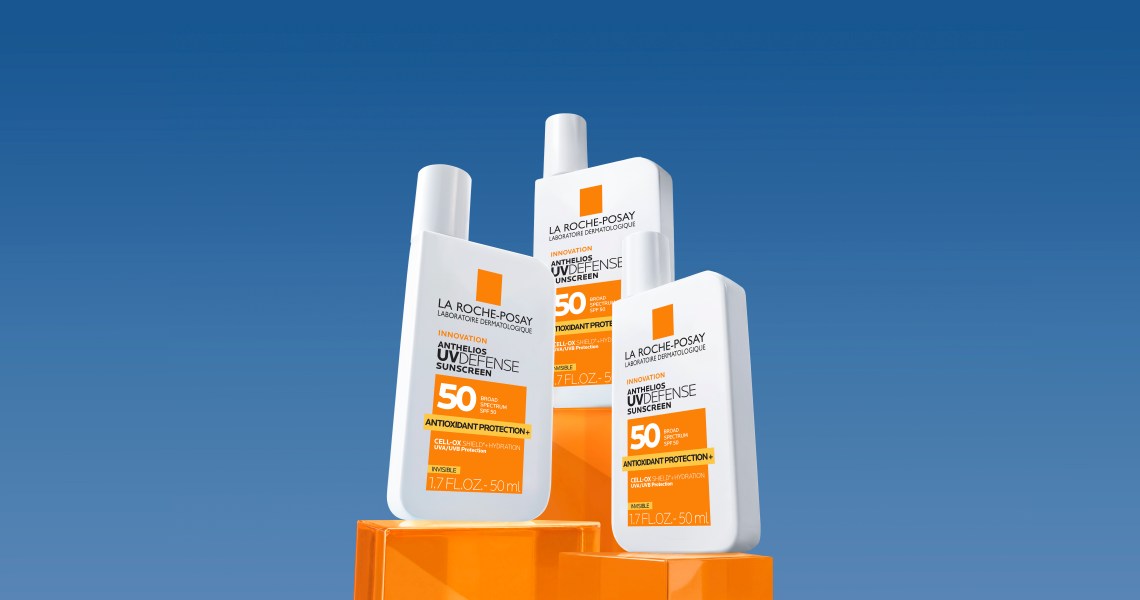
On October 20, the company rolled out its first formula with BEMT, a $39.99 face sunscreen named Anthelios UVDefense Sunscreen SPF 50. The formula uses BEMT plus U.S. filters avobenzone, homosalate, octisalate and octocrylene. The first retailers to sell the new formula include Ulta Beauty and Amazon, with more to come soon.
In terms of sales, “We’re tracking ahead of what we expected at this moment,” Riggenbach told Glossy. “We want to continue to use this filter across more parts of our portfolio that serve different parts of the body and face.”
Riggenbach joined the team in April after nearly two decades at Procter & Gamble, most recently serving as vp and gm of the conglomerate’s Japan and Korea beauty businesses, overseeing brands like Pantene, Head & Shoulders and Herbal Essences.
Brands like Ultra Violette and Neutrogena have also added BEMT to their formulations, with many more likely to follow.
The filter is made and sold by Swiss-Dutch conglomerate DSM-Firmenich, which spearheaded the lengthy, expensive FDA approval process. The company manufactures a wide range of flavors, fragrances and ingredients for a variety of CPG markets including beauty and sun care.
DSM-Firmenich reported $13.81 billion in revenue for its full fiscal 2025. It cost the company $20 million to bring BEMT to market, according to reporting in many publications, including Allure. It’s unclear how much profit growth could come from this new ingredient, which it exclusively makes and sells to sunscreen manufacturers.
Both consumers and manufacturers have been hoping for new filters in the U.S. for years. “It’s enabling us to have a new conversation with new consumers,” Riggenbach told Glossy. “Whether it’s from the dermatologists that come and ask us about it or the regular consumer who is now a bit more intrigued thinking about sunscreen, it’s been an opportunity to drive more continued education in sun.”
When it comes to education, top-performing channels for the brand include its U.S. Open partnership, which includes in-person sampling plus free skin checks, and partnerships with dermatologists.
“We’ve been prescribed and recommended by over 100,000 dermatologists,” she said. “Leveraging the expert voices — the true expert voices, not just [those] on social media — [has been successful],” she said. “[And] we are sampling millions of sunscreens a year.”
La Roche-Posay was founded in 1975 and named after the thermal hot springs in the town of La Roche-Posay, France. The thermal springs are said to have been used by those seeking healthy, balanced skin since the 14th century. L’Oréal Group acquired the brand in 1989.
During its October earnings call, L’Oréal Group CEO Nicolas Hieronimus told investors that La Roche-Posay’s business was growing by double digits and represented the top three L’Oréal brands within its top-performing dermatological skin-care division alongside CeraVe and SkinCeuticals. “The one that’s [growing] the fastest is La Roche-Posay, which is flying [off shelves] everywhere,” Hieronimus said during the call.
La Roche-Posay expanded to Walmart in April of this year, rolling out to 1,460 stores.
Looking ahead, Riggenbach told Glossy the team will be investing in retail. “As we go into more physical distribution, you’re likely going to see the displays [in-store],” she said. “We’re very active on social media, driving education and awareness of all of our products, and you’ll see some of the traditional channels you’ve come to expect from LRP. But this is a really important launch for us because it’s not just about driving sales; it’s really about driving education.”