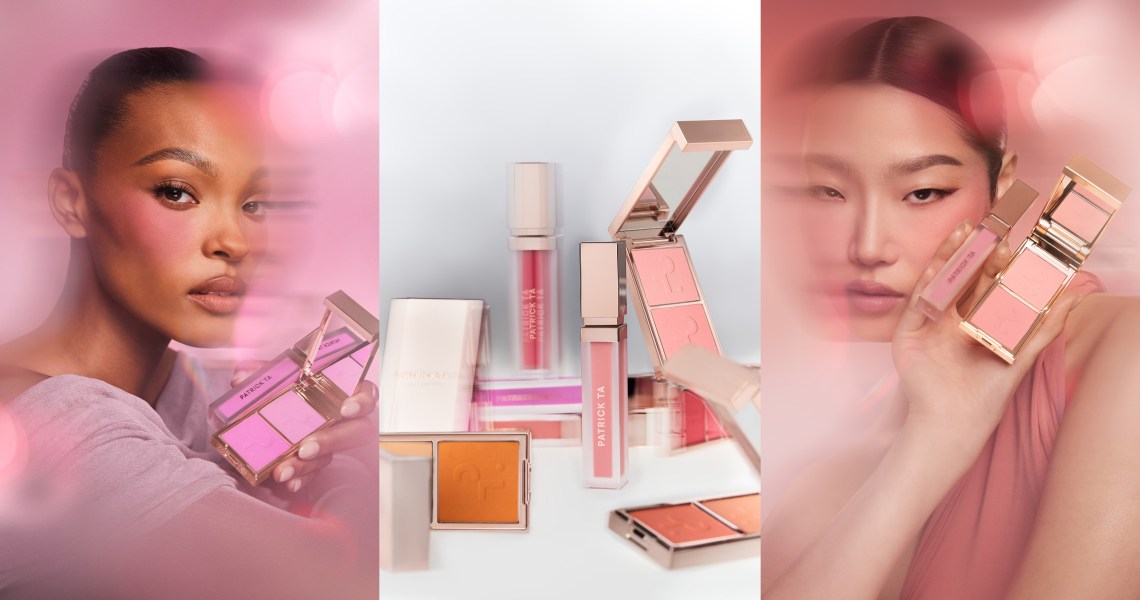
Patrick Ta’s latest launch was meant to further capitalize on the success of the brand’s Major Headlines Double-Take Crème & Powder Blush Duo, a $40 powder/cream product now available in 15 shades.
Glossy Pop reported on the product’s success in 2024, in a story titled “Patrick Ta is (also) quietly building a blush empire.”
At the time, the brand’s blush ranked as the No. 2 blush at Sephora, based on sales, trailing only Rare Beauty’s Soft Pinch Liquid Blush. The product became popular just as much for its formula as for Ta’s unique technique: He layers cream over powder to ensure the skin looks alive, rather than flattened by powder.
Today, depending on how the sales are calculated — and whether the $25 mini version is included — the blush often flip-flops with Rhode’s Pocket Blush for the No. 1 sales spot, a representative for the brand told Glossy. Over three per minute are sold in the U.S.
On Wednesday, the brand released its first additions to its blush family: a three-piece collection, including the Liquid Transition Brightening Blush ($34), the Transition Blurring Blush Duo ($30) and the Dual-Ended Transition Blush Brush ($40). The products are designed to soften the potentially harsh lines between under-eye concealer and blush, creating a seamless, gradient, airbrushed effect.
In a press release, the brand described the new products as “the blush you didn’t know you needed.” But last week, as the brand began promoting the product, many social media commenters were quick to claim that this is something people simply don’t need. And that was just the start of the blowback.
In response to the notion that the product is unnecessary, a brand representative noted frustration. It would have been easier and faster, they said, to launch, say, a shimmery-finish blush or a traditional liquid format. This, after all, is how many brands go about category expansion.
Ta’s idea to launch transitional blush was introduced over a year and a half ago, in a meeting discussing the brand’s innovation calendar, the source said. The brand iterated many versions of the product that mimicked its famed powder-and-crème format before settling on a dual powder and corresponding liquid product, developed alongside the brand’s concealer, which launched in February. When the team initially presented Ta with the idea of creating a more traditional liquid blush, he said he didn’t feel it was a form he felt he could innovate on. He is driven by a desire to help people easily achieve the looks he creates for his celebrity clients, the source said. He began to tease the launch on his celebrity clients as early as March, using it on celebrities including Ciara Miller in the lead up to the official launch.
The brand took this route because it wanted to do something truly different and expand its blush category in a more unique, artistry-driven way, rather than taking the faster route of simply expanding finishes or textures, the source said. Ta was adamant that the brand not follow industry norms but rather follow his artistic inspiration, which does not always align with traditional ways to expand a beauty brand’s portfolio, the source said.
“My love for blush has always been a core part of my artistry and a core product at Patrick Ta Beauty. Transition Blush has been in development for over a year and a half from my desire to make a blurred under-eye-to-cheek blush feel more effortless and approachable for consumers,” said Patrick Ta, co-founder of Patrick Ta Beauty, in an exclusive statement provided to Glossy.
On TikTok, countless creators have noted that you do not need dedicated products to achieve the look of “transition blush”; you can use concealer, a pink setting powder — items you already have. The brand representative acknowledged that some people may feel such products drive consumerism or are unnecessary, particularly in the current tough economic landscape, but said these products were made for true enthusiasts and beauty junkies.
The brand’s original marketing plan was heavily focused on education. On May 7, I attended a Zoom broadcast in which Ta demonstrated his technique using the new products to members of the press. “It really solves the problem for anyone who ever has a hard time blending blush. This is going to be your best friend. So it’s gonna make your blush application literally look flawless, your cheekbones look airbrushed and your under-eyes brightened and blurred,” Ta said of the collection in a recording of that event. The brand tapped a number of creators, including Jennie Pham, Judy Lim and Danielle Estrada, for paid partnerships that went live a week ago, promoting the new collection and educating consumers on how to use the products.
But then, as Ta began to promote the product on his own TikTok, where he has 2.6 million followers, he met his first backlash on the products in the comments section: People said he was taking credit for a look popularized by Ngozi Esther Edeme, a makeup artist and content creator best known by her handle @paintedbyesther (320,000 TikTok followers). In addition to her blush technique, Edeme is known for her work on stars including Naomi Campbell, Tyla and Olandria Carthen of “Love Island.” In Ta’s posts promoting his brand’s launches over the weekend, commenters rushed to accuse Ta of profiting off of a Black woman’s artistry.
Countless other marketers, beauty creators, cosmetic chemists and brand experts chimed in on their own channels, offering their takes on the conversation and causing the topic — and product launches — to go truly viral. It is never the way you would want to launch a product, the representative said, adding that the brand’s intentions have been gravely misunderstood.
On Sunday, Edeme posted an over nine-minute-long video herself, stating that she did not claim to own the transitional blush technique and that she herself is inspired by artists including the late Kevyn Aucoin, who was known for a similar technique.
Aucoin’s brand launched a gradient blush, dubbed the “Neo-Blush,” in 2015. On Monday, it posted its own TikTok aggregating comments that credited the brand with introducing customers to the look, while also crediting Edeme with “refining” it over time; Aucoin, the person, passed away in 2002.
“My goal is to constantly reference Kevyn Aucoin, Danessa [Myricks], Pat [McGrath] — how they move with grace and intentionality,” Edeme said in her post. “It’s already hard being Black, being a woman in this industry. You have to generally fight to get just half of what you deserve,” she said. At 29, she does not claim to have invented the transitional blush look, but she has helped popularize it, she said. “What you will not belittle is my influence,” she added.
On Wednesday, MAC released the May issue of its MACzine, focused on blush, featuring Carthen in a look created by Edeme. The caption reads, “Find out how Esther mastered her signature gradient blush technique, how Black women inspire her artistry, and her rules for the perfect blush — every time. Exclusively on MACzine.”
The representative for Ta’s brand said that Ta also does not claim to have invented the look.
In another TikTok post, on Sunday, Ta himself addressed the backlash, with a caption stating, “I started working on transition blush 1 and half years ago. I wanted to create a product that was specifically made for this blush look. I do not own this look. @Paintedbyesther she Is Amazing and so talented. she popularized this look through her work and through Olandria. i also have been doing this blush look since 2021. Not the same as Esther but my own version. I am a makeup artist . … I have nothing but love and respect for Esther.”
In her TikTok, Edeme recalled an experience in which Rima Minasyan, co-founder of Patrick Ta Beauty, had reached out to hire her for a personal professional makeup application in Los Angeles — an appointment Edeme alleged that she canceled when she found out Minasyan wanted to film the session.
The representative for Ta’s brand, however, said the appointment was canceled due to a same-day rate change and that the tone of the correspondence never changed, remaining positive throughout. In emails reviewed by Glossy, this account was corroborated. An employee of Minasyan’s canceled the appointment after learning the rate differed from what had originally been quoted, adding that she hoped the two could work together in the future. The emails did not mention social content as an issue or as a reason for the pricing change, and Edeme’s agent had referenced the inclusion of social content in the initial email outlining her rate.
“This launch was never about claiming ownership over a makeup technique that artists have interpreted over time. I have a great deal of respect for Esther and the creativity she brings to the beauty space,” Ta said.
The representative for Ta and Ta himself both stated that the brand had hoped to work with Edeme, in a paid capacity, to launch the Transition collection.
“Prior to launch, I personally reached out because I genuinely admired her work and hoped to do a paid collaboration artist-to-artist. My team also followed up regarding a paid partnership opportunity for this launch, however, her team declined. I’ve always respected Esther’s artistry and would absolutely remain open to collaborating with her in the future,” Ta continued.
The current narrative makes it appear as though the brand is trying to be deceitful or steal something, but that was never the case, the representative said. They added that the Patrick Ta Beauty team had discussed how it may collaborate with Edeme to launch the collection.
Edeme did not reply to a request for comment before this story’s publication.
Patrick Ta wanted to make products that would make this technique easy for regular people to bring to life at home, the source said, adding that the company still stands by that goal.
“At Patrick Ta Beauty, our mission has always been about making artistry feel more accessible,” Ta said. “I am proud of the work and development behind Transition Blush and excited to continue creating products that inspire artistry and creativity.”