Julie Bailey Blanche, vp of global marketing at Shark Beauty, knows a thing or two about disrupting the beauty industry.
In May, parent company Shark Ninja reported a 15.6% net sales increase during its Q1 2026 to reach $1.4 billion in sales, driven by a 40% increase in skin-care device sales. Zooming out, the company was up 15.7% in 2025 and up 30% in 2024.
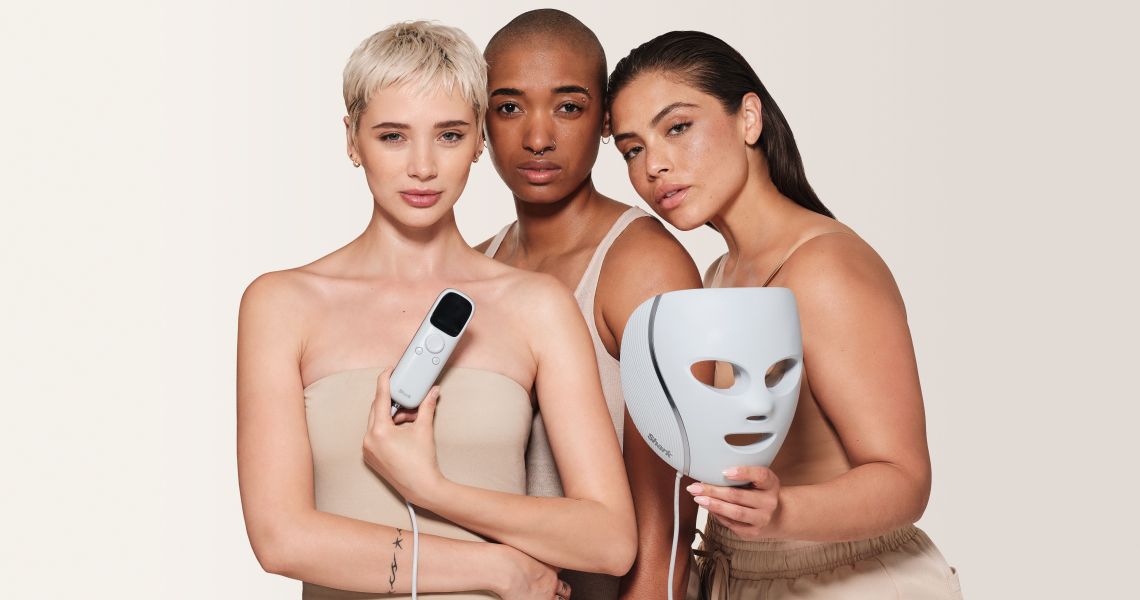
The household appliance company debuted its beauty division in 2021 and has spent the last five years quietly rolling out cult-status hair tools, LED face masks and at-home facial systems.
Blanche joined the stage at Glossy’s annual E-Commerce Summit last week in Miami Beach to discuss the secret sauce driving Shark Beauty’s success, including a simple ethos that’s proven to be the beauty division’s “biggest unlock,” Blanche said.
“The consumer doesn’t care about how they get [a product’s promised results], they care about what they get,” Blanche told Glossy. “You need ‘the how’ as the proof, right? But what we find is that if you lead with the what and back it up with the how, that’s the win.”
That’s because consumers have been increasingly inundated with science- and technology-focused beauty marketing over the past few years, including clinical stats and high-level educational content that’s starting to lose its luster. Blanche has found that most shoppers just want to know how a product will benefit their everyday life.
“[We don’t want our shoppers to have to] do the education or the research on what ion technology is; they just [need to] know it’s going to eliminate frizz,” she said. “That’s what they care about: the what, not the how. I think we find a lot of brands focus on the how and they get lost in the clutter and the chaos of that.”
For example, a hair- or skin-focused before-and-after campaign converts better than anything that leads with the science. “There are a lot of brands that focus on innovation — almost innovation for innovation’s sake,” Blanche said. “My job is to make sure [our] engineers, the marketing folks and the social teams are focused on the what.”
In terms of content types, user-generated content is a top performer at converting prospective shoppers into Shark brand customers. To ensure UGC content is authentic, Blanche’s team works with creators during the product development process.
“We’ll give them the product weeks and months in advance, … so that they feel like, as they’re using it, I’m not telling them how to use it; I’m actually observing how they’re using it,” she said. “In some instances, we come up with new use cases based on that.”
For her, an ideal consumer journey includes discovery through creator UGC, which prompts a consumer to research the product only to find a flurry of UGC from relatable, unpaid sources.
“We look to have about 70% of our content be UGC and only 30% be paid from the brand, because that is the magic formula for us in terms of you seeing your neighbor use it, you seeing your mom use it, you seeing your cousin use it, right?” Blanche said. “That trusted community of individuals, when they start using it and posting about it purely on their own, that’s where the magic happens — because you’ve got credibility, you’ve got authenticity, and it feels real and not forced. We don’t want anything forced.”
Blanche joined Shark in 2025 after 3 years as CMO at i-Robot and 18 years at Digitas, where she worked on accounts like CVS Health and Dunkin. The biggest change she’s seen in the industry over the years is how to successfully speak to consumers.
“Those years of big campaigns just talking at consumers are dead,” she said. “I don’t want to talk at you anymore. I’m done with that. … It has to be a two-way dialog. It has to be a value exchange. It has to feel authentic. I cannot tell you how much authenticity plays into it.”