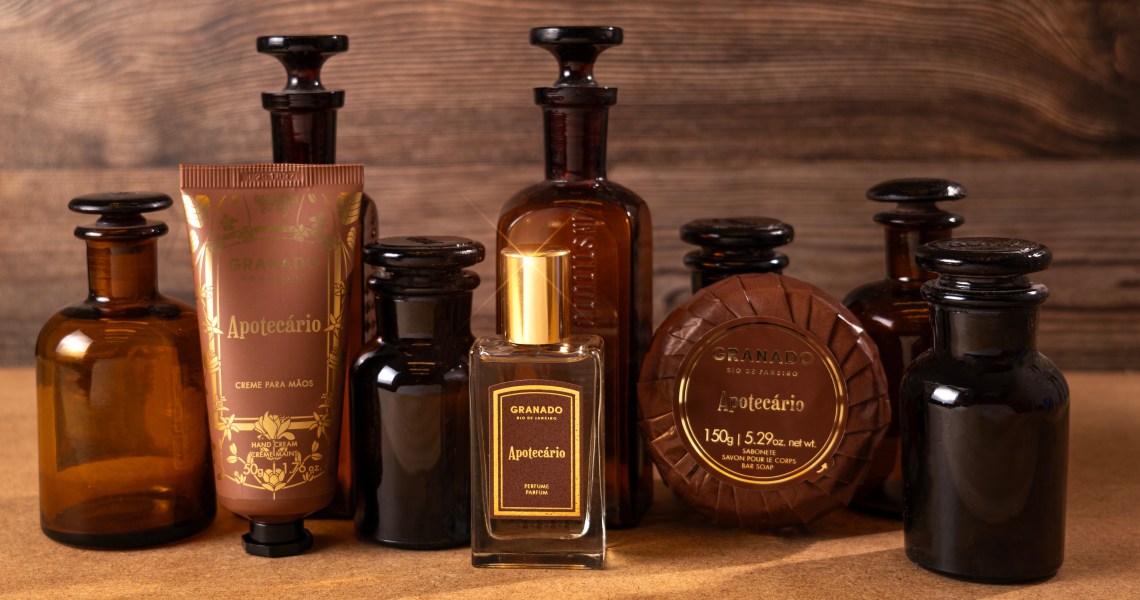
In March, Brazilian beauty brand Granado invited the perfume content creator and host of the Perfume Room podcast, Emma Vernon, to celebrate Perfume Week with an event at its Soho store. The event was part of the brand’s mission to introduce itself to the local market: The Prince Street store was still new to the neighborhood, having only opened in December, and Vernon was a recent convert to the brand, after encountering Granado’s perfumes for the first time on a trip to Lisbon.
But Granado itself is hardly new to the beauty industry. Founded in 1870 in Rio de Janeiro, Granado is Brazil’s oldest body-care brand, with its perfumes, soaps and lotions appearing in bathrooms across the country. But despite its storied history, the Brazilian brand is still unknown to many American consumers. Granado is hoping to change that.
“We were already in the U.K. and in France. And so many American consumers were coming to our [European] shops and loving the brand, and saying, ‘You have to sell in the U.S.,’” said Sissi Freeman, Granado’s director of marketing and sales. “On our website, we were seeing a huge demand coming from the U.S., and that was when we said, ‘I think now might really be the time for us to give another look at the market.’”
Armed with internal sales growth — the company closed 2025 with a 12% increase in revenue — and a still-growing appetite for fragrance among American consumers, Granado is opening two new stores in the U.S. in 2026 and tailoring new launches to suit the local consumer base.
According to the brand, Granado has achieved 95% year-over-year sales growth in the U.S. The brand opened its first U.S. store on New York’s Madison Avenue in January 2024, followed by the Soho store in December. Though fragrances account for only about 40% of the company’s sales in Brazil, outside of Brazil, they drive close to 70% of sales.
“[Growth] really picked up after the Soho store, and especially because that area is so big now, with so many upcoming fragrance brands,” said Freeman. “Now, our focus is really going to be on wholesale and opening new shops.”
In 2016, the Spanish conglomerate Puig purchased a 35% stake in Granado. The investment triggered a European expansion, with Granado opening stores in Paris, Lisbon and London in subsequent years, along with securing partnerships with European department stores like Liberty London and Italy’s La Rinascente.
It was in Europe that Granado first connected with many American customers, like Vernon. Vernon said the brand, whose scents are largely under $170 a bottle, fills a gap between mass body mists and high-priced luxury perfumes that has been largely absent in the U.S. fragrance market.
“These feel like luxury perfumes. The price point would suggest otherwise,” said Vernon. “[Granado] has managed to put out a product that still gives us the bottle design and intention and aroma of luxury, but at a price point that’s much more accessible.”
Granado is also one of many global perfume brands to find a U.S. consumer base. Brands from the likes of Vietnam and Mexico are resonating as perfume lovers seek more authentic storytelling.
“There are so many stories in perfumery and so many inspirations that are at best borrowed and at worst appropriated from other cultures,” said Vernon. “I think people want to hear from the primary source.”
Digital influencers like Vernon are key to Granado reaching American consumers. But the brand is also prioritizing IRL interactions, including a pop-up at Miami’s Aventura Mall in 2025 and a presence at trade shows in Dallas and Atlanta in 2026. In 2026, Granado plans to open two new stores in the U.S., including a permanent location in Miami. It arrived at Nordstrom’s revamped Columbus Circle location in NYC in November, after considering other department store options like Saks Fifth Avenue.
“We’re also looking at markets like Boston, Chicago, even D.C. Through our website, we can see that these are markets where people are interested in the brand,” said Freeman. “And then, through wholesale, we also get to get the brand’s story across.”
Granado is shaping its scent creations around U.S. tastes, as well. According to Freeman, Granado created 2024’s vanilla-based perfume Esplendor with the American consumer in mind. It is now the brand’s top-selling fragrance globally. All of Granado’s planned releases for 2026 will be made by U.S.-based perfumers to further reach the local market, Freeman added, including Givaudan’s Adriana Medina and Mane’s Ugo Charron.
While Brazil is one of the world’s largest beauty markets, local brands have struggled to expand internationally. In 2017, Brazilian body-care brand Natura opened a store in New York’s Soho neighborhood, blocks from Granado’s current outpost in the neighborhood. But the company has simplified its operations in recent years to refocus on Latin America, including by closing its Soho store and delisting from the New York Stock Exchange.
“Natura is a perfect example of what had been a massive Brazilian business that failed to expand globally and has fallen on very tough times in its home market,” said Wendy Nicholson, managing director in Baird’s Global Consumer Investment Banking Group. “And the reason, fundamentally, that they had a challenge coming to the U.S. was their distribution strategy. They were a direct seller like Avon, and direct selling in the U.S. has never been as viable a business model — or, it hasn’t been for a long time as it has been in the emerging markets.”
Brazil’s high import taxes have traditionally kept Brazilian brands isolated from the global market. But Freeman said going abroad has also helped Granado locally, such as by attracting renowned perfumers to work with the brand. In 2025, the brand launched three scents with Givaudan perfumer Quentin Bisch, who has created best-sellers for the likes of Parfums de Marly and Marc-Antoine Barrois.
And there is reason to believe there is an appetite for Brazilian products in the U.S. After all, one of the most viral fragrance brands in recent years — Sol de Janeiro — is inspired by Brazil.
“Brazil is in a hot moment, where you have many brands inspired by Brazil or using Brazilian ingredients. And even in fashion, you have Havaianas, you have Farm [Rio],” Nicholson said.
But while Sol de Janeiro is American-founded, Granado offers the real thing.
“What makes us unique, in a sense, is that [Granado] is a heritage brand from a country where all of our products are actually made here,” said Freeman. “They tell a story. It’s colorful, so it’s a bit different from everything else.”