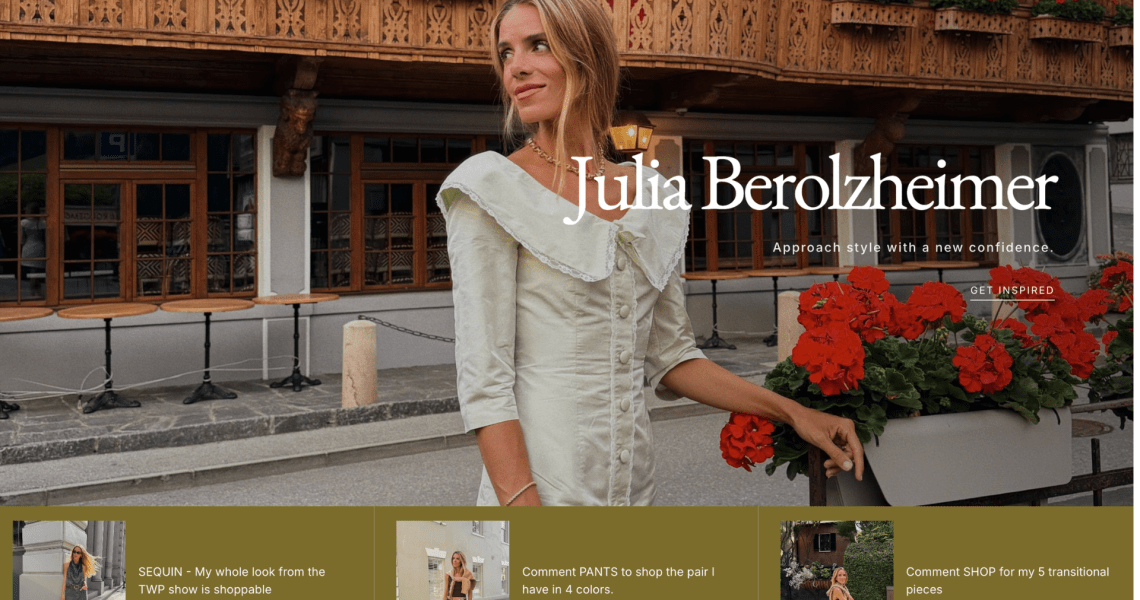
Coreli, a creator-commerce platform built for fashion, beauty, interiors and other taste-led creators, is adding an LTK integration as the link-in-bio, affiliate and creator-storefront categories continue to blur.
The feature will allow creators to display both LTK and ShopMy content on one Coreli page, with visitors able to switch between the two storefronts in a single shoppable block. Creators connect their own LTK handle and ShopMy username through Coreli’s editor, which pulls in their public posts, product links and collections, and refreshes the page throughout the day.
The integration is not an official partnership with either LTK or ShopMy. Coreli said it does not take a cut of affiliate revenue and remains subscription-only, charging creators $29 per month or $290 per year.
Coreli’s bet is that creators increasingly need a front door for businesses spread across Instagram, LTK, ShopMy, Amazon, Substack, YouTube, TikTok and owned content. Linktree and Beacons solved the basic bio-link problem. LTK and ShopMy built affiliate storefronts and creator-brand marketplaces. Squarespace, Wix and Shopify offer more ownership, but require more upkeep.
Coreli is trying to sit between those worlds: more visual and commerce-led than a link page, less labor-intensive than a custom website and broader than a single affiliate storefront. The company describes ShopMy and LTK as strong storefronts that nevertheless sit inside their own ecosystems, while a custom site is harder to maintain.
The company was co-founded by Thomas Berolzheimer, the business partner and husband of fashion creator Julia Berolzheimer, and Chloé Watts, founder of the former creator services agency Chloé Digital. Julia Berolzheimer, who has around 1.4 million Instagram followers, is an adviser to Coreli and its first user. She is one of the stronger commerce operators in the creator space, ranking No. 2 on ShopMy for earnings and GMV and running Trade Offs, the No. 6 fashion and beauty newsletter on Substack, according to her team. She is also an investor in ShopMy. Coreli itself was inspired by the longevity of JuliaBerolzheimer.com, which her team describes as the backbone of a multi-million-dollar affiliate business.
According to the company, Coreli began as an internal tool for her brand before being made public, and she pushed for its Substack and LTK integrations. In its first 30 days, Coreli signed more than 250 paying users representing a combined 17 million followers, including Nastia Liukin, Marianna Hewitt, Mary Lawless Lee, Jenn Lake and Mary Glenn McElveen, according to the company.
The product grew out of the complexity of running a mature creator business. Thomas Berolzheimer said he first became involved in Julia’s business through photography, before moving into analytics, affiliate commerce and operations. Today, the business spans a daily blog, Instagram, Substack and affiliate commerce with a 10-person team.
“I’m sort of this unicorn in the sense that I am a husband who’s incredibly dedicated to his wife’s business,” he said. “She’s the face of it, and it is her business. Without her, it doesn’t exist.”
Watts said she saw the same need from the agency side. Through Chloé Digital, she worked with women creators who had strong audiences but lacked operational support. “They didn’t have a Thomas, and I ended up becoming their Thomas,” she said. The question became how to help creators see themselves as “talent, but also the CEO of this creative business.”
That also explains Coreli’s focus on what Thomas Berolzheimer calls the “aesthetic entrepreneur,” including fashion creators and interior designers whose businesses rely on visual presentation. Watts said many still wanted a digital home, but had stopped maintaining the blogs and websites that defined the early creator economy once brand budgets moved to Instagram. In some cases, she said, she would check sites she had built years earlier and find the latest post was a two-year-old Nordstrom sale post being used primarily to house links.
Per the company, Coreli has 561 paying subscribers and live pages, with roughly $16,000 in monthly recurring revenue and about $190,000 in annual recurring revenue. Nearly half of ShopMy’s 25 Most Trusted Curators are already on Coreli, including Berolzheimer, Shea McGee, Grace Atwood, Liz Adams and Meg Defeo.
The launch comes as both LTK and ShopMy are adding more functionality around shopping and discovery. LTK has introduced AI-powered tools for creators and in-app checkout, while ShopMy has expanded into redesigned storefronts, wishlists, Circles and Noir, its text-based personal shopping service.
In an April interview, ShopMy co-founder Tiffany Lopinsky said creators are increasingly functioning like multi-brand retailers. Shoppers who once discovered products at Bergdorf Goodman or Saks, she said, are now discovering them through content creators. That thinking also informed Noir, which was built around behavior ShopMy was already seeing from stylists and creators.
“Every recommendation you get online is very algorithmically driven,” Lopinsky said. “And still, we always come back to word of mouth as the thing that makes you convert.”
That same thinking is showing up beyond affiliate platforms. Creators are increasingly being brought further inside businesses, whether as investors, advisers or operators. Sofia Richie Grainge became an investor and founding curator at ShopMy, while Alix Earle has built a portfolio of consumer investments, and fashion creator Jordan Grant has backed startups including creator platform Komi. At Blenders Eyewear, creator Jordan Howlett took the more operational route, joining as chief content officer and working across social strategy, storytelling and product development. CEO Jack Gray said the goal was to avoid treating creators as rented distribution. “We can’t be in the business of renting customers and renting culture,” he said.
For Watts, Coreli’s defensibility will not come from features alone. “It’s not about features on features,” she said. “One of the biggest moats to what we’re doing is the brand value we’re providing and the community we’re building around this product.”
That matters in a market where creators increasingly use several platforms at once. “They’re not dedicated to that specific platform because they don’t own that platform,” Watts said. “They’re dedicated to themselves and what they’re trying to achieve.”