There’s a race underway to collect, store, manage, and analyze consumer health and wellness data — and Google just pulled ahead.
On May 19, Google parent company Alphabet will begin a global rollout of its new AI-powered health coach in an effort to centralize a user’s health data collected through wearables, labs, telehealth and doctor visits.
“[This launch] signals the next phase of wearables [are] moving beyond passive tracking toward interpreting data and guiding action,” David Hamlette, health and wellness insights manager for Mintel market research firm, told Glossy.
Just under half of all U.S. adults use a smartwatch or fitness tracker today, according to Mintel, but consumers have yet to declare a data management platform as the market leader.
Leading wearable brands certainly want this job, including Oura, Apple, Garmin and WHOOP, which have each optimized their apps to compete to become the health and wellness data hub of choice. For example, Oura added a wellness chatbot trained by a female-focused LLM to gain attention from women earlier this year, while Apple partnered with OpenAI in January to allow the exchange of data between Apple’s Watch and Health app and ChatGPT’s new Health chatbot.
Then there are standalone SAAS platforms, like Bevel, which raised $10 million in late 2025 to compete, and telehealth providers like Function Health, which is snapping up supply chain stakeholders, like lab company GetLabs and MRI imaging company Ezra, on a path toward vertical integration.
“People are increasingly open to AI when it helps make health and wellness feel more manageable, especially when it is positioned as support rather than authority,” Hamlette said. To wit: Forty-three percent of consumers were using generative AI wellness tools late last year, more than double the 19% of consumers that used AI for fitness or health advice in 2024.
Now, after six months of beta testing its new offering, Google is ready to compete with the rollout of Google Health Coach next week.
“Wearables have unlocked a wealth of insights that help make more sense of our health. But with so much information, many people don’t know what to do with it,” Andy Abramson, head of product at Google Health, wrote in a blog post published on May 7. “Now, you can have the most personalized, holistic, adaptive coaching possible, right on your phone, 24/7, to easily understand what data is important, connect the dots and surface it when it’s helpful.”
Around a third of U.S. consumers are interested in digital fitness coaching, sleep optimization and personalized nutrition plans, according to Mintel. “Expectations are broadening beyond step counts to more comprehensive, everyday support,” said Hamlette.
Google’s new Health Coach is built with its Gemini AI platform. It launched in beta in October, allowing the company to collect insights from early users. Google used Fitbit Premium, the subscription platform that powers the Fitbit wearable, as its wireframe. Google acquired Fitbit in 2021 for $2.1 billion to compete with the Apple Watch and the Oura ring.
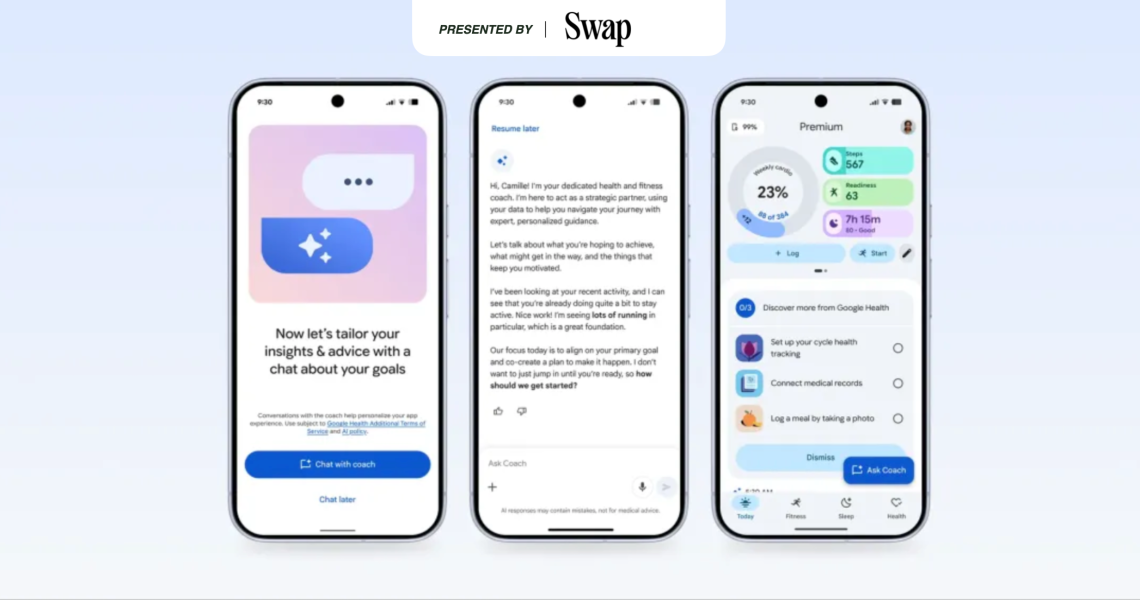
The new app provides users with a laundry list of offerings, including health data analysis, workout plans, medical record integration and multiple ways to log information (including voice, images and documents), plus advice on health, fitness and wellness topics like sleep and weight loss.
The app’s launch aligns with the rollout of the latest Fitbit, called Fitbit Air, which also drops on May 19. Users can sync their Fitbit or Google Pixel watch upon launch, with support for other devices coming soon.
The Google Health Coach will live within the Google Health app. New users can access the app for $9.99 per month or $99 per year.
As far as the future goes, personalization will be key, which Google understands. “We’ve invested heavily in quality and personalization, based on user feedback, making it incredibly easy to interact using quick-reply chips [pre-drafted responses],” said Google’s Abramson. “And you never have to wait for a nudge — you can get guidance 24/7 by simply hitting ‘Ask Coach’ at any time.”
“AI health coaching won’t win through a one-size-fits-all promise of optimization,” Hamlette said. “Brands will need to design distinct experiences that reflect different needs — physical performance and efficiency for some, private and responsive reassurance for others.”