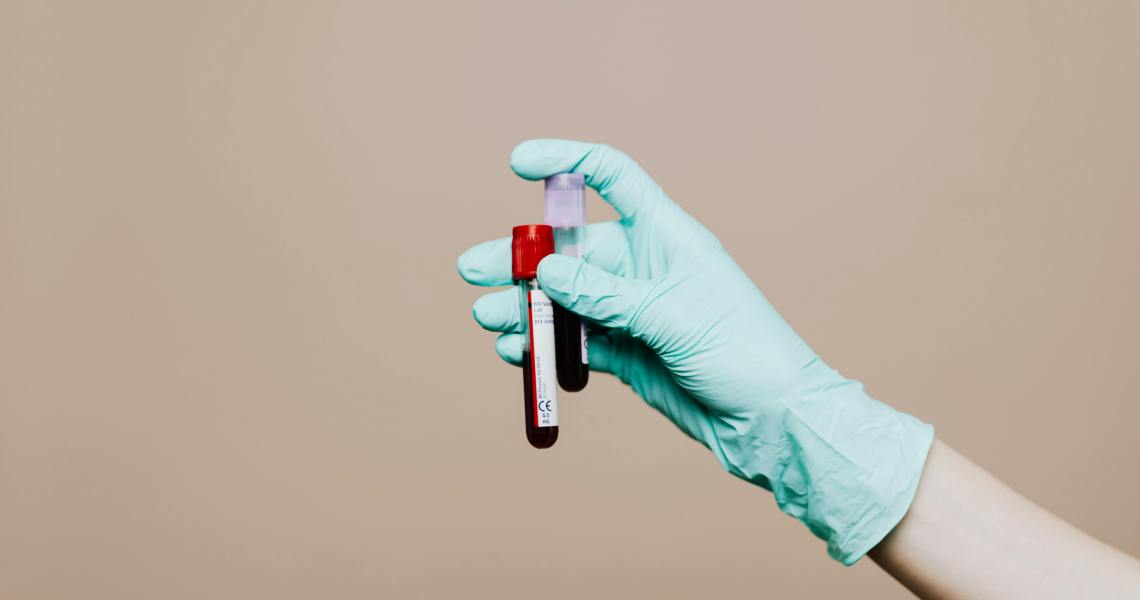
For the Wellness Briefing, Glossy is unpacking the evolving market of blood panel diagnostics, which were traditionally only ordered by one’s physician but have quickly become big business in the wellness industry. This includes Function Health’s acquisition of Getlabs, announced last week. Additionally, Unilever buys Grüns gummy supplements for $1.2 billion, menopause-focused Stripes Beauty launches spa services at luxury resort Canyon Ranch, and U.S. gym visits hit an all-time high.
Blood panels become big business as Function Health acquires GetLabs mobile bloodwork diagnostic company
Blood panel diagnostics, which were traditionally only ordered by one’s physician, are becoming big business in the wellness world.
Last week, Function Health announced the acquisition of Getlabs, a mobile lab testing network that sends a certified phlebotomist to one’s home or office to collect lab samples, including blood, urine, stool or saliva, before delivering them to a partner lab for processing.
“The problem has never been whether we can detect [chronic diseases]. it’s whether people can consistently get tested,” Jonathan Swerdlin, co-founder and CEO at Function, said in an emailed statement to Glossy. “By removing barriers like travel and scheduling constraints, Getlabs ensures more members stay on their testing cadence, which means we catch what’s changing in their biology before it becomes a diagnosis. When people can see what’s actually happening inside their body, they become owners of their health.”
The telehealth platform launched in 2022 with direct-to-consumer medical testing, including labs for nutritional deficiencies, hormone irregularities and other biomarkers it says are often missed in traditional medical visits. Function’s acquisition of Getlabs seeks to make lab collection easier and faster for its 500,000 members.
“Ultimately, you can’t really define your health without knowing your personal health data,” Mark Hyman, MD, co-founder and chief medical officer of Function, told Glossy in February. “And that’s really where Function comes in. It allows you to understand what’s going on with your biology in real time, to put your biology online, [and] to have it really give you insights about what’s happening.”
To do so, Function Health has an in-person partnership with Quest Diagnostics, the labs business with more than 6,000 locations across the country. Function members can visit one of around 2,000 Quest locations for testing. This partnership will continue, but now Function users will have at-home and in-person options: Those who select Getlabs will have their samples delivered to Quest for processing.
Function Health members pay $365 per year with one round of included blood test labs. Extra tests can be added à la carte.
Getlabs launched in 2021 with a $3 million seed round from Pivot North Capital, then raised $20 million in Series A funding in 2022. It was led by Emerson Collective and the Minderoo Foundation. Getlabs was helmed by founder Kyle Michelson, who worked as CEO until June 2025 when Claire Hough, former CTO at Carbon Health, took over as CEO.
The global blood panel diagnostics market was valued at $94 billion in 2024 and could exceed $160 billion by 2030, according to market research firm Grand View Research. The firm has charted a compound annual growth rate of 8.83% for the industry, which is led by North America with 44% of the market.
According to the firm, the most common reasons to seek a blood panel include testing an individual’s blood sugar, including A1C and glucose testing, followed by cholesterol testing, which is categorized as LDL or lipid testing, followed by Covid-19 tests. Kidney, thyroid, and prostate testing populated the next spots. However, only one nutrient test ranked in the top 10: vitamin D testing.
This aligns with a 2010 study at Oregon State University that found 95% of adults are deficient in Vitamin D, which has been a primary focus for new supplement brand launches.
However, as the supplement space has ballooned in size, many health experts warn against “supplement stacking” without first understanding one’s nutrient deficiencies, which is done through blood panels.
“People are walking around feeling like crap, [and] they just don’t know why,” Hyman told Glossy. “[Then they see their blood test results and realize], ‘Gee, wow, my vitamin D is like [a level] 12. No wonder I’m getting sick all the time, I’m tired, my muscles hurt, and I feel depressed — I thought that was normal.’”
The blood panel market is currently populated by leaders like Quest Diagnostics, as well as at-home leaders like Abbott and Roche Diagnostics, which offer cutting-edge solutions for at-home testing and glucose monitoring. Grand View Research also identified two emerging players: Guardant Health, which reported $281 million in revenue in Q4 2025, and Bio-Rad Laboratories, which generated $693 million during the same quarter. Both are headquartered in California and offer various at-home lab tests.
Meanwhile, blood panel diagnostics have become a hallmark of longevity clinics like Love Life, launched by a former Whole Foods founder in 2024, and Miora, the new longevity clinic from luxury gym Life Time Fitness. Membership at Love Life starts at $650 per month, while Miora offers a diagnostics package, which includes a consultation, blood work and a wellness protocol, for $299.
Nearly every heavy hitter in the health data tracking market has added blood panels to their list of offerings. For example, users of the Whoop wrist tracker or Oura ring can purchase blood tests through their app to check for a bespoke combination of biomarkers. Launched in September and October, respectively, both tracker brands partner with Quest Diagnostics to facilitate the tests. Oura charges $99 per test, while Whoop operates an annual membership that starts at $199 and includes one test.
There are also health platforms based primarily around lab test analysis, like Superpower, which facilitates payment, scheduling and analysis of tests done at Quest Diagnostics locations. The company raised $50 million in Series A funding led by Forerunner Ventures last year. Then there is Levels Health, co-founded by Casey Means, MD — President Donald Trump’s current nominee for U.S. Attorney General — in 2019. The health platform utilizes continuous glucose monitoring devices to track blood sugar and other biomarkers.
But Function Health isn’t the only health data company eyeing vertical integration.
In early 2025, Hims & Hers announced plans to introduce at-home lab testing through its acquisition of New Jersey-based Trybe Labs, maker of an FDA-approved, minimally invasive at-home blood-collection device that allows users to collect their own blood at home and mail it to the lab. The company also announced plans to acquire YourBio, a Boston-based maker of its patented TAP device, which uses a proprietary Halo microneedle system to collect blood at home.
Executive moves:
- Sandy Saputo, CEO of clean skin-care brand True Botanicals, is set to retire after a four-decade career. Her CV also includes P&G and Kendo brands. Her replacement has not been named.
News to know:
- Unilever has acquired Grüns gummy supplements for $1.2 billion. The vitamin company launched in 2023 and currently sells individually-packaged servings of vitamin gummies made from green vegetables at Target, Walmart, Amazon and DTC. Unilever also owns Olly, a leader in vitamin gummy supplements, and the electrolyte drink mix brand Liquid I.V. Grüns founder and CEO Chad Janis served on Dr. Squatch’s board from 2021-2022. Dr. Squatch was acquired by Unilever in 2025 for $1.5 billion.
- Protocole, a members-only telehealth platform launched in 2025, has launched a new clinical platform to sell research peptides like BPC-157 and TB-500. While the category is still operating in the gray market, it will sell “medical-grade peptides compounded in the U.S. by FDA-registered pharmacies, prescribed by licensed clinicians, and tested for 99% purity, sterility, and potency,” according to the company.
- A new infrared yoga franchise is heading to New York and other markets. Yoga Joint, the Florida-based fitness concept launched in 2010, has taken on $5.5 million in funding for U.S. expansion. The studio will open 15 locations across key markets this year including at least two in New York City. The chain has 17 studios in Florida. Investors behind the $5.5 million include Port Street Ventures, backer of Barry’s and Crunch, and Jon Canarick, board member of companies like Therabody and SLT.
- Speaking of fitness market innovation, Solidcore has announced it will soon test heated mat pilates classes as part of a new innovation lab strategy. The classes will launch in its Navy Yard location and, if popular, will roll out to other markets. Solidcore currently offers reformer pilates group classes at more than 100 locations in the U.S.
- Stripes Beauty, the menopause-focused wellness and beauty brand from Naomi Watts, has launched a menu of spa services with luxury hotel chain Canyon Ranch. This includes a “hormone support massage” for $250 and “root & crown renewal ritual” for $150, both of which utilize Stripes Beauty products. The services will first launch at Canyon Ranch locations in Tucson, Arizona and Lennox, Massachusetts.
- Supplement brand Amulet, which launched in 2025 with a hormone-focused supplement for women, has taken on investment from tennis star Maria Sharapova and designer Gabriela Hearst. The supplement line was launched by Squared Circles, backer of Magic Molecule and Algae Cooking Club. Amulet is helmed by CEO Suzanne Stockbridge, former GM of Oddity-owned SpoiledChild.
Stat of the week:
Americans made nearly 7 billion visits to gyms, health clubs and studios last year, according to a new report from The Health & Fitness Association. Released on April 9, the report studied how Americans engaged with fitness facilities in 2025 and found that gym visits grew 5.2% year over year. What’s more, the report found that around 81 million Americans belonged to a gym, studio or other fitness facilities in 2025, marking an all-time high. Gen-Z adults had the highest membership penetration, with around 35% visiting facilities, while older adults were the fastest-growing cohort, with members aged 65 and older growing 8.6% year over year, according to the report.
In the headlines:
WHOOP sues AI health coach Bevel [FittInsider]. Peloton taps Hudson Williams for new ad campaign, doubling down on cultural relevance [AthletechNews]. Wellness brands cash in on sperm health [WSJ]. Why your morning coffee—or matcha!—needs collagen [Vogue]. Should I worry about the plastic in my floss and toothbrush? [NYT]. New, ‘rigorous’ study offers answer on whether fluoride in drinking water affects kids’ IQs [Today]. The robots are here to fix your relationships [Allure].
Listen in:
On this week’s episode of the Glossy Beauty Podcast, co-host Sara Spruch-Feiner is joined by senior beauty reporter Emily Jensen to discuss the staple millennial brand Glossier — which famously helped pioneer the modern “clean girl” aesthetic — and what its next chapter may hold.
Need a Glossy recap?
It’s a 10 Haircare taps Khloé Kardashian as ambassador, plots packaging rebrand, book release for 20th anniversary. The business of being Rachel Zoe. Courteney Cox’s Homecourt doubles down on luxe hand care with new exfoliating product. ‘Not just the 1%’: How JCPenney is banking on the lower part of the K-shaped economy to fuel its turnaround. For Mother’s Day, Kendra Scott invests in its largest influencer activation to date. Sol de Janeiro’s director of global influence on the rise of ‘non-followers’ and the new rules of social engagement.
Update: Glossy added a comment from Jonathan Swerdlin, co-founder and CEO at Function, after this story’s initial publication.