In this week’s Luxury Briefing, I look into American luxury prep brand Ralph Lauren – as its marketing investment reaches 8.2% of sales, the brand is extending the tennis tournament into a retail season spanning luxury hospitality, personalization, vintage and home. Also, luxury brands‘ bet on animation in the face of AI, executive moves at Farfetch, and news from Frasers and Shein. For tips or comments, email me at zofia@glossy.co.
The U.S. Open begins Sunday, but for Ralph Lauren, it started nearly three weeks ago.
On August 4, the brand opened a takeover of The Corner at Nordstrom’s New York flagship. The installation will remain open until September 20, one week after the tournament ends. In total, Ralph Lauren’s retail activation will last six weeks, almost twice as long as the sporting event it was built around. (The U.S. Open runs from August 23 to September 13.)
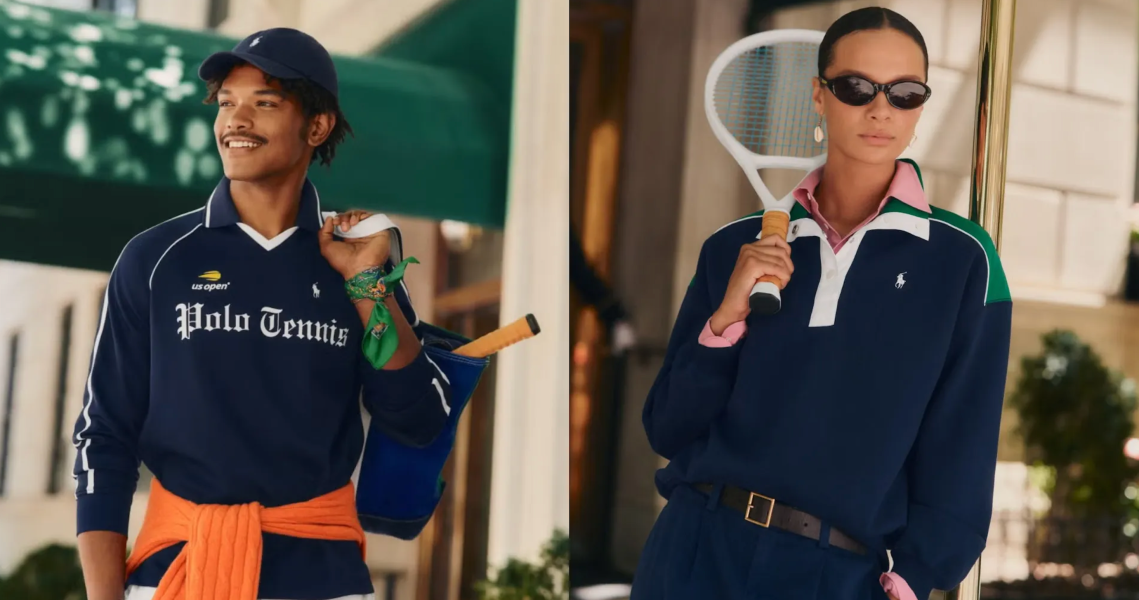
The extended window is showing how the American prep brand’s relationship with the U.S. Open is evolving. After more than two decades as its official outfitter, the brand is turning the tournament into a retail season, according to the company. Personalization, vintage, home products, hospitality and store events now sit alongside uniforms and commemorative merchandise.
The expansion comes as marketing plays a larger role in Ralph Lauren’s growth and elevation strategy. In its first quarter of fiscal 2027, marketing investment reached 8.2% of sales, up from 7.5% a year earlier and approximately 3.5% during an earlier stage of its elevation.
The investment has not yet come at the expense of pricing power. Quarterly revenue increased 13% in constant currency to $1.96 billion, while average unit retail rose 15%. Ralph Lauren also recruited 1.5 million new direct-to-consumer customers during the quarter.
“Our marketing teams are really doing a fantastic job around the world, building brand desirability, recruiting new customers,” CEO Patrice Louvet said on the company’s August earnings call. He added that Ralph Lauren was generating “really good returns” from its increased marketing investment.
In press materials and a statement shared with Glossy, Ralph Lauren said it is taking this year’s U.S. Open activation “beyond the court” through retail, consumer activations and hospitality.
The Nordstrom takeover encompasses men’s, women’s, children’s and home products, rather than solely tournament merchandise. Customers can personalize products through printing, embroidery and debossing, while the activation also includes cocktails, styling appointments and other events.
At the tournament, Ralph Lauren has expanded its Create Your Own product personalization program with patches, printing and embroidery that tournament goers can customize at its station.
The brand is also bringing its certified vintage program to the U.S. Open for the first time. The program launched in September 2024 with authenticated archival pieces priced from $150-$3,500. It’s a smart tactic – placing vintage alongside customizable tournament merchandise gives shoppers access to products with greater scarcity and collectibility, while allowing Ralph Lauren to capture part of the resale demand surrounding its own archive.
The brand’s expanded hospitality suite at Arthur Ashe Stadium includes separate areas for viewing, dining and gathering, all furnished with its homeware brand Ralph Lauren Home. As a result, the suite acts as both a private VIP environment and a showcase for the company’s broader luxury lifestyle proposition.
Ralph Lauren will also dress 800 people during the tournament, comprising 300 ball-crew members, 215 on-court officials and 285 court attendants. In its statement to Glossy, the brand said the latter group includes VIPs ranging from celebrities to athletes with existing Ralph Lauren relationships. This week, Ralph Lauren announced it also has a new informal relationship with tennis player Alex de Minaur, but the company told Glossy that the player is not a formal brand partner.
Ralph Lauren’s dedicated strategy expansion reflects how the U.S. Open has grown from a tennis tournament into a broader fashion and social moment, giving brands a reason to build campaigns that extend well beyond the matches.
“The U.S. Open is a pop-culture happening,” said Joe Favorito, a sports-marketing consultant and former USTA executive. “It becomes the front porch for the right brands to engage — not just for two weeks, but for life.”
Favorito said brands at the U.S. Open can no longer purchase sponsorship visibility and simply “hope that you win.” Instead, the event must be integrated across retail and marketing channels, with specific commercial and customer-acquisition goals.
Fine-jewelry brand Aurate provides evidence of the sales opportunity surrounding tennis. The tennis bracelet and necklace category now generates approximately half of the New York brand’s annual sales and has grown by more than 60% year over year since its 2021 launch, Aurate shared with Glossy.
The assortment also demonstrates how brands can use tennis to connect accessible products with luxury price points. Aurate’s stainless-steel and lab-grown white-sapphire bracelet costs $198, compared to $388 for a vermeil version. Its 14-karat-gold bracelet with lab-grown diamonds starts at $1,748, while the equivalent natural-diamond design starts at $2,588.
Aurate marketing director Zoé Macias told Glossy that the brand sees a 10% sales increase in its tennis category during the U.S. Open period. After the holidays and Mother’s Day, September is its strongest selling month for tennis jewelry.
The company’s 2025 Wilson collection, which extended from the U.S. Open through the holiday season, sold out within three months. Product merchandiser Sarina Moscatiello said Aurate’s first natural-diamond, 14-karat-gold tennis bracelet and necklace became two of its five best-selling styles in their first year.
Why luxury brands are getting animated
This week, Dior Beauty released a hand-painted animated film telling the story of Miss Dior, while Hermès has filled its website and social channels with artist Linda Merad’s surreal pen-and-ink sea creatures. The timing is telling of how anti-AI imagery the industry has become. As the technology is making slick campaign imagery easier to produce, luxury brands are leaning into work that looks more human, imperfect or clearly made by an artist.
“The fear for any brand is now about feeling generic, feeling AI or feeling like it is without a soul,” said Hana Shimizu, managing partner of creative studio Hornet, which has worked with Tiffany & Co., La Mer, Longchamp and Loewe. She said animation was once seen as a social-media add-on, or even as too childish for luxury. Now, hand drawing, felt and stop motion are reinforcing the qualities luxury brands want to sell: “craftsmanship, authorship and authenticity,” said Shimizu. Even behind-the-scenes footage of an artist’s process has become important, serving as “a proof point that it was done for real,” according to Shimizu.
Brands are also getting more use from the work as content demands grow across different owned channels. Instead of ordering one animated film, they are commissioning entire visual worlds that can run across stores, websites, social media and outdoor ads. According to Shimizu, brands are looking beyond views and clicks and paying more attention to “asset longevity, reuse across channels, retail adaptability, consistency and brand recall.”
Executive moves
- Farfetch appointed Manny Suero vice president of Private Client Americas to grow its top-spending customer base across the U.S., Mexico, Brazil and Canada as aspirational customers pull back. The hire shows the Coupang-owned marketplace is leaning further into its small but valuable group of top spenders as aspirational luxury demand remains weak.
News to know
- Since Glossy covered the sale of Harvey Nichols, Frasers owner Mike Ashley has wasted no time in making new moves. Since Sunday, Frasers has increased its Hugo Boss stake to 47.9%, while Harvey Nichols’ website has gone offline — customers owed refunds or holding gift cards from before the takeover must now place a claim through the administration. Frasers has also pledged to pay affected freelance personal shoppers and stylists in full within 72 hours, before moving them from quarterly to monthly payments.
- In fast fashion news, Shein has pushed its planned Hong Kong listing from August 28 to September 1. Also, France fined Boohoo $2.7 million after finding that many of its advertised discounts were misleading and some synthetic products were labeled as leather or suede.
Listen in
On this week’s Glossy Podcast, Glossy’s Danny Parisi is joined by Highsnobiety style writer Chris Erik Thomas to discuss the growing fashion ambitions of tech companies including Palantir, Anthropic and OpenAI. From chore coats and “thinking caps” to sold-out streetwear drops, the items have picked up their fair share of negative comments online. The two unpack who is buying the merch, why it feels dated and why fashion insiders have reacted so negatively. Listen here.
Read on Glossy
We look into the wave of fashion brands opening Los Angeles stores this summer. BaubleBar is turning college fandom into a year-round growth engine. Maisonette is launching a tween vertical, forgoing social ads targeting kids.