
Welcome to Glossy’s Holiday Countdown, a bi-weekly guide to the new and noteworthy strategies brands and retailers are employing to capitalize on holiday spending.
As the holiday shopping season begins, artificial intelligence is transforming how consumers search, compare and buy. In this interview with Glossy, Kelly Pedersen, global retail leader at PwC U.S., builds on key findings from PwC’s 2026 Holiday Outlook report. From prompt-driven gift curation and AI price tracking to Gen Z’s record store foot traffic and Gen Alpha’s growing algorithmic influence on household spending, Pedersen highlights the major trends and consumer behaviors set to determine brands’ success this season.
Considering the data PwC has compiled and your expertise across the retail sector, how will artificial intelligence shape the holiday shopping season this year?
“This year, our survey found that 29% of consumers plan to use AI throughout the holiday season for their shopping. While 29% might seem like a modest overall percentage, its actual impact on shopper behavior is significant and growing very quickly. Consumers are deploying AI for concrete, practical tasks like research, product discovery, price checking, maintaining budgets and understanding specific product features.
If we step back to a year ago, our holiday survey showed 20% of shoppers planning to use AI as part of their holiday shopping. At that time, there was immense hype surrounding automated purchasing — the speculative idea that you would simply put your credit card on file and products would automatically start showing up at your door. That transactional vision never fully came to fruition because major platforms held back on the actual transaction mechanics. What was unfulfilled transactional hype last year has now normalized into a very common, functional tool to search, compare and shop for the holidays.
What stands out in our consumer research is how rapidly shoppers are building prompting skills. Shoppers are putting much more time and effort into writing detailed, descriptive prompts that outline their recipients’ specific likes, dislikes, current possessions and lifestyle traits. Rather than walking around a physical shopping mall hoping to randomly encounter a great gift idea, consumers are using AI to instantly generate hyper-personalized, curated gift lists for every single person on their shopping list.”
How do you expect current macro consumer trends, including low confidence, to play out across holiday spending behavior in both physical and digital sales channels?
“We’re seeing a major macroeconomic paradox right now. Consumer confidence is hitting near all-time lows, yet there is a massive ‘say-do gap’ where consumers report plans to cut spending significantly but end up shopping anyway. The mindset about future economic conditions is far more negative than how consumers feel about their current day-to-day spending power. Despite what they indicate in sentiment surveys, we project consumers will actually spend 6-7% more this holiday season compared to last year.
At the same time, physical retail traffic is showing record numbers. This footprint isn’t necessarily driving higher in-store conversion rates, as e-commerce continues to grow faster than store sales, but consumers are visiting physical stores specifically for product interaction and discovery. We see this most dramatically with Gen Z shoppers aged 14-29. Gen Z presents a fascinating paradox: They are the most digitally native consumer cohort, yet they are driving record amounts of physical store foot traffic because they value the social, real-life experience of interacting with products and store associates before ultimately converting online.
When looking at spending allocation, consumers are continuing a multi-year shift away from physical goods toward experiences and wellness, which remains one of the fastest-growing gift categories. While consumers indicate a desire to pull back on holiday travel due to elevated hotel and airfare costs, actual airline booking volumes remain high. Consumers are adapting by using AI scraping and price-tracking tools to monitor airfares and securing refundable fares early, canceling and rebooking whenever prices drop to manage costs effectively.”
With early October promotional events like Amazon Prime Day reshaping the calendar, when do you expect sales and discounting to peak this holiday shopping season? And do you expect brands and retailers to be prepared with the right inventory at the right time?
“Early October events like Prime Day have become the true preemptive start of the holiday shopping season. Prime Day is no longer isolated to a single merchant; it has transformed into an industry-wide event that triggers immediate price-matching across competing retailers. Twenty years ago in retail, you had to wait until Wednesday or Thursday before Black Friday for physical newspaper flyers to drop before you knew what competitors were pricing. Today, online price-matching happens in near real time, accompanied by strategic secrecy around what retailers plan to put on sale during early October. Once brands launch discounts in early October, they rarely return to full price because businesses become accustomed to the sales uplift generated by continuous promotions.
However, the overall promotional environment this year differs fundamentally from last season due to inventory dynamics. A year ago, retailers had aggressively stockpiled inventory ahead of anticipated tariff implementations, resulting in surplus stock that forced early, aggressive site-wide markdowns. Today, inventory levels are far tighter and healthier. Retailers are not sitting on excess stock, meaning we will likely not see sweeping early markdowns across the board. If shoppers see an item they want on sale early, they should buy it, as waiting for Black Friday carries a real risk of stockouts.
Promotional intensity will vary significantly by sector. Categories that have performed exceptionally well — such as specialty, mall and apparel retail, which have seen strong demand driven by trends like GLP-1 adoption — will not need to promote as aggressively. Conversely, consumer electronics and tech gadgets are underperforming, with younger consumers ironically shifting back to ‘analog’ tech like digital cameras. Because the classic Black Friday shopping narrative is deeply rooted in consumer electronics, we anticipate the deepest discounts and sharpest promotional battles will concentrate heavily in tech and gadget categories.”
To what extent will brands’ savvy in generative engine optimization (GEO) determine this holiday season’s winners? What else is having a greater influence on sales this year?
“Optimizing for AI discoverability requires a complete departure from traditional search engine optimization toward generative engine optimization, or GEO. AI search engines operate conversationally and prioritize authoritative, specific product claims rather than simple keyword density. This creates a stark divide between large corporate brands and agile startups. Legacy brands are often risk-averse and hesitant to make bold, definitive product claims, whereas smaller, digitally native startups take greater risks in their messaging. Because AI algorithms scan for expert claims, these agile startups are consistently capturing top recommendation slots over established industry giants.
We saw this directly in a recent real-world search test for youth bicycles for 11- and 14-year-olds: AI prompts consistently recommended two or three small startup brands that made bold, explicit claims about being the ‘safest’ or ‘fastest,’ entirely bypassing well-known legacy manufacturers whose messaging was more conservative.
Simultaneously, we are seeing the rise of the Gen Alpha algorithm feedback loop. Gen Alpha — individuals under 14 years old — represents the largest generational cohort in history and spends over 3.5 hours online daily. While not direct buyers, 97% of Gen Alpha children influence household purchasing decisions. By spending hours online interacting with digital platforms, these children actively train and program recommendation algorithms. Because parents share home devices, accounts and environments, they are served product recommendations shaped by the exact algorithms their children programmed. This dynamic is so powerful that during our recent back-to-school research, child preference surpassed price as the primary purchase driver for the first time in retail history, completely overriding traditional cost sensitivity.”
Glossy+ Research: Leveraging the holiday season for long-term customer acquisition
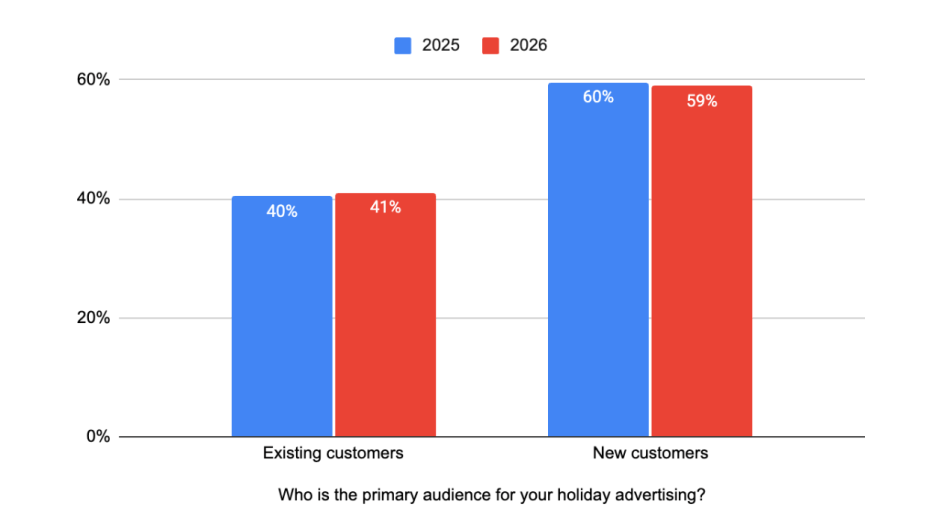
In a recent Glossy+ Research survey, 90 brand and retailer professionals revealed that, as in 2025, around 60% of their holiday advertising will target new customers, while 40% will be directed at existing customers. Those interviewed said they see the opportunity to convert new customers into returning customers in the first quarter of 2027.
“[Holiday] is a time when you can acquire a lot of new customers,” said Ari Bloom, founder and CEO of brand incubator A-Frame Brands. “We naturally see new customers come into the holiday funnel; we see about a 20-30% increase in new customers as a percentage of total, and that’s because [customers] are looking to discover.”
He added, “AI is going to become one of the newest and probably most important funnels for new customers, because instead of using old habits to discover existing brands, there’s essentially a whole other ‘person’ shopping for them.”
Holiday news to know
- After rolling out its 2026 iteration of its popular beauty Advent calendar on September 1 — it has already sold out and been restocked — Selfridges will launch its first fragrance-focused Advent calendar on October 8.
“Beauty is always a major part of our Christmas business, but we’re particularly excited about the opportunity this year,” Melissa McGinnis, Selfridges’ beauty buying director, told Glossy in an email. “We’re seeing strong customer appetite across gifting, fragrance and discovery, supported by our most ambitious Advent offer to date and a compelling mix of exclusive brands, products and experiences. Fragrance in particular continues to be a significant growth area for us, and alongside color and beauty services, we expect the category to play an even bigger role in how customers shop and gift with us this holiday season.” - Macy’s and DoorDash have expanded their partnership, timed with the start of the holiday season. Starting on September 29, a dedicated Macy’s storefront has launched in markets including Chicago, San Francisco, Jersey City and Houston. Expansion to additional markets covering 360 Macy’s locations will continue through October.
- For the first time, The Home Depot is selling a holiday sweater. Retailing for $29.99, it combines the tradition of the classic novelty sweater with the function of the company’s “iconic” orange apron, according to a press release.