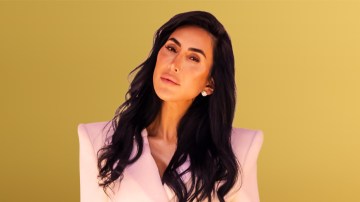
This is an episode of the Glossy Beauty Podcast, which features candid conversations about how today’s trends are shaping the future of the beauty and wellness industries. More from the series →
Subscribe: Apple Podcasts • Spotify
Over the past week, the internet has been ablaze discussing the beauty industry’s biggest controversy of the year. From social media to global news outlets, everyone is talking about something that’s been dubbed “eye patch gate.”
Around September 17, several beauty brands, including Fenty Beauty, Glow Recipe and Huda Beauty, began to tease the release of products that appeared to be almost identical. A small plastic jar that twisted to reveal a freshly sliced hydrogel eye mask. What was meant to be a first-of-its-kind innovation from each of the brands ended up looking more like an April Fools’ joke.
As a response, Fenty Beauty and Glow Recipe meme’d themselves before continuing their launches, while Huda Beauty announced it was pulling the product from production. Turns out, the products all came from the same K-beauty manufacturer named Samhwa.
“It really comes down to a question around exclusivity, meaning these brands likely received some degree of the [same] innovation in a very similar capacity [but have no exclusivity on the innovation],” Jaimee Holmes, veteran beauty exec-turned-brand founder, told Glossy. “[When] I was leading merchandising at Goop [from 2019-2023], I was really seeing this across every single category. So many brands presented quite literally the same product from the same suppliers, same presentations, but sometimes there might be a price difference of up to $100 between two [of them].”
Holmes knows a thing or two about innovation. She got her start at Sephora, followed by Benefit Cosmetics, then Too Faced, where she was an integral part of bringing one of the top-selling mascaras of all time, Better than Sex, to market in 2013. She’s also held executive roles at Kendo Brands, Gwyneth Paltrow’s Goop, Memebox and L’Oréal-backed Timeline Longevity.
At Goop, Holmes “would get samples from the same suppliers sent to my doorstep [on behalf of different brands],” she said. “It gave me a lot of pause. … Ultimately, it’s what led me to step away and create something of my own called Fel Beauty.”
Fel Beauty (pronounced like “feel”) launched in December of 2025 at Sephora and DTC with just one product. Called Kissylips, the $22 lip-and-cheek hybrid launched in eight universal shades and has since sold out several times. The line is made in Canada with a custom formula and custom packaging, which was far from easy. “This was a two-year development cycle to create [the product],” Holmes said. “It was 56 trials, which means we failed about 55 times before we succeeded to create this at all. And we didn’t give up.”
Fel Beauty has taken on minimal funding from angel investors. With a lean team of five – including secret weapon Erik Frey, a packaging design expert who’s made products for Rhode, Tatcha and MPH – Fel Beauty has since added an overnight lip mask and is soon expanding into other categories. Certain shades, like CutiePie, have sold out four times at Sephora. “We’ve been beating our plan as a brand by over 200%,” Holmes said. “The last time we tracked and pulled this number, it was around 35,000 [units sold].”
Holmes sat down with Glossy Beauty Podcast host Lexy Lebsack to unpack the innovation struggles in the industry, share lessons from her career, and spill the secret sauce behind 10-month-old Fel Beauty’s quick success.
On ‘eye patch gate’
“I don’t think it’s a blip; I think it’s a little bit of a cautionary tale. … I don’t think this is the first time we’ve seen something like this. I think it’s just become the loudest sort of moment around it because of how similar, or maybe exactly the same, these products actually are — and timing, because it was all happening at the same moment versus a month from now or six months from now/ … [Something like this] happens in a couple of different ways. Sometimes manufacturers create something really interesting that is an innovation, and they share it, and they present it to brands. Sometimes there’s not always exclusivity in those conversations or in those previews, and so when something new and interesting comes to be. Then brands get excited about it, retailers get excited about it, and unfortunately, that can sometimes create duplicity, and unfortunately, sometimes it creates it in a moment when it’s unexpected like this.”
On seeing a lack of innovation while working for Goop as VP of beauty and wellness
“I got a real helicopter lens into what was starting to happen within the industry, and it was truly this. So beyond what we’re seeing in real time in the moment with these eye masks, it was happening long before this. … In the early years, the percentage of innovation would probably be 60-70%. Really new, really different, really interesting things. … [A few years later] I would say maybe 30% became real, true innovation that didn’t exist in other categories or other retailers. So, it changed. It was impacted for sure in the time that I was there. … Covid and the impact of that changed the landscape in many ways that were unexpected, meaning it could create new and interesting category behaviors overnight because of that. … After the impact of that, when people started to go back to some sense of normalcy and back into offices, then different behaviors started to emerge [again that also shifted things].”