The collegiate business of BaubleBar, the accessories brand founded in 2011, is growing quickly, but the company is increasingly looking beyond the traditional back-to-school sales opportunity.
The brand’s collegiate revenue is up more than 50% year to date, after launching the category with 12 schools in February 2025. It now works with 25 schools, including Pennsylvania State University, the University of Michigan, the University of Florida, the University of Tennessee and the University of Texas, and roughly half of its collegiate sales come through wholesale. Retail partners include campus bookstores, Fanatics, Dick’s Sporting Goods, Rally House, Alumni Hall, Palmetto Moon and Revolve. It expanded its collegiate assortment last month with Virginia Tech, Florida State University and Missouri State University.
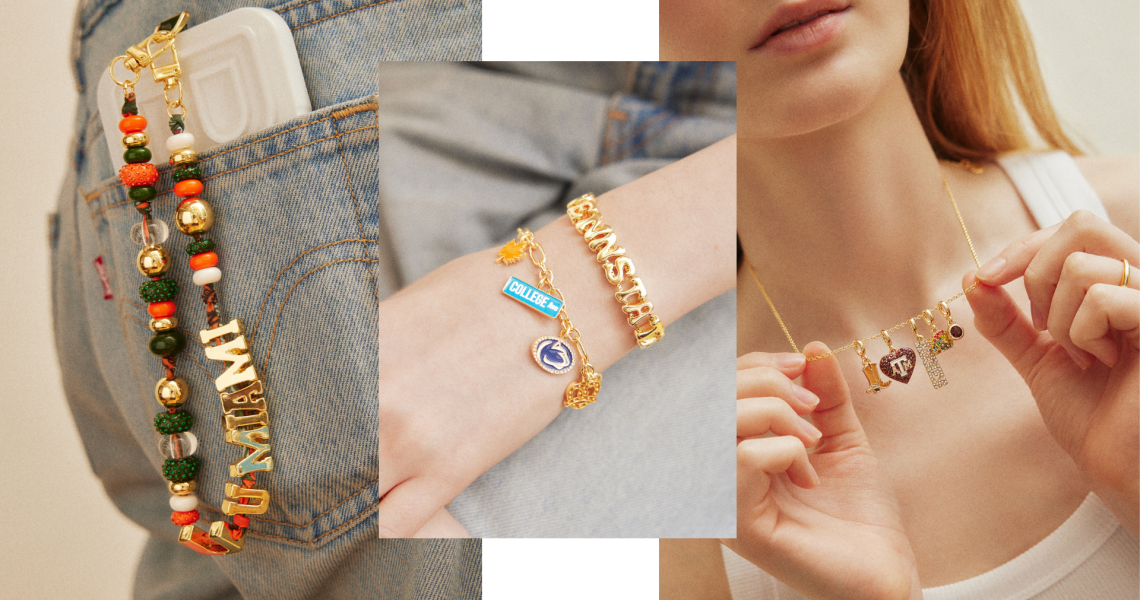
The assortment goes beyond conventional logo merchandise. BaubleBar sells school-specific charm bracelets, necklaces and earrings, alongside accessories including hair clips, phone straps and bag charms. Its $38 University of Michigan Pisa Bracelet, for example, mixes gold beads with motifs including the university logo, the outline of Michigan, cherries and mittens.
For BaubleBar co-founder Daniella Yacobovsky, the bigger opportunity is tapping into communities with deep emotional ties to a school. BaubleBar, which is privately held and declined to disclose annual revenue, has historically kept its financials close. Forbes estimated sales at roughly $75 million back in 2015. The collegiate collection sells through over 300 wholesale doors.
“It does give you access to a group of people that really identify with something,” she said. “Whether it is a school, whether it is an entertainment IP, a sports team, whatever it is, they really identify.”
That matters more as fashion brands compete to acquire customers in increasingly fragmented digital environments. Rather than building a community from scratch, collegiate licensing gives BaubleBar an entry point into an existing one.
BaubleBar has seen the same dynamic through licensing partnerships including Disney, the NFL and MLB. Its first licensed collection launched with Disney in 2020. Yacobovsky said licensing gives brands access to consumers “proactively raising a hand and saying, ‘I care about this thing.’” In practice, licensing gives BaubleBar permission to use protected logos, names and other brand assets in exchange for royalties on licensed product sales; the exact rates vary by partner and agreement.
But access alone does not guarantee sales.
“You can’t just take a school logo and slap it on a product and say, ‘Here you go, I’m done,’” Yacobovsky said.
Instead, BaubleBar researches the details that distinguish individual college communities, from chants and local foods to street signs and campus landmarks. The company speaks with employees, friends and family with ties to particular schools and uses social listening and customer surveys to inform product development.
The strategy is also creating new distribution opportunities. BaubleBar’s collegiate business is now split roughly evenly between its own channels and wholesale, and the brand has added more than 30 retail locations this year.
“Collegiate shoppers have their own retail universe,” Yacobovsky said, adding that physical distribution also boosts BaubleBar’s online business in those markets.
BaubleBar is not alone in expanding its collegiate strategy. New York fashion brand Parke is launching its first licensed collegiate collection on August 25 through a collaboration with sports lifestyle brand ’47, known for its licensed team headwear and apparel — it covers nine universities, including the University of Michigan, the University of Alabama, the University of Texas and the University of Georgia. The assortment includes mock-neck sweatshirts, sweatpants and headwear, positioning traditional campus staples through Parke’s more fashion-forward aesthetic.
And Fabletics has doubled the size of its College Shop from roughly 100 universities in the spring to 200, Modern Retail reported Tuesday. The activewear company is also testing collegiate merchandise in 14 stores near university campuses. Fabletics president Meera Bhatia told Modern Retail that the assortment can appeal to existing customers while also helping “bring new customers into the brand.”
BaubleBar is pursuing a similar opportunity, but is now getting more granular about what happens after that first collegiate purchase. The company is tracking whether shoppers who enter through a Michigan or Penn State product go on to browse and buy from other parts of the business, including phone cases, custom jewelry and its core beaded assortment.
The company is also getting more sophisticated about how it measures that journey. Yacobovsky said the company rebuilt parts of its website backend in July, adding new data and analytics tools to better understand how customers discover collections, what they browse next and which products they buy together. With the collegiate business now more than 18 months old, she said BaubleBar has enough historical data to start building a clearer picture of repeat purchasing and how licensed customers move into the wider assortment.
“Last year, when we had sub-12 months of data, you have to really make a lot of assumptions,” she said. “Now that we’re at the past 18-month mark, we have so much more to go off of.” At an assortment level, Yacobovsky said BaubleBar can already identify which parts of the business a shopper is most likely to be interested in next, even if it cannot yet predict the exact product they will buy.
Yacobovsky said early customer metrics are are equal to or exceed BaubleBar’s overall baseline, suggesting that collegiate shoppers may be valuable not just as one-off fan customers, but as a route into the wider brand.
The company also has an affiliate network of around 5,000 people, which it uses alongside social media to put collegiate products into the hands of both students and alumni. Yacobovsky described affiliates as particularly important because BaubleBar wants to create a “groundswell” of people wearing the assortment.
And while August provides an obvious marketing moment, BaubleBar no longer views collegiate as simply a back-to-school category. Football and basketball seasons, graduation, reunions and homecoming provide recurring reasons to buy.
“There is this assumption that collegiate means I am a college student that goes to the school,” Yacobovsky said. “But really it doesn’t begin and end with physically being in college.”