This week, we take a look at a recent trend in luxury marketing: Brands are mythologizing their founders in animation, comics and video games, turning the founding and early days of their history into exaggerated, mythologized versions of reality. But is there a risk associated with this strategy?
Many of the most prominent European luxury brands were founded decades, or even centuries, ago. But even though the founders may be long dead, that hasn’t stopped them from showing up in brand campaigns.
Over the last year, a surprising number of luxury brands have rolled out campaigns featuring their original founders, often reinterpreted through mediums like animation, video games, comics or even being portrayed by modern actors.
Dior’s recent animated holiday ad featured an animated version of Christian Dior, voiced by the French actor Louis Garrel, telling a fantastical version of Dior creating a dress for the actress Marlene Dietrich. The campaign combines true elements, like Dior’s relationship with Dietrich and the fact that he personally designed dresses for notable women, with a fairytale atmosphere, like his atelier being full of helpful bees who aid in the stitching.
The watch brand Jaeger-LeCoultre released two campaigns recently that followed a similar vein. One, released last winter, involved the artist Olivecoat, who created a webcomic (a vertically scrolling comic made for mobile devices) that dramatizes the invention of Jaeger-LeCoultre’s famous Reverso watch. The comic spans multiple chapters, featuring comic versions of real people like Jacques-David LeCoultre, grandson of the brand’s founder Antoine LeCoultre, and César de Trey, an entrepreneur who helped invent the Reverso.
Jaeger-LeCoultre went further this November, partnering with the game designer Zain Memon to release a free video game called “The Valley of Inventions.” In the game, players take control of Elie LeCoultre, the real-life son of founder Antoine, as he solves watch-related puzzles around his father’s workshop.
The idea behind these campaigns is clear: turn the brand’s history and its founder into an iconic, memorable character to solidify the brand’s story in a customer’s mind.
“Luxury brands sell the mythology, and that’s always been the case,” said Tracy Lamourie, a publicist and brand strategist. “We always say in PR and media that everything begins with a founder. The founder story gives buyers, consumers or watchers something that no competitor can copy, no matter how closely they try to imitate the actual fashion product.”
Outside of Dior and Jaeger-LeCoultre, luxury brands have been mythologizing their founders in many different ways, and not all of them include an actual portrayal of the founder in question. Zegna has been releasing an ongoing campaign over the last year that sees actor Mads Mikkelsen “retracing the footsteps” of founder Ermenegildo Zegna, visiting places like Oasi Zegna, a natural reserve that Zegna himself helped reforest and turn into a free public space in the 1930s. Cartier has also released a campaign with famous manga and anime artist Naoki Urasawa that, among other things, dramatizes the global travels of the Cartier brothers.
These campaigns tend to get good engagement. Dior’s animated campaign got around 230,000 likes on Instagram, compared to the 20,000-30,000 that its average posts get. But are there risks associated with this mythologizing?
According to Mary Elkordy, founder of Elkordy Global Strategies, which has worked with brands like Jovani, brands risk taking the exaggeration too far.
“There’s also a big difference between creatively telling your story and creating a version of your story that isn’t necessarily reflective of reality,” she said. “We live in a world today where virtually anyone with a phone or a computer can become a fact-checker. If consumers sense that something isn’t accurate, not only are they going to look into it themselves, but they’re also very quick to publicly call it out. What was intended to be a creative marketing campaign could very easily turn into a reputation management issue.”
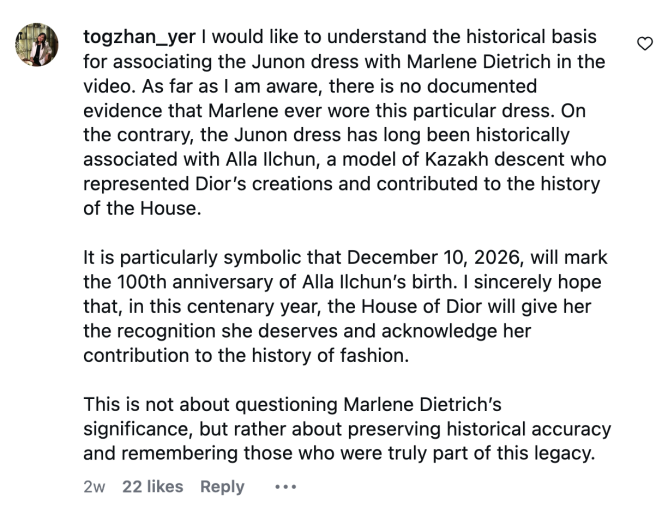
That was reflected in the Dior ad, which showed Christian Dior creating the famous Junon dress for Marlene Dietrich to wear. Except, Dior never made that dress for Dietrich, nor did she ever wear it. It was, in fact, made for Alla Ilchun, an actress, model and muse for Dior who was the first Asian woman to model for a major European house. One commenter on Dior’s Instagram post pointed out the discrepancy, questioning why Dior chose not to include Ilchun in the campaign. While historical accuracy concerns likely didn’t have a major effect on the campaign’s reach — it had bigger concerns over accusations of using AI — it does show that die-hard luxury fans notice these sorts of historical elisions.
Michael Bismuth, co-founder and lead AI director at the Miami creative agency Cuz, which has worked with brands like DKNY and Karl Lagerfeld, said there’s an additional concern of turning the serious legacy of a brand’s founder into something silly and cartoonish. Harlan Sanders, the founder of Kentucky Fried Chicken, is a good example of a real person whose cultural depiction as “Colonel Sanders” has become almost completely divorced from reality.
“It works when the exaggeration sits on something true,” Bismuth said. “A myth is allowed to be bigger than life; that’s the whole point. An invented one gets found out fast. There’s a thin line between a legend and a cartoon, and once the founder starts winking at the camera, the prestige is gone.”
News to know
- Shein agreed to pay $100 million to end an FTC investigation into deceptive marketing practices. Shein’s revenue has fallen by over 25% in the last quarter.
- The Trump administration is planning a new wave of tariffs on countries like China, Vietnam and the European Union. Some of the rates could be up to 40%.
- Bloomberg reported that shoppers are bringing information gleaned from AI chatbots into retail stores, causing headaches for store associates when that information is faulty.