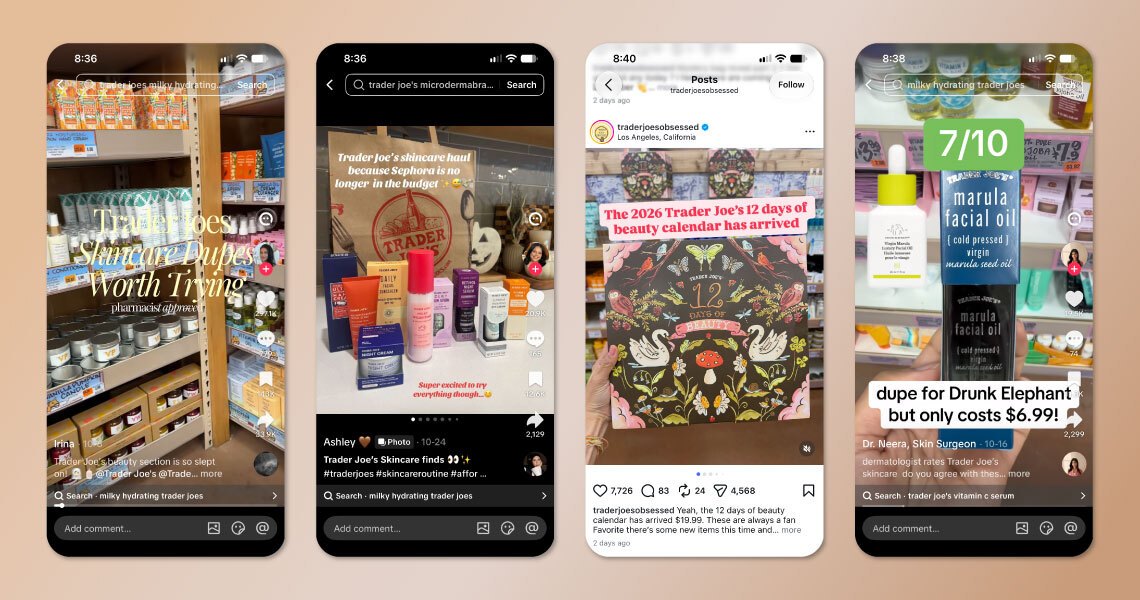
Shannong Fong has acquired more than 1 million followers on Instagram by sharing what’s new at Trader Joe’s. Recent finds posted to her page, @traderjoesobsessed, include sticky toffee-flavored cheddar, instant pho noodles and a $19.99 beauty advent calendar — the latter drumming up particular excitement.
“It’s really just a fun place, and the price point’s great,” said Fong, who has been posting about new products from Trader Joe’s since 2018 and runs a similar Instagram account tracking Costco finds. “Times are tough right now. People want to still feel luxurious, but they don’t want it to hit their pocketbook so much.”
The California-based national chain has long cultivated a devoted fan base unlike other grocery stores thanks to its mix of inventive snacks and treats, colorful branding and affordable prices. But shoppers are increasingly expanding the fervor they feel for Trader Joe’s core food offerings to its growing beauty aisle.
“Trader Joe’s has always been a brand or a story about novelty,” said Matt Klein, head of consumer insights at Reddit. “People have gotten savvy with how Trader Joe’s works and how they’re not always manufacturing their own foods. … That realization has been applied to the beauty front, and I think that’s coincided with the larger energy around dupe culture, as well.”
Redditors have been posting about Trader Joe’s beauty and personal care offerings at least as far back as 2019, and Refinery29 beauty writer Mi-Anne Chan reviewed its products in 2018. But demand for the grocer’s skin- and body-care products is growing beyond TJ obsessives: In 2026, outlets including The New York Times’ Wirecutter and Business Insider, and creators like viral cosmetic chemist Javon Ford, have posted guides and roundups of the grocery store’s beauty products.
According to Spate’s proprietary Pop Index, which combines Google searches, TikTok views and Instagram posts, the popularity of Trader Joe’s in conjunction with skin care has grown 122.9% year over year as of November. The popularity of Trader Joe’s sunscreen, which some have compared to pricier formulas from Supergoop, is up 123.2% year over year, while its face category as a whole is up 293.5% and body 95%.
Kaylee Lieffers, co-founder and CEO of beauty private label manufacturer Blanka, attributes the growth of Trader Joe’s beauty offerings, which, like its food, are all white-labeled under the Trader Joe’s brand, in part to the growth of private label beauty as a whole.
“Private label is so much more accessible than it was 10 years ago,” said Lieffers. “The manufacturing infrastructure [is there] for Trader Joe’s to not only do private label beauty, but also to do it in a way that mimics the way they do food private label, which is really quick turnovers and new product launches.”
As consumers grow savvier about cross-checking ingredients and embracing dupe culture to find a good deal, they are also more willing to trade down from a traditional name brand product to a cheaper in-store brand. Trader Joe’s beauty offerings all come in at under $20.
“It’s the same thing as what Kirkland did in building out a status for Costco,” said Lieffers in regard to Costco’s much-loved private label brand Kirkland Signature. “That is something that’s now happening in beauty, and Trader Joe’s is embracing it.”
Like its food offerings, which range from maple brown butter-flavored almonds to frozen kimbap, Trader Joe’s beauty lineup speaks to current trends — and is frequently subject to limited availability. Fong cited the Milky Hydrating Bi-Phase Face Mist, Marula Face Oil and dry shampoo as among her favorite products. She said she has seen the beauty space grow from just half a shelf or items scattered throughout the store to a more dedicated section with two to three shelves. “It looks almost like a beauty counter at a department store,” she said.
The chain’s new scent-forward launches, like the Bergamot & Vetiver hand soap and Neroli Blossom room spray, have been particular hits online, Klein noted. Some Redditors compare TJ’s scents to pricier perfumes from the likes of Jo Malone and Tom Ford — with their limited-time availability likely driving more people to buy them to see how they compare for themselves.
“That bodes well with Trader Joe’s seasonality strategy, where there’s this air of exclusivity, like, ‘You’ve got to get the candles now,’ or ‘You’ve got to get the room spray now because this is limited,’” said Klein. “They’ve done drop culture before drop culture was drop culture; they know how to play that game.”
Anyone who has seen a line around the block for a Trader Joe’s tote bag drop would likely agree the retailer knows how to drum up hypebeast-level excitement. But with its beauty assortment, the retailer has also tapped into the craze for dupes of higher-end products.
Sol de Janeiro fans may recognize the salted caramel and pistachio notes in TJ’s Brazil Nut Body Oil as taking cues from the body-care brand’s signature Cheirosa 62 scent. But it’s in the facial products where consumers really seek out the power of the dupe: Shoppers have compared Trader Joe’s $6.99 Marula Oil Cream Cleanser to a similar $36 cleanser from Drunk Elephant, and the grocer’s $9.99 Vitamin C Serum to a $185 SkinCeuticals serum.
Lieffers cautions that the same ingredients don’t always equal the same quality, however.
“Just because one product has a vitamin C and another product has vitamin C, it doesn’t mean that those are the same vitamin C,” she said. “For Trader Joe’s, which is usually more bargain-style, they’re going to have to cut corners somewhere.”
Lieffers believes Trader Joe’s likely works across a handful of contract manufacturers to source its beauty offerings. Products with direct-to-package printing, as Trader Joe’s uses on its Cypress and Bergamot deodorant, would take longer to produce than those sold in stock bottles with adhesive labels, which the chain uses on its Leave In Conditioner. Trader Joe’s would also need to go to the extra step of securing FDA approval to sell its sunscreens, she noted. But without the time-consuming process of developing a formula from scratch, Lieffers estimated that, at the fast end, a private-label beauty product could get from the manufacturer to the shelf in as little as six weeks.
Despite the famously chatty nature of its cashiers, Trader Joe’s as a company remains relatively circumspect about the origins of its products and manufacturing processes. Fong said Trader Joe’s lawyers have contacted her in an effort to remove her page as they “want to control their own marketing. They don’t like that I get inside information.” Trader Joe’s declined Glossy’s request for an interview, but shared the following statement over email:
“Our buyers travel the world looking for products they think our customers will enjoy. To earn a spot on our shelves, each product is submitted to a rigorous panel process, in which every aspect of quality is investigated in context of the price we can offer. If a product is assessed as an outstanding value, and the panel thinks our customers will love it, it becomes an essential part of the Trader Joe’s shopping adventure.”
While Trader Joe’s is unique in its reliance on white-labeled products, it’s not the only grocery store to add more beauty products to its aisles. Beauty and wellness brands are showing up at health-conscious grocers like Sprouts and Erewhon, while big-box stores like Walmart and Target are investing in more elevated beauty offerings.
For those retailers, selling trendy items like face mists and body butters can encourage consumers to expand their basket size beyond basic groceries. And for beauty brands, a spot at the grocery store checkout may be even more beneficial to reaching new consumers than a gondola at Sephora or Ulta.
“I see national chains getting into [beauty], and I think the logic is, ‘Why wouldn’t they?’” said Lieffers. “You’re going to the grocery store two or three times a week, versus you’re only going to Sephora once every two weeks.”