This week, a look at why luxury brands are closing smaller stores and spending more on their biggest locations, just as unrest in France forces some doors shut. Plus, the standouts from this week’s earnings, exclusive Traackr data on luxury’s reliance on celebrity buzz, and leadership changes at Marc Jacobs and Calvin Klein. For tips or comments, email me at zofia@glossy.co.
French brand Hermès had two very different store updates for investors on October 22. Its new London flagship was exceeding expectations without taking sales from its other locations in the city, while its Marseille boutique, looted during unrest in France, would not reopen “anytime soon,” CFO Eric du Halgouët said. The company has increased security at its French stores as protests — coupled with opportunistic looting — have shaken France this week.
The contrast comes as luxury groups put more money into selected stores while closing others. On their earnings calls this week, Prada outlined plans to reduce its presence in smaller cities, while Kering raised its annual net closure target to at least 125. Their remaining locations will have to make a stronger contribution to sales and work harder, even as disruption makes operating some stores more difficult.
Prada Group CEO Andrea Guerra was direct about where the company sees opportunity. In some second- and third-tier Chinese cities, he questioned whether the group needed two or three stores when one might suffice.
“We’re trying to be more prominent in those 10, 12 cities, which make up a great part of the business,” he said on October 22.
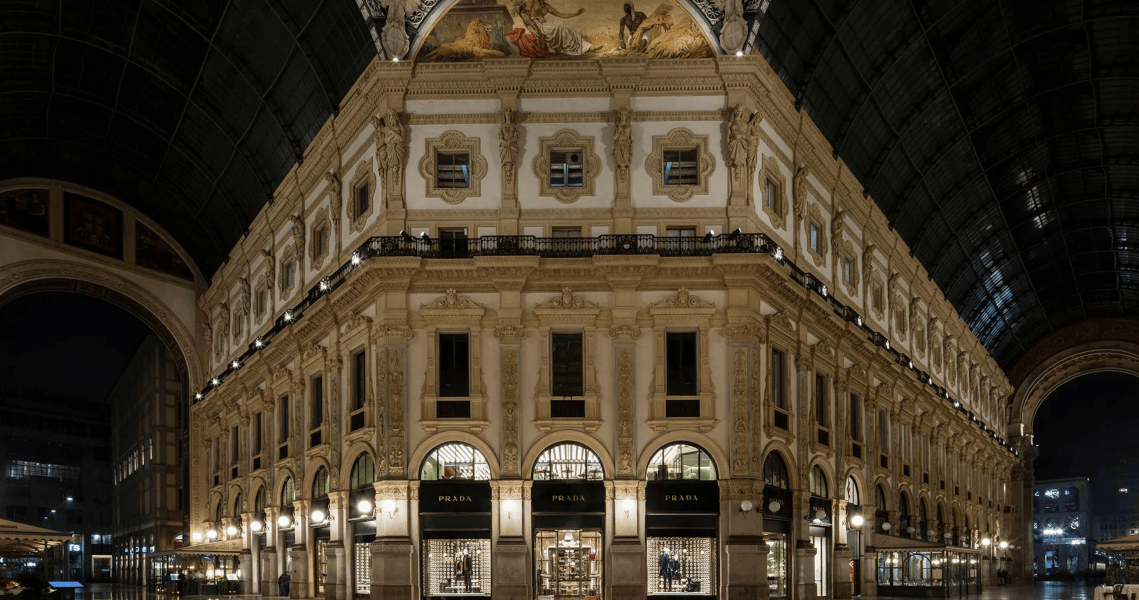
In Italy, where Prada has an extensive network, Guerra said it would close stores in two or three secondary cities in 2027–2028. Guerra pointed to Prada Galleria in Milan as an example of where the group is putting its money. Speaking on the earnings call, Guerra described its new Milan Galleria destination as “a fantastic brand place, but also a great revenue place”.
Unveiled in September, the expanded complex builds around Prada’s original 1913 store, bringing shopping, exhibitions and private entertaining across eight floors. The women’s boutique has nearly doubled its display space, adding more room for travel, home and beauty alongside clothing and bags. A new underground passage connects it to the men’s store across the arcade.
The bigger change is what customers can do beyond shopping at Prada. Above the existing Marchesi pastry shop, the building houses the brand’s first permanent exhibition, “Pradasphere,” tracing its history. Further upstairs, appointment-only salons offer private shopping, while an invitation-only apartment pairs antique Italian furniture with photographs by Andreas Gursky and hosts dinners and special events. That gives Prada somewhere to entertain its biggest clients, as well as more reasons for other visitors to come through the door. Combining fashion, food and the exhibition, the project could provide a model for the wider group. Guerra hinted at similar future initiatives for Miu Miu and Versace.
Kering is further along with its cuts. The group ended September with 1,614 directly operated stores, a net reduction of 105 since the beginning of the year, including 25 at Gucci.
“Having fewer stores, we also can concentrate our CapEx on refurbishment,” CFO Armelle Poulou said on October 22. Kering had initially targeted 100 net closures this year. Poulou said the increase reflected faster negotiations with landlords, rather than a decision to expand the closure program. “The plan is executed quicker, but the list is staying the same,” she said.
Some of the stores that remain are overdue for an update. Poulou said Gucci and Saint Laurent still had locations in China reflecting previous creative directions. Gucci will unveil its new store concept on Avenue Montaigne in November, followed next year by major refurbishments and smaller restyling projects to bring more star status to the location.
Gucci’s own stores remain under pressure: Comparable retail sales fell 9% in the quarter. Meanwhile, sales to wholesale partners, such as department stores and independent boutiques, rose 45%. In a post-earnings note, Bernstein analyst Luca Solca questioned whether Gucci was pushing more stock through those retailers to support sales. Kering said the increase reflected when orders were delivered and a weak comparison with the same quarter last year.
For brands investing in their stores, the question is whether the upgrades will persuade customers to spend. Hermès’s new London flagship offers an encouraging early result: Sales are exceeding expectations without taking business from its other London locations, according to du Halgouët.
Opened in June, its Maison at 166 New Bond Street combines six historic buildings, nearly 21,500 square feet and 55 rooms across five floors. Red leather-goods rooms lead to powder-pink shoe rooms, an atrium staircase features a calfskin-wrapped handrail, and more than 500 artworks sit throughout the building.
Watches and jewelry occupy six rooms, while homeware spans five. Leather artisans work on the third floor. Dior’s historic 30 Montaigne flagship in Paris features a restaurant and fashion gallery alongside its boutique; Hermès’s London store places art and craftsmanship throughout its shopping spaces.
“We want to better show off our offering of jewelry and fine jewelry,” du Halgouët said on the Hermès earnings call, explaining the purpose of store extensions. On Bond Street, he said, “We are not encroaching on the other stores in London and doing better than expected.”
Last weekend’s unrest showed how difficult it is to protect those environments. Private security officers guarded Dior’s Avenue Montaigne flagship, while attackers failed to enter Louis Vuitton’s Place Vendôme store, where an employee credited specialist windows, according to Financial Times reporting.
But the risk for brands predates the latest protests. Chanel’s art-filled East 57th Street flagship in New York was burgled in July 2024, with prosecutors alleging approximately $1.7 million in merchandise was stolen. That was an organized burglary, distinct from the recent looting in France.
And while there’s no evidence that more elaborate stores are more likely to be targeted, if a store closes and customers and tourists stay away, brands lose sales and a place to host, too. Prada and Kering are counting on fewer locations to do more business, making disruption at the stores they keep harder to absorb.
Earnings Recap
- Stone Island grew while cutting discounts. Third-quarter sales rose 5% at constant currencies, outperforming Moncler’s 1% decline. More interestingly, Stone Island’s full-price sales grew in the low double digits as it reduced markdowns. Overall direct-to-consumer growth of 2% masked that stronger performance.
- Hermès’s leather goods kept pulling ahead. Leather goods and saddlery sales rose 10.8%, while ready-to-wear and accessories fell 2%, and watches declined 6%. Group growth of 4.3% missed analysts’ expectations of 5.2%, showing how uneven demand remains even within one of luxury’s strongest houses.
- Prada held up better than Miu Miu. Prada’s retail sales rose 1% at constant currencies, while Miu Miu’s fell 3%, weighed down by the Middle East. Without that region, Miu Miu was broadly flat. Elsewhere in the group, royalties jumped 24%, supported by eyewear and beauty.
- Kering’s jewelry business offered a brighter spot. Comparable retail sales in jewelry rose 18%, ahead of analysts’ expectations, while Gucci’s fell 9%. Kering Eyewear also grew 4%, underscoring the gap between the group’s stronger specialist businesses and its largest fashion brand.
- Moncler is preparing for later winters. With brand sales down 1%, management said it will slow some in-season production and put more spring/summer merchandise into more stores next year. The aim is to serve shoppers buying lighter clothes into September and October, as warm weather delays winter purchases.
Luxury’s buzz rests on a few famous faces
Jennifer Lopez and boy band ATEEZ member San generated 74% of Dolce & Gabbana’s September creator impact, according to Traackr data shared exclusively with Glossy. Its Brand Vitality Score measures creator volume, posting frequency, potential audience and content performance. D&G ranked second in the U.S. luxury benchmark, ahead of Chanel in fourth. But Chanel attracted over 5,000 creators, versus D&G’s roughly 1,500, and its top contributor, A$AP Rocky, generated just 5% of its score. Similar rankings, very different reliance on star power.
Executive moves
- Emily George will become Marc Jacobs’s global president on November 1 as CEO Eric Marechalle exits after nine years. The former Marc Jacobs executive takes over following G-III and WHP Global’s acquisition, with plans to revive Marc by Marc Jacobs and explore licensing opportunities. Jacobs remains creative director.
- Calvin Klein has appointed former Lacoste product executive Ayub Mohamed as chief product officer, effective January 25, overseeing global design and merchandising. The appointment follows news of Veronica Leoni’s departure from Calvin Klein Collection. A separate search for its next creative leader is underway.
News to know
- Arav, the owner of John Richmond and Silvian Heach, is considering a bid for LuisaViaRoma ahead of its November 12 court-supervised auction. It would challenge an existing €18.83 million offer from Italian investor group ATO, whose operating company has kept the luxury e-tailer running since July. Bids are due November 8.
- The Lede Company has acquired London communications agency Aisle 8, whose clients include Merit, Ferrari and Jo Loves. Founder Lauren Winslade joins as president of brand in London, bringing her 21-person team. Aisle 8 will be fully absorbed into Lede, expanding its U.K. presence following acquisitions in Paris.
- The British Fashion Council unveiled its 2026 New Wave: Creatives list on October 21, adding beauty commentators and show producers to its annual selection of 50 emerging talents. Honorees include Mei Pang, Biz Sherbert and photographer Salomé Gomis-Trezise. They will be celebrated at The Fashion Awards on November 30 at London’s Royal Albert Hall.
Listen in
On this week’s Glossy Podcast, senior fashion reporter Danny Parisi, international reporter Zofia Zwieglinska and editor-in-chief Jill Manoff unpack LVMH’s latest sales decline, questioning whether its brands are doing enough on design and pricing to win shoppers back. Listen here.
Read on Glossy
Veja is sticking with Brazilian production despite higher U.S. tariffs. John Hardy is getting into celebrity collaborations with Billie Eilish and Finneas. And fragrance brands are testing whether shoppers will spend $775 without smelling first.