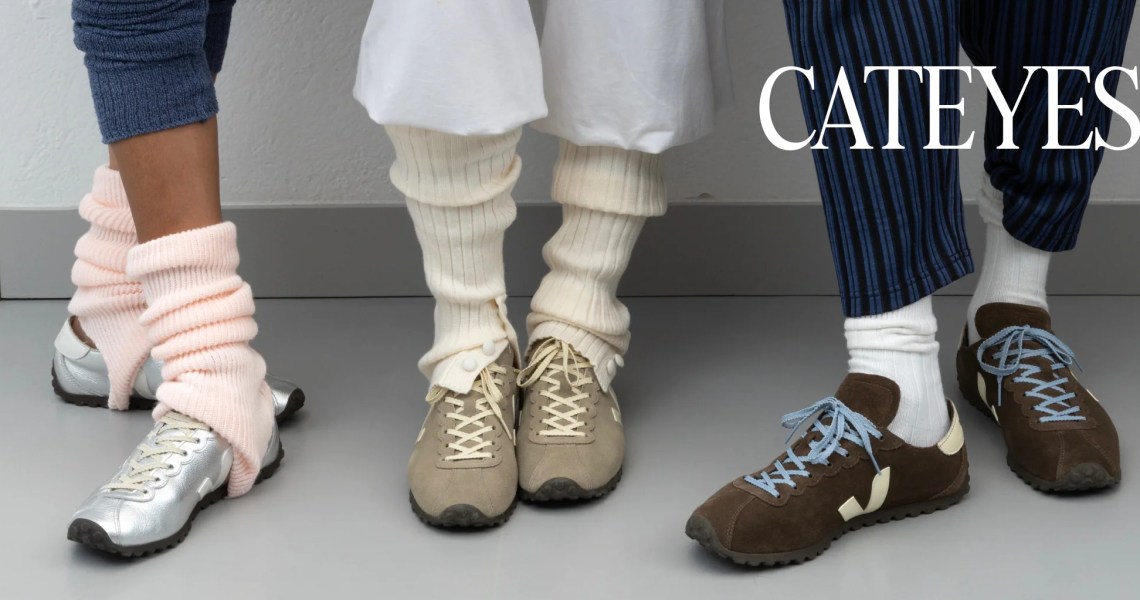
Veja has spent two decades building a footwear supply chain in Brazil that it says it cannot simply relocate. Brazilian footwear now faces an additional 25% U.S. import tariff on top of standard footwear duties, which vary by the shoe’s materials and construction. Veja is maintaining its supplier relationships while investing in the parts of its business it can control, including distribution, stores and new products.
The French sneaker brand is now bringing its U.K. wholesale operation in-house by opening local showrooms, plus expanding its owned retail and repair networks and moving further into performance footwear. Together, the changes show how Veja intends to keep growing without loosening the supplier relationships that underpin its sustainability credentials.
“We are touched by the U.S. tariff mess,” co-founder François-Ghislain Morillion told Glossy. “We are so deeply engaged with all our partners, whether they are factories, farmers or families, that we cannot change [our] supply chains.”
Since July 22, Brazilian footwear entering the U.S. has been subject to an additional 25% duty under a new Section 301 action, and the tariff is still in place. Footwear companies warned during the U.S. government consultation that they could not easily replace production in Brazil with the same quality and scale, and that the duties could raise costs for American retailers.
Veja has three U.S. stores, in Nolita and Williamsburg in New York, plus in Venice in Los Angeles, alongside its American wholesale business. No price increases are planned.
“We have always prioritized price transparency in all our products,” he said. “If a country decides to put a very high tariff, we try to reduce the impact as much as possible, but we will be transparent and explain it to customers.”
Keeping manufacturing in Brazil is part of Veja’s commitment to fair supply chains. Two of its Brazilian factories, Wirth and Ramarim, are now Fair Trade USA certified and together account for more than 75% of Veja’s production. Before the second factory received certification in 2025, the proportion was approximately 22%.
The certification applies to the factories, and Veja holds a Fair Trade USA license. Under its agreements with Wirth and Ramarim, Veja reports the value of the shoes it buys from each factory every quarter and contributes an additional 1% of that value to funds managed by factory workers. Workers determine how the money is spent on projects related to working conditions, health, education and community infrastructure.
If Veja is unwilling to respond to tariffs by moving production, it needs closer retailer relationships, stronger local knowledge and more ways to explain the value behind its prices.
In Britain, that means replacing an external wholesale agent with a locally based team and opening a permanent Shoreditch showroom. The space, which opened in May, is intended for buyer appointments, screenings and events rather than consumer shopping.
“We used to go through an agent, and then we took the business over,” Morillion said. “The idea is to grow the team and to be more present in the U.K.”
Veja is also recruiting a wholesale sales representative to manage accounts including stores like End, LN-CC, Kith London and Goodhood, while identifying new independent retailers across Britain and Ireland.
The move follows a strategy previously used by Birkenstock, which took control of its own British distribution to respond more directly to customer feedback. Birkenstock has since built a six-store U.K. network, although wholesale still accounted for 88% of its British sales in 2024. Other footwear companies, including Xero Shoes and Cat Footwear, have taken the opposite route by appointing external U.K. distributors.
Veja’s U.K. sales fell 12.6% to $25.4 million in 2024, but operating profit rose 20.6% to $2.3 million. Its local workforce also grew from three to 11 employees. The company does not disclose separate results for its stores, wholesale business and e-commerce operations.
Morillion said Veja’s previous wholesale model provided distribution without enough contact with customers. “It was basically distributing our shoes in many stores,” he said. “Things started to change when we opened our own store in London and started to interact directly with people.” That feedback has supported its expansion into sandals and performance footwear. “If you go to the stores in July, customers don’t want to buy sneakers. They want to buy sandals,” he said.
Veja also takes retailers, runners, creators and press into its Brazilian supply chain twice a year for a gritty, real press trip — a far cry from the glitzy retreats offered by fashion brands. Attendees visit producers’ homes, watch rubber being tapped and tour its factories. For the September launch of the Harpie trail shoe, guests visited its Campo Bom factory before testing it across the mud, rivers, rocks and steep climbs of the Paraty UTMB trail race.
Performance footwear now represents approximately 15% of Veja’s collection and an estimated similar share of revenue, according to Morillion. Lifestyle sneakers make up the majority of Veja’s business, Morillion said. Developing technical footwear within the brand’s sourcing requirements can make the process longer. “We want to be as good as the other brands, but respecting our principles,” he said. “We don’t want to use the same materials as everyone in the market.”
Owned stores are also giving Veja more control after purchase. For example, the cobbler inside its Covent Garden flagship repaired 1,026 pairs of shoes from Veja and other brands in 2025. The company now operates nine cobbler locations globally, including in Brooklyn and Los Angeles.
The strategy is a bet that closer local operations, new footwear categories and a clearer account of sourcing can offset some of the disadvantages created by a concentrated supply chain.
“Our strategy for the next few years is to grow with strong roots,” Morillion said. “It’s important that we don’t just chase numbers, but create real encounters and relationships.”