For the Wellness Briefing, Glossy sat down with Drew Taylor, Ph.D, CEO and co-founder of Acorn Biolabs, a Canadian regenerative medicine company that turns one’s own hair follicles into stem cells for longevity- and aesthetic-focused therapies. The company is tapping U.S. doctors to scale its You secretome offering in the U.S. Additionally, functional fragrance has a new wellness player, the chief merchandising officer at CVS steps down, and Merrithew invests in emerging fitness modality gyrokinesis.
The floodgates are open for stem cell innovation
Move over, peptides! Stem cell therapy has new momentum in the wellness space thanks to Acorn Biolabs, a Canadian stem cell bank-turned-regenerative medicine company currently scaling an innovative stem cell treatment in the U.S. called You.
While certainly not new, stem cell therapies have received renewed interest, and expanded business opportunities, in the past few years.
For example, in 2023, Los Angeles-based aesthetician Angela Caglia made a splash in the skin-care market when she released Cell Forte, a one-ounce serum priced at $395 that claims to brighten, firm and smooth the appearance of skin using human-derived stem cells donated by plastic surgery patients. Consumers went wild for the serum, and sales grew by 450%, propelling the indie line into retailers across the country.
Topical serums aside, the majority of invasive stem cell therapies are not FDA-approved in the U.S., which has driven a wave of medical tourism to places like Mexico, Colombia, Panama and South Korea for consumers looking for more invasive options to treat joint pain, muscle issues, autoimmune disorders and more.
Kim Kardashian promoted her “stem cell journey” on Instagram last year, which included traveling to Mexico for treatment, while actor Adam Devine shared in an interview that he traveled to Colombia for his treatment. Then there are wellness and longevity KOLs, such as Dr. Mark Hyman, who also heralded the benefits on his blog.
Meanwhile, U.S. health czar Robert F. Kennedy, Jr. teased deregulation of stem cell therapies on X in late 2024, saying he was “ending the FDA’s war on stem cells,” effectively announcing a “hands-off” regulatory precedent for innovation in the space.
Now, first-movers in the space are in a race to bring innovation to the U.S. market. This includes Acorn Biolabs, which soft-launched its You secretome treatment in late 2024 and has spent the first half of 2026 scaling.
Acorn was founded by Dr. Drew Taylor after he realized the opportunity to harvest one’s stem cells from hair follicles, a gentler alternative to sourcing from bone marrow or fat, during his PhD research at the University of Toronto.
He launched Acorn in 2017 as a hair-follicle bank that collects and deep freezes follicles for future use. This is similar to banking a newborn’s cord blood; freezing stem cells, or the blood, fat or hair follicles collected to make them, is a health insurance policy of sorts. It’s a bet that, by the time you need your own stem cells, such as for disease or injury treatment, you’ll be able to withdraw them.
“There are definitely some people who are thinking about this as a prospective purchase, and for them, it was less important to have an immediate use case,” Dr. Taylor told Glossy. “In their minds, it was really about engaging with the biologic health insurance policy, of knowing that they would then have the best version of themselves to use [down the line, if needed].”
Acorn charges around $16 per month to store 50 follicles, which are extracted by a partnering doctor and tested for viability before being cryogenically frozen. The price of extraction, plus five years of banking, starts at $1,650.
“Of course, that’s a really special person who is thinking about the future,” Dr. Taylor told Glossy. “A lot of the growth that we’ve seen over the years is really driven by patients that are saying, ‘I want to use my cells right now.’”
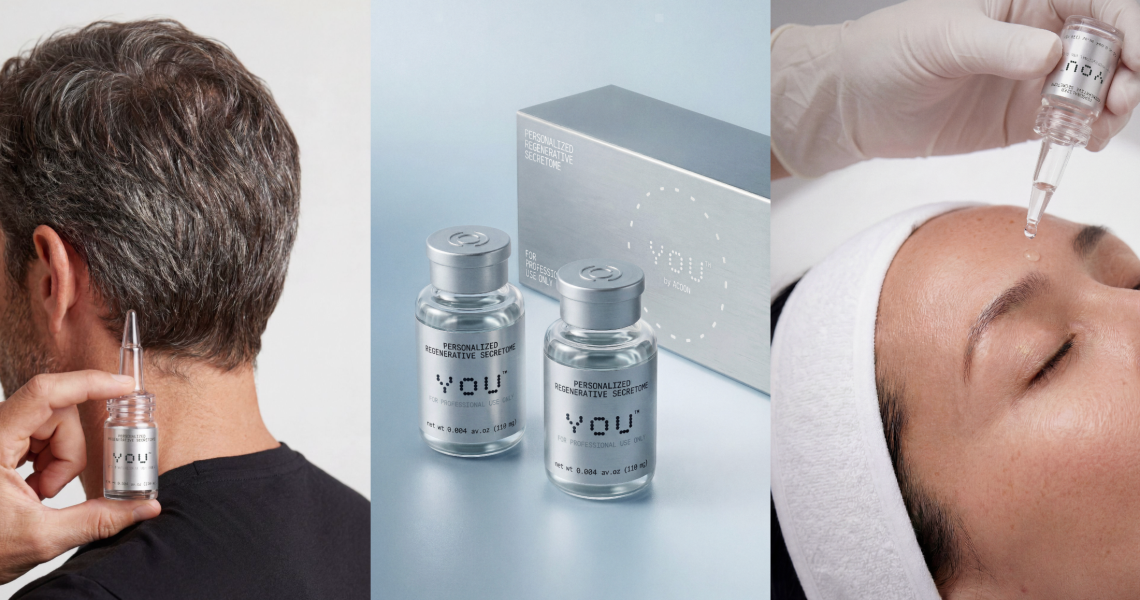
Now, the company is hoping to appeal to consumers who are looking for immediate gratification through a new offering called You. The process starts with the follicle collection. Acorn then processes the follicles into a powder stem cell material that is shipped back to the collecting doctor for in-office application.
To reach consumers, Acorn is partnering with leaders like Los Angeles dermatologist Dr. Nancy Samolitis and Beverly Hills-based dermatologist and hair transplant surgeon Dr. Craig Ziering.
Dr. Samolitis, founder of the skin-care clinic and brand Facile, calls the collection process “unpleasant.”
“You have around 100 hairs that shed each day, so it’s a normal amount of [hair loss],” Dr. Samolitis said. “And as far as, ‘Does it hurt?’ It’s kind of like having your eyebrows tweezed, but waxing is worse.”
Her practice charges $2,500 for the extraction and processing, which takes several weeks, then $550 for each in-office application. Medical practices can set their own pricing, and Acorn takes an undisclosed cut.
Dr. Samolitis recommends that patients pair the application with laser therapy or microneedling, which help to prime the skin to take the stem cells, to achieve desired results, which include firmer skin, less inflammation, more even skin tone and better hair growth when applied to the scalp.
Meanwhile, Dr. Ziering uses the treatment in his practice to boost hair growth after surgery, among other things, by applying the stem cell mixture to the skin and scalp during and after treatment or surgery.
“I’ve been very intrigued by any kind of stem cell technology and growth factors for hair growth, and I knew that exosomes themselves were effective for hair growth from previous use, … [but] patients didn’t like that it was an exogenous [donor] source,” Dr. Ziering told Glossy. “The whole idea of being able to be your own donor and recipient is right in parallel with hair transplants, where you’re the donor and the recipient.”
Both doctors have seen growing interest from patients, although it’s still early days.
However, this is just v1 for Acorn, which is already working on the next iteration of You. The company is currently running trials to bring an injectable version to the U.S. market and is heavily researching the impact on eye health, fertility and more.
“My hope is that one of those patients who came in and banked their cells at their dermatologist’s office, and maybe used them to rejuvenate their skin, will need them again 10 years down the road [to save their life],” Dr. Taylor said. “[My dream is they give me a call in 10 years and say], ‘I just used them to treat my fill-in-the-blank, like Parkinson’s, right? That is the dream of what we’re trying to create: a platform where patients can add to that value today, and into the future, for multiple things.”
Executive moves:
- Musab Balbale has stepped down from his role as chief merchandising officer at CVS. “I’m incredibly proud of what our team has accomplished together,” Balbale wrote on Linkedin. “From sharpening our merchandising fundamentals to deploying new AI tools that improve how we work, we drove meaningful customer growth in an intensely competitive retail landscape.” Zachary Dennett, VP of merchandising, will step into an interim role of chief merchant until Balbale’s replacement has been announced.
News to know:
- It’s been a big week for functional fragrance. A new sleep company called Kimba has secured $6.5 million in funding led by Selva Ventures to bring its AI-powered sleep device to market. Its forthcoming machine responds to the user’s real-time biometric data to release plant-based fragrances into the air to help aid in rest. Meanwhile, home fragrance company Pura has partnered with the Calm mental health-focused meditation app to release “a first-of-its-kind fragrance launch that integrates scent and sound to create immersive, multi-sensory wellness experiences at home,” according to the companies.
- Move over, pilates. Is gyrokinesis the next exercise star? Merrithew International Inc., equipment manufacturer and parent company to Stott Pilates, Total Barre, Halo Training and others, is betting on it. The company has acquired the gyrokinesis method and its gyrotonic machine from the Gyrotonic Organization. With some overlap in pilates, gyrokinesis utilizes a large machine with pulls and straps and is inspired by yoga, dance, tai chi and swimming. There are around 3,000 gyrotonic studios worldwide today. “We are honored to support the continued growth of the Gyrotonic and Gyrokinesis methods, while preserving the philosophy, education standards, and community that have defined the organization since its founding,” said Jim Heidenreich, CEO of Merrithew, in a statement.
- Third spaces are trending. The Portal, a members-only wellness club concept launched in the affluent California town of Marin in 2024, is expanding. The company plans to open its flagship location in Austin, Texas this fall. The new location will be 15,000 square feet and will offer co-working spaces, a restaurant and bar, and fitness offerings, plus wellness modalities like cold plunge and sauna.
- Elysium Health, maker of NAD+ supplements, has launched a new offering with creatine, the latest supplement darling believed to increase the benefits and results of strength training. The new drink mix, called Creatine+, will sell DTC for $70 for a one-month supply. Elysium joins AG1 and Lemme, both of which launched a creatine formula this year.
Stat of the week:
Strength training is fundamental for GLP-1 success, according to a new study commissioned by leading fitness trade orgs, including the U.S.-based Health & Fitness Association. While the results are not surprising, they do strengthen the argument that GLP-1 users need consistent fitness support. The study, which was commissioned by HFA with AUSactive, Exercise New Zealand and Fitness Industry Council of Canada, found exercise improved numerous long-term health outcomes, reduced subsequent costs and improved positive economic returns.
In the headlines:
Neko wants to be the ‘affordable luxury’ of longevity [Vogue Business]. Amazon sellers are feeling better about Prime Day, but they’re still watching margins [Modern Retail]. Glutathione is vital for health. Is it worth buying as a supplement? [NYT]. Testosterone is being overprescribed to men — here’s who should take it, and when it backfires [Business Insider]. Forget longevity. The next frontier of wellness is learning to rewire your mind. [Robb Report]. Gen Z’s new drug of choice? Caffeine [Dazed]. Ex-Planet Fitness CEO backs Absolute Recomp, a premium strength gym with a ‘holy f—’ factor [ATN]. SoulCycle returns to the Hamptons for third annual Wellness Weekend [WWD].
Listen in:
How are beauty and wellness business leaders actually using AI today? That was the question posed to three longtime industry executives onstage during Glossy’s annual E-Commerce Summit in Miami Beach earlier this month. In this week’s episode of The Glossy Beauty Podcast, host Lexy Lebsack is joined by David Baker, chief revenue officer of Beekman 1802; Jenna Manula Linares, vp of digital marketing and TikTok Shop at Tarte Cosmetics; and Josh Friedman, SVP of digital and e-commerce at Ulta Beauty, to learn how these leaders are implementing AI into big-picture strategy and daily workflows.
Need a Glossy recap?
Wearables that track sun exposure are here and ready to disrupt the sun-care market. The men’s grooming opportunity at the World Cup. Aritzia is achieving double-digit e-commerce growth in new markets, amid sped-up US store expansion. Luxury Briefing: Mytheresa is using AI to find future VIPs. Beauty Briefing: AI-developed fragrance molecules to be put up for auction at the World Perfumery Congress. ‘We believe in America’: Nike global vp of soccer Camilo Andrade on the brand’s all-out World Cup strategy. ‘TikTok is a mafia’: Winning on TikTok Shop means playing the game. Where to invest, sell and set boundaries: The 6 truths guiding brands’ next steps. Saie bets on education with ‘The Makeup Class’ to create brand ‘superfans’. Perfume brand Heretic is leaning into the ‘B-side’ of pop culture, one unexpected collab at a time.