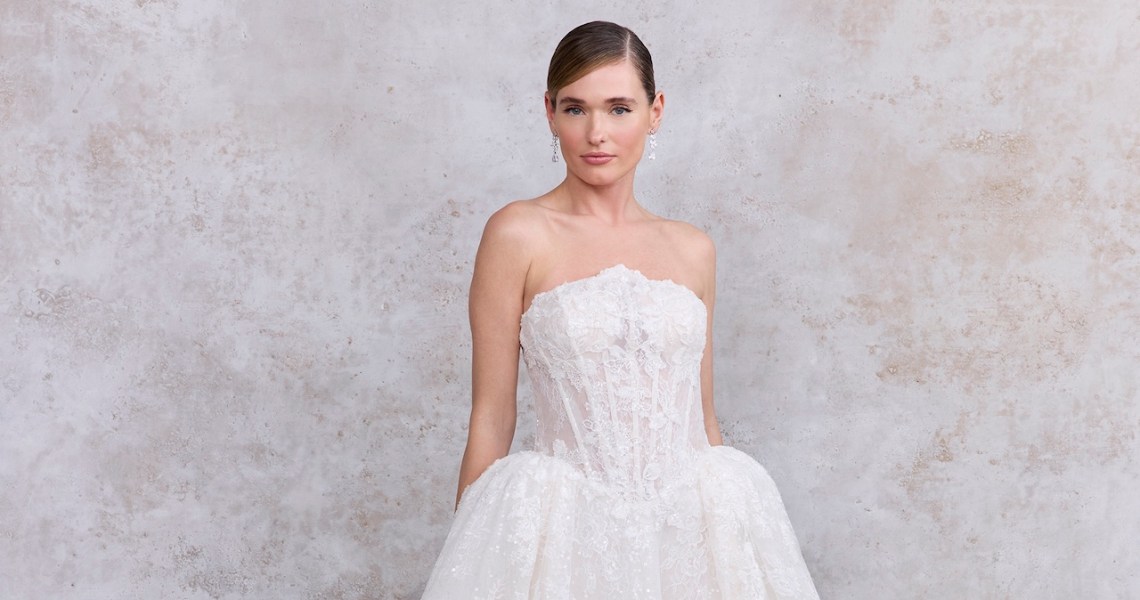
On Monday, David’s Bridal announced the launch of a wholesale business focused on selling exclusive capsule collections by a handful of designers to boutiques. According to the company, the offering gives partners margins of at least 70% and fast fulfillment, plus the products, meant to retail for $1,000-$6,000, offer inclusive sizing.
Ahead of the news, Glossy met with David’s Bridal CEO Kelly Cook at eTail West to learn more about the company’s growth and evolution plans, which also include opening shop-in-shops in department stores. Highlights from the interview, below, have been lightly edited for clarity.
The company has been evolving pretty significantly. Tell me your current direction and what inspired it.
“We’re a 75-year-old legacy retailer that has been focused on big-box, expensive stores. We filed [for bankruptcy] in 2018 and again in 2023, so we [had to] change or die, basically. And so we started looking at all the data we had available and what our customers were telling us and what they needed — and we found a gap in the market and built a new strategy called ‘Aisle to Algorithm,’ which is about being the largest AI network and retail media planning marketplace serving weddings. So now, we’re not just retail, but we’re also wholesale, and we’re planning, and we’re agentic AI — and it’s working. To be honest, we’re busting at the seams a little bit; we’re having a hard time keeping up.”
How would you describe the overall business opportunity?
“We’re the largest bridal brand — we have a third of the share. But, for 75 years, we were selling her the dress, and that was it. The [wedding] dress [market] is valued at $4 billion, but the average wedding is $40,000, and the [overall wedding market] is $75 billion. So the agentic AI-planning system we built is not just focused on selling the dress, but we’ll also help her find a venue, get a dress for the bachelorette party and book her travel. Our system takes her through each step, but then we monetize that by taking a little haircut of each.”
What role will your physical stores play in the future of the company?
“We’re actually going to grow the store base, but not in a traditional sense. Opening up your own store takes a lot of money. So, we tested a store-in-store with Liverpool [department store] this year in Mexico. It’s very asset-light, very small — 1,500 square feet. Our normal stores are, like, 10,000 square feet, and they’re very expensive to deal with. And the Liverpool store broke even in a month, which is very, very good. So, we’re going to take that same model, and we’re going to implement it with various partners in the United States. We may have 500 shops and stores by the end of 2030, but we’re not going to be opening them all ourselves. Our partners like it because we’re bringing the 21-year-olds to them. Most department store customers are 38-40 years old. What we’re finding is, when we bring the bride into a department store like that, they’re cross-shopping in seven categories outside of bridal. Our Liverpool partners love it. So, we’re working with several retailers right now to move that strategy forward. We want to own bridal, but it doesn’t have to be through our stores. It can be with anybody.”
How will your product assortment evolve, as a result?
“Through our [joint venture], we own sourcing, manufacturing and design, through 46 factories all over the world. Because we sell 2 million products a year, we have very, very good margins. Now, we’re taking those products and margins and giving them to the boutiques that would normally be our competition. We’re going into them and saying, ‘We’ll sell you the services of our factories — whatever dress you want. And we’re going to save you 20% off the margin, right off the bat. We created this whole revenue stream, so now, we don’t really have competitors. We want to sell a bridal gown, even if it’s from a boutique across the street — if we gave that to them through wholesale, we win. So, the whole definition of our competitive landscape has changed. We don’t really have competition anymore.”
Are these private-label dresses?
“No, just wholesale — but the wholesale catalog is unique. It’s nothing that’s inside David’s Bridal’s mainline stores or on our website. Plus, we just got the Vera Wang license — so [our partners] can have exclusive Vera Wang. And we just got the Marchesa license, so they can sell exclusive Marchesa. And we have four more [licenses] we’re working on. That’s why the model is so exciting: We were this store retailer for all these years, and now there are just so many different monetization streams, and we just want to be great partners to people and pass along our margin opportunity to them. And the boutiques are like, ‘Yes, please. I want more.’”
Is there any indication that the wholesale dresses are produced by David’s Bridal — on a tag, maybe?
“No. So, when I got to David’s, I took the David’s Bridal tag [out]. We don’t want the tag in our dresses, because we want to be a house of brands. A boutique is not going to want to sell a David’s Bridal dress, but they’ll sell a Vera Wang or Melissa Sweet or Galina or Oleg Cassini dress. So, we create their own designs, and we give them a great price. They’re all happy because we have so many factories — and our tariff impact was 4%, while everyone else’s was 20%; we were able to move things around. So, it’s a great model — and it’s nice to be at the helm, seeing it all come together, and seeing the hard work of the dream-makers inside the company pay off.”
You mentioned Mexico. Will most of your growth from here be focused on the states?
“So, we’ve got an expansion plan with Liverpool right now. And we’re also talking to four major department stores about putting shop-in-shops in their stores. But because we have our [joint venture], we can go from lowest market to couture, depending on the store. Because we own Vera Wang, we can put a Vera Wang Bride shop in a Saks Fifth Avenue, for example, and it’s all David’s behind the scenes. We can put a Diamonds & Pearls couture store, which we have two of ourselves, in a Nordstrom. We can put a David’s Bridal mainline in a Kohl’s, and then we can put a no-name edit in Walmart or Target — but it’s all being produced by us. So, it’s a very asset-light approach to growth, and that’s what we needed to do.”
I remember when Saks had a bridal boutique!
“They did. And you know why they stopped? Because they had to hold all that inventory — and it doesn’t have the same turnover as T-shirts and panties, right? And so, we hold all that inventory, and they don’t have to worry about it. We twisted the model a little bit and pivoted it, to make sure it worked for them, as well as for us.”
I know that the recent tariffs have been challenging for the global bridal gown industry. Outside of the smaller margins you’re able to offer, is this creating new opportunities?
“I’ve got three [deal proposals] on my desk right now, and two are from distressed brands — so I want to pick up as many of those as I can. And then, we have one other brand that’s very, very big in the U.K., whose growth strategy is the states. So, we’re working on a deal right now to be their exclusive distributor in the states and do production for them. I’m happy to not only be David’s, but to also have a mechanism to help small business owners. That is a whole new dimension for us.”
Will it continue to be brides and bridal parties that you’re catering to, across channels?
“There was an interesting stat last year. We have an opening price point for bridal that is, like, $500 — though our Marchesas sell for $10,000; we’ve got a huge span. But at the opening price point, 23-27% of those dresses are sold for graduations and debutante balls and colleges’ winter formals, because sometimes it’s mandated that the girls wear white. And we’ll continue to have all that.”
Do you have specific revenue goals for your own channels versus partner channels?
“Look, my job, ultimately, is to provide shareholder value. There’s a certain amount of EBITDA that I’m being tasked to get. How we do it — as long as we’re meeting that objective — I don’t think we care, really. I love the expansion of our offerings to a wide variety of people that can help them achieve their dreams, as well. So, we have goals and budgets, but I mean, if I sold all my stuff on Amazon or at Walmart or through DoorDash, or whatever, and I made my profit goals, I’d be OK with that.”
As you’re trying new things, does resale or rental make sense?
“We tested resale with a partner, and the AURs were higher than what we thought, but the company ended up going out of business. So, I’m thinking we may try rental again — in Vegas, because you may want to rent a dress there. As for resale, we may go there. The resale market for dresses has been hovering at 2-3% for about five years, and it’s not really growing. Vintage is big, and resale and thrifting are big, but they’re kind of static in our category. So, we’re watching it to understand what may make sense for us.”