In this week’s Luxury Briefing, I dig into Prada Group’s earnings as it deals with its Prada Kolhapuri scandal backlash, with comments from analysts on how Prada and Miu Miu are trying to revitalize while retail sales slip. Also, a look at a new Cubitts-led AI audio launch and a newly formed Irish luxury group. For tips or comments, email me at zofia@glossy.co.
Prada’s attempt to move past last year’s Kolhapuri sandal backlash has resulted in an awkward moment.
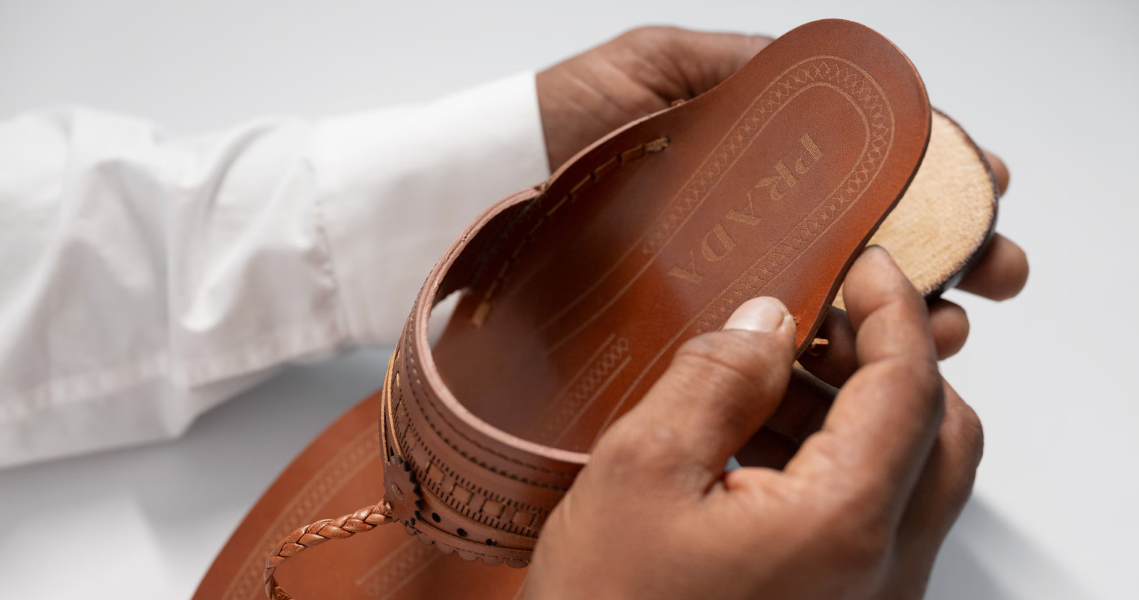
On April 27, Prada launched Kolhapuri-inspired sandals made in India by artisans from Maharashtra and Karnataka, along with a three-year training program for 180 artisans. The move followed backlash from June 2025, when similar sandals appeared on Prada’s spring 2026 runway without crediting their Indian origins.
The new version is meant to show Prada listened, but the price gap remains hard to ignore. Prada’s pair is about €750, or $881, according to Reuters. Traditional Kolhapuri chappals can sell in India for a few hundred rupees to around ₹1,000, or roughly $4-$12, depending on maker and quality. Indian coverage has zeroed in on that contrast, with some reports putting Prada’s local price at around ₹80,000.
The renewed criticism has come largely from South Asian fashion commentators, stylists and consumers who see the launch as only a partial fix. On Instagram, a fashion commentator who goes by Tanya (@tktanya) said Prada had sent “the desi side of the internet into a frenzy” again, while stylist and commentator Sujata Assomull (@sujstyle) called out the wider pattern of Indian craft and jewelry references that remain throughout luxury without consistent credit.
Prada is hardly alone. A 2020 New York Times investigation found that Dior, Saint Laurent and other luxury brands had long used Indian embroidery workshops, often without making that labor visible to customers. That history is why the Kolhapuri debate now goes beyond one sandal, with new inquiries around who gets credit, who gets paid and who benefits when Indian craft becomes a luxury product.
And the timing is not great for Prada. The brand is trying to make its craft story more credible, just as investors are asking whether its growth story is strong enough.
On April 30, Prada Group reported first-quarter revenue of €1.43 billion, or $1.63 billion, up 14% at constant exchange rates and 3% organically. But retail, which made up 87% of revenue, grew just 1% organically, while wholesale rose 17% on renewed Saks Global shipments and stronger duty-free sales.
The brand numbers were more muted. Prada retail sales rose 0.4%, while Miu Miu grew 2.4%, compared to 60% last year. Versace, now part of the group, contributed more than €100 million, or about $114 million, in retail sales and €143 million, or about $163 million, in net revenue in the quarter.
On the call, CEO Andrea Guerra framed the quarter as a difficult comparison rather than a loss of momentum. “Q1 was our toughest quarter, in terms of comparables,” he said, noting that overall Q1 2025 revenue was up 13%. He added that Prada had taken “further steps to reduce our exposure to outlets” and that full-price growth was “above, well above” the reported level.
Luca Solca, senior research analyst at Bernstein, was less forgiving. He said Prada “missed on retail sales” and that “Miu Miu seemed to have decelerated even faster than expected.” He added that management noted the Middle East conflict while acknowledging the company’s weaker like-for-like performance.
On the call, HSBC’s Erwan Rambourg pressed management on Miu Miu’s slowdown, noting that “the deceleration is quite steep” and that it was “the first time in years” the brand had moved into single-digit growth. Guerra pushed back against the idea that the brand’s run had simply burned out, listing Miu Miu’s annual growth over the past five years of 20%, 20%, 58%, 93% and 35%. The brand is now approaching $2 billion in annual sales, he said. Guerra said Miu Miu’s slowdown was concentrated in Italy and France, where lower tourist spending weighed on sales. He framed it as a scale issue, not overexposure: Prada is still building Miu Miu’s local client base in Europe, while outlet and wholesale represent just 12-13% of sales.
Still, Solca said the second half will depend more on Prada itself. Miu Miu is normalizing, Versace remains a turnaround project, and competition is getting sharper. Prada, he said, needs “big white rabbits out of the hat” to bring back brand momentum and investor excitement.
When Solca asked Guerra where those “white rabbits” may come from, Guerra pointed to markets, stores and product. “We have two regions in the world where we still have to conquer our fair share,” Guerra said, naming America and China. He cited Prada’s Fifth Avenue building purchases and future projects in New York, plus the Rong Zhai development in China, which he described as the brand’s “epicenter” there.
Guerra also pointed to the product range. At the high end, Prada has already sold more “precious bags,” likely exotic or specialty-leather styles, in the first four months of 2026 than in all of 2025. At the entry end, he cited a “huge push” around the brand’s Re-Nylon and SEA BEYOND collections, including Re-Nylon styles with “very competitive pricing.” Current Re-Nylon bags start at just over $1,000.
The Lyst Index, released this week, shows Prada’s problem in ranking form. Miu Miu and Prada remain highly visible, at No. 4 and No. 7, but both fell two places as rivals with clearer creative resets gained ground. Chanel debuted at No. 1, Dior entered at No. 3, Gucci climbed to No. 5 after Demna’s debut drove a 12% day-on-day demand lift, and Versace demand rose 17% quarter over quarter.
Chanel is the sharper comparison. It still does not sell fashion directly online, but since Matthieu Blazy came in last year as creative director, it has become more visible through celebrities, influencers and runway-inspired conversations. The brand’s cruise 2026 show in Biarritz this week showed why: The most talked-about item was a barely-there sandal, closer to a heel cap than a shoe, that was mocked as impractical but spread quickly because it read instantly as a “Chanel coded-item” pushed to an extreme.
And so Chanel’s sandal became an instant talking point, while Prada’s became a stress point as other houses are pulling ahead.
Exclusive: Wearable tech is still striving for a better-looking pair of glasses
Altina, a new AI-powered hearing eyewear startup founded by former Amazon Echo Frames product lead Tal Bar-Or, launched its waitlist on Friday. The company will first introduce a product said to help people hear conversations in loud restaurants, offices and travel hubs. Its first frames were built with British eyewear brand Cubitts, which did $22 million in revenue last year, using handcrafted acetate frames.
Bar-Or told Glossy that Altina glasses use “two microphones per side, AI chips built in and then an open ear speaker,” with AI used to separate speech from background noise, rather than simply amplify surrounding sound. He said the company deliberately placed electronics in the temples, not the frame front, to allow for “a huge variety of styles and sizes.” It will experiment with more style-focused brands in the future.
“With a lot of the innovation, you can tell the people designing the products are coming from a world of augmented reality, or a world of wearables. But we’re coming at it from a world of 300 years of spectacles legacy,” Cubitts founder Tom Broughton, noting that glasses are often a status symbol, in addition to offering utility.
The launch comes after other smart glasses offering audio support have come to market. EssilorLuxottica has Nuance Audio, for example. At the same time, Meta’s Ray-Ban partnership has helped normalize glasses as a wearable tech form. But Altina’s bet is narrower: that the next growth area is about making smart frames look normal.
VYKO aims to build up Irish exports of luxury
This week marked the launch of VYKO Group, an Irish luxury holding company targeting a €50 million raise ($57 million) to acquire and scale Ireland-linked brands.
Founder Ashley McDonnell, previously at Puig and LVMH, said the group has submitted letters of intent for its first two acquisitions, with a third expected imminently. All three are in fashion, though the company plans to expand into areas like beauty, spirits, jewelry and fine food. The idea is to use Ireland as an export base, with brands aiming for 90% of their sales to be exports, McDonnell said.
The U.S. is expected to be central to that plan, through retail, pop-ups, hotel shopping and consumers with an emotional connection to Ireland. “It’s targeting the type of consumer that wants to be a part of Team Ireland,” she said.
Earnings: Zegna
- On its April 30 earnings call, Zegna downplayed the impact of the Middle East conflicts on its business. While local revenues have been down double digits since the conflict began, CEO Gianluca Tagliabue said spending by the broader Middle Eastern client cluster, including their spending abroad, has been “substantially flat to last year.” He credited years of relationship-building: “We are not transactional.” That high-touch strategy is driving sales of the company’s made-to-measure offering, Su Misura, which chief of external relations Paola Durante said is “around 10%” of Zegna brand sales and growing. Tagliabue said Su Misura “intrinsically carries” a higher average unit retail, giving Zegna another way to grow.
Executive moves
- J.Jill named former Coach North America marketing vp Kimberly Wallengren as svp and chief marketing officer. The women’s apparel retailer aims to expand beyond its core middle-aged and older customer base after its 2025 net sales fell 2.3% to $596.5 million.
News to know
- Saks Global is cutting about 640 corporate jobs, or 16% of its corporate workforce, as the bankrupt luxury retailer reduces costs, consolidates Saks Fifth Avenue and Neiman Marcus functions, and works toward a planned Chapter 11 exit this summer backed by $500 million in exit financing.
- Walmart is opening a SoHo fashion pop-up through May 10 amid a repositioning, during which it has introduced $45 cashmere pieces, silk styles and leather shoes, while using creators, private brands and store remodels to acquire fashion customers beyond its core value shopper.
- France’s consumer regulator said 75% of more than 600 products it tested from seven foreign e-commerce platforms in 2025 failed E.U. rules. Pressure is building on Shein, Temu and other low-cost marketplaces ahead of incoming Digital Product Passport requirements for textiles and other categories under the E.U.’s Ecodesign framework.
Listen in
Kering’s new CEO, Luca de Meo, has laid out a broad turnaround plan after several years of sales pressure, driven by weakness at Gucci. On the Glossy Podcast, senior fashion reporter Danny Parisi and international reporter Zofia Zwieglinska discuss what went wrong, what de Meo is proposing and whether the plan can work. Listen here.
Read on Glossy
Prediction markets are coming for the fashion industry. Urban Outfitters is co-creating campaigns with Gen Z. Welcome to the golden age of thrifting.