This story is part of our week-long editorial series on how major retailers, fashion conglomerates, beauty brands and CPG startups are leveraging this year’s biggest-ever FIFA World Cup to their advantage.
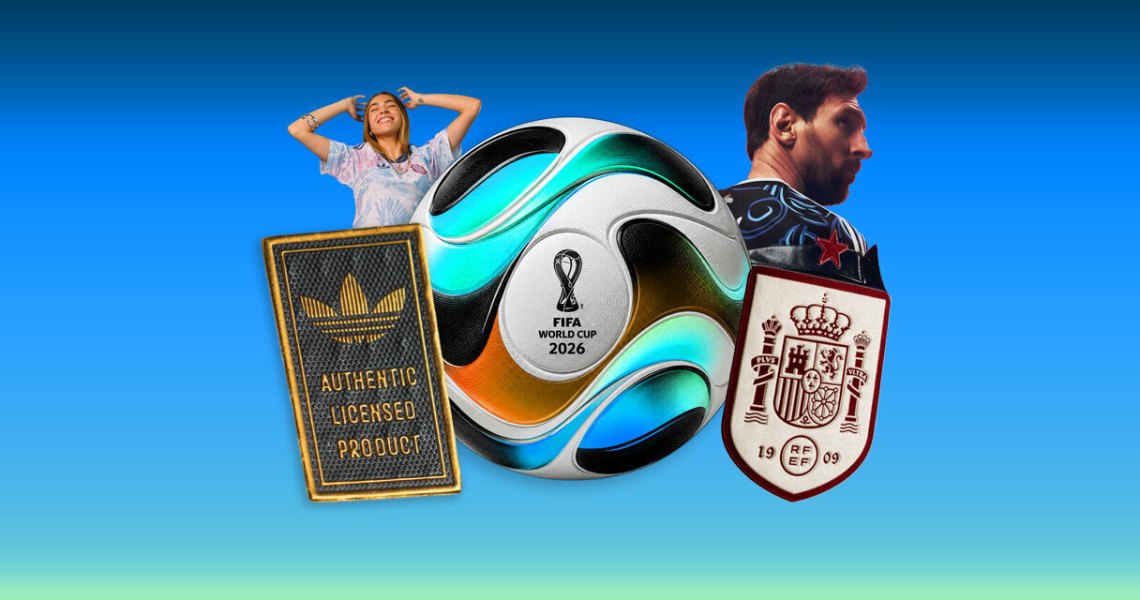
Major sportswear brands are using the World Cup to link new products to football memories. That includes Nike, with its Cryoshot sneaker inspired by the Mercurial R9 boot Ronaldo wore at the 1998 World Cup, as well as Adidas, with its “Backyard Legends” campaign, Trionda official match ball and Predator cleats. As the tournament arrives in North America, that same nostalgia play is showing up across fashion collections, from archive football jerseys to World Cup-inspired capsules built around national colors and fan dressing.
According to a new Bank of America Global Research report, the 2026 World Cup is set to be the biggest to date, with 75% of the world expected to engage with the event in some way. The tournament, running from June 11 to July 19, will include a record 104 games across the United States, Canada and Mexico. For fashion brands, that creates a reason to tap into football’s archive of old kits, national colors, cult boots, memories of tournament summers and fan dressing from decades past.
The resale market has helped make that opportunity more visible. The RealReal stated in its 2025 resale report that searches for vintage jerseys were up nearly 30% year-over-year, while online retailers like U.K.-based Classic Football Shirts, a specialist retailer founded in 2006, now sell original football jerseys, reissues and current-season kits side by side. Football shirts are nostalgia mementos: They carry a team name, but also signal a country, a year, a player, a sponsor, a tournament and a specific summer.
For Lotto, the Italian sportswear brand owned by WHP Global, the World Cup is a chance to turn its archive into a cultural asset. Founded in Italy in 1973, Lotto built its football credibility over decades through its boots, kits and sponsorships tied to clubs and players across European and international football. Its current campaign for the World Cup is built around a “starting 11” cast of athletes, creators and cultural figures, including rapper Flavor Flav and players Sofia Huerta, Stu Holden and Kellen Acosta, as well as Italian Football TV’s Marco Messina.
“We knew we weren’t going to invest at the level of Nike or Adidas in a purely performance-led way,” said Jameel Spencer, chief marketing officer for fashion and sports at WHP Global. “That also wasn’t what felt most charming about Lotto. The brand has always sat between performance and culture.”
Instead, Spencer said Lotto is leaning into culture, nostalgia and memories. “We wanted to have one foot in nostalgia and then one foot in the future,” he said. “That was a place Lotto had the right and the privilege to live because it’s the brand’s reality.” One example is the Lotto Zhero, the late-1980s and early-1990s sneaker remembered for its removable Velcro logo patches. Spencer said unique items like the Zhero still resonate strongly with stylists and editors today, as they link nostalgic football designs to fashion.
The Lotto brand is pairing the campaign with a broader World Cup calendar, including a collaboration with H&M, a luxury project with hat brand Melrose High, football community tie-ins with football clubs Bowery FC and Saturdays Football, and a pop-up at American Dream, the mall located next to MetLife Stadium, where the World Cup final will be played on July 19. The H&M collaboration, which launched on May 21, draws directly from Lotto’s football archives, reworking jerseys, shorts, caps, socks and footwear with graphic stripes and the brand’s double-diamond jacquard.
The same tension between memories and newness is visible at the biggest sportswear brands. In a note about Nike’s World Cup product-reveal-focused event, Needham analyst Tom Nikic wrote that sales tied directly to World Cup products likely will not move the needle for Nike, but the hope is that tournament attention and products worn “both on and off the pitch” will drive momentum beyond the six-week event. Among the products shown was the $200 Cryoshot, a sneaker inspired by the Mercurial cleats Ronaldo wore during the 1998 World Cup.
Adidas is taking a more cinematic route, but still calling on memories and nostalgia. Its “Backyard Legends” campaign brings together actor Timothée Chalamet and artist Bad Bunny with football players Lionel Messi, David Beckham, Zinedine Zidane, Jude Bellingham, Lamine Yamal and Trinity Rodman. Geoff Cook, partner at international creative company Base Design, said the campaign works because it grounds celebrity in the everyday memories of playing football.
“Soccer is not only the world’s most popular sport, but also the most democratic of sports,” Cook said. “As the Adidas film demonstrates, anyone with a ball can start up a game of soccer.”
Adidas is also using “Backyard Legends” to connect its current football roster to its own archive. The Predator boot franchise, first launched in 1994, was worn by players including David Beckham and Zinedine Zidane, and its foldover tongue became one of football’s most recognizable design details. In the campaign, that familiar silhouette helps bridge football memories with current Adidas stars like Jude Bellingham.
Australian denim brand Ksubi is approaching the same nostalgia economy from outside traditional sportswear. The brand is launching a football-inspired capsule built around national colors, ambiguous graphics and the number 99, a reference to the year Ksubi was founded in Sydney. The design team started with Australia and the U.S., where Ksubi has stores, before adding colorways inspired by Mexico, Portugal and Argentina.
The pieces are not exact kit replicas, which is the point. CEO Craig King said the graphics were kept “somewhat ambiguous,” allowing one color combination to speak to more than one country. Rather than reproducing old kits, the collection borrows from the visual memory of tournament summers: the colors people wear to bars, watch parties and street celebrations, even when they are not buying official team merchandise. That puts the brand in the same broader nostalgia economy as Lotto, Nike and Adidas.
“We like to think we don’t really chase trends,” King said. “We take our leads from what we see around us that inspires us.”