In this week’s Luxury Briefing, Hugo Boss’s revenue decline raises questions about the fate of mid-premium brands in a K-shaped economy. Plus, Republic Brands Group acquires Joie, Equipment and Current/Elliott, and investors react to Prada’s Versace deal. Finally, executive moves and news to know. For tips or comments about Versace or other industry news, email me at zofia@glossy.co
For most of the last four years, the Hugo Boss Group behaved like a company in revival mode. It doubled its sales, rebuilt its visual identity and planted its two core brands – Boss and Hugo – back into the cultural conversation with an impressive roster of celebrity partners: David Beckham in 2022, followed by Kendall Jenner, Naomi Campbell and Korean actor Lee Min-ho. By 2024, Boss was also working with Gisele Bündchen, Patrick Mahomes, tennis player Taylor Fritz and rapper Gazo. The brand blanketed social feeds, wrapped Milan Fashion Week runways in light shows and leaned heavily into its “Be Your Own Boss” narrative. On paper, this looked like momentum.
That narrative has begun to fray. In 2024, Hugo Boss Group’s sales grew by 3% to €4.3 billion ($4.7 billion), but profitability slipped, and the company now expects 2025 revenue to be essentially flat, at €4.2–€4.4 billion ($4.6–$4.8 billion). Management reiterated that softer outlook in its March update and again in its third-quarter 2025 results. Then, at its December 3 Strategy Update, the Group reset expectations entirely, designating 2026 as a consolidation year with a planned mid- to high-single-digit sales decline, followed by a return to growth in 2027.
Some of the reasons for the 2026 expectations sit within the wider economy. “Consumer sentiment is down wherever you go,” Hugo Boss Group CEO Daniel Grieder said this week during the December Strategy Update meeting focused on the brand’s progress. Grieder pointed to mall traffic falling “20-30%” in key markets in the U.S. In the meeting, Hugo Boss Group also unveiled “Claim 5 Touchdown,” the next phase of its growth plan launched in 2021 that extends the strategy through 2028. The brand declined to comment on the changes.
Elizabeth Lafontaine, director of research at the location intelligence platform Placer.ai, described the current retail landscape as a K-shaped economy, in which brands in the middle lose out. “Retailers who focus on value are doing very well, and retailers who focus on a higher-income consumer are doing well, which leaves a lot of traditional apparel retailers [like Boss] in the middle fighting for attention,” she said.
But Bryce Quillin, an economist previously with the World Bank Group, questioned the company’s blame on consumer sentiment, telling Glossy, “Accessible luxury brands like Coach and Ralph Lauren have recorded strong growth. Hugo Boss’s issues aren’t just macro, but also brand-specific,” he said.
In late November, while speaking about the falloff of luxury consumers, Federica Levato, senior partner at the global consultancy Bain, said that even greater affordability wouldn’t be enough to win today’s consumers; emotional value must also rise to meet the more discerning shopper.
This is where Boss has struggled. Even with its big-name ambassadors over the last few years, Boss has showcased “poor market differentiation, underpinned by relatively flat brand storytelling across its digital and IRL touchpoints,” Quillin said.
Launchmetrics’s SS26 Fashion Week report lists Boss’s Milan show among the season’s visible events, though it did not appear in the ranking of top runway performers by Media Impact Value.
In 2021, Hugo Boss Group launched Claim 5 to modernize the brand and accelerate growth. It was built on five pillars: brand, product, digital, distribution and operations, each focused on elevating desirability and improving efficiency. In turn, Boss invested €500 million ($545 million) into stores and launched a loyalty program that now boasts 30 million members — a base that it has under-leveraged, brand strategist Ana Andjelic said.
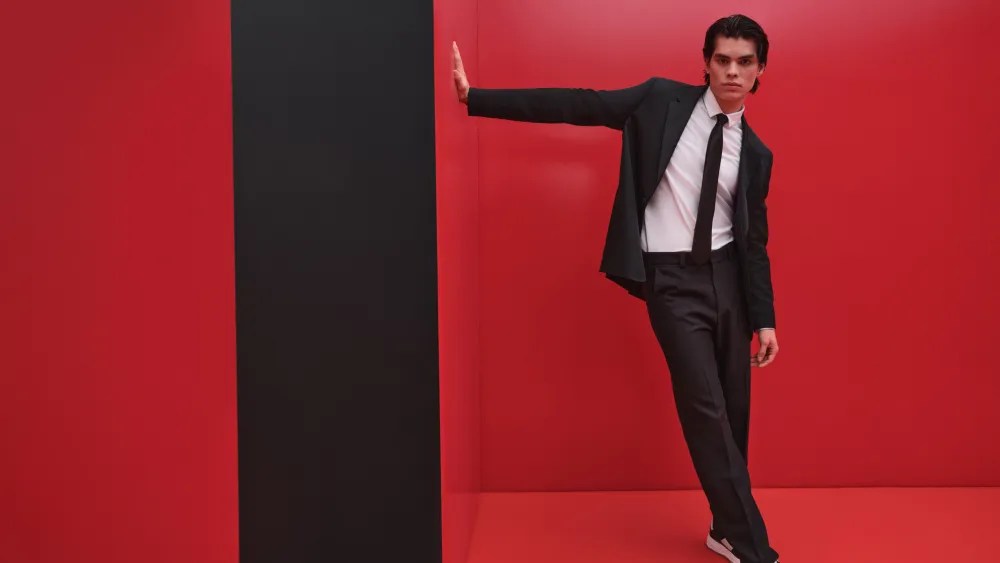
The company’s portfolio is split into Boss — the core premium brand anchored in menswear, with its Boss Camel, Boss Black and Boss Green sub-brands — and Hugo, the younger, more street-influenced label, with Hugo Red and Blue sub-brands. Menswear still accounts for most of the Boss business, with tailoring as the anchor. Boss suits range in price from €350–€500 ($380–$545), while shirts sell for €99–€149 ($105–$160), and casual pieces push modestly higher. The brand’s womenswear sales have tripled under Claim 5, but the category still lacks a clear point of view, according to industry insiders. Boss’s sister brand, Hugo, caters to a younger shopper and has a lower price point, at €120–€250 ($130–$270).
With the expanded plan, Grieder said Boss is focused on being “better before bigger,” and the brand’s chief sales officer, Oliver Timm, said the brand must define its DNA before scaling. Moving forward, to clarify the brands’ positioning, sub-labels will be simplified: Boss Camel (classic tailoring) will fold into Black (polished outerwear and suiting), Hugo Red (more fashion-forward) will shrink as Hugo Blue (denim and casual) expands, and Boss Green (active performance) will be tested as a standalone sport-performance concept in the U.S. and Asia. According to the brand, the intent is clarity in positioning.
Assortments will also be downsized. “Collections have been too big,” Timm said on the call. Boss has already reduced its SKU count by 25% and will cut another 20% by 2028. As Lafontaine put it: “If [consumers] go into a store and they’re not instantly seeing something that gravitates toward them, they’re going to leave.” Boss has become too broad when it needs to be sharp to pull customers in.
In step, over the next three years, the brand will close around 50 stores, according to Grieder, citing declining foot traffic and talking up a focus on successful locations. This leaves the brand with over 1,450 stores globally.
In addition, Boss will continue to invest 7% of revenue for marketing and to leverage region-specific ambassadors.
According to Andjelic, the brand’s new plans are promising: “This is a very clear strategy. They don’t want to be everything to everyone; they’re focusing their marketing dollars on existing customers and strong prospects, and capitalizing on their brand equity,” she said.
She added, “There is never a more important time to be culturally relevant than when the business is under pressure. There’s nothing worse than being both culturally irrelevant and doing poorly in terms of performance.”
Financially, Boss has stabilized margins even as sales fall. Its gross margin sits above 61% and is expected to exceed 62% next year. It has invested heavily in the supply chain across its brands. Hugo Boss, for example, has a €50 million ($54 million) Digital Twin program across the brand, which is a real-time, data-driven model of its supply chain that improves forecasting, speeds up production and reduces excess inventory. It has also made a €100 million ($108 million) automation investment, which includes a new robotic warehouse in Germany, designed to cut fulfillment costs and create a faster, more flexible logistics network.
But, according to Quillin, “[Supply chain] efficiency is not a substitute for growth indefinitely. And long-term strength requires at least modest sales recovery.”
RBG aims to rebuild Joie, Equipment & Current/Elliott for a new retail era
Republic Brands Group’s $36 million purchase of Joie, Equipment and Current/Elliott from the Los Angeles–based The Collected Group brings three once-influential contemporary labels into a portfolio of roughly 10 brands the company has steadily scaled through licensing and global distribution. RBG also owns the Paris Hilton, Jason Wu and Avani Gregg brands.
Each of the newly acquired labels built a cult following between 2008 and 2015 — Equipment for silk shirting, Joie for feminine ready-to-wear and Current/Elliott for premium denim — before losing steam under the weight of an outdated retail model, according to RBG CEO Sami Souid. “A lot of the brands that are going through a rough time didn’t change their business model; they kept a mono-store strategy. And that is a very costly strategy today,” he said.
Souid called wholesale and digital DTC “a lot more profitable. The group is planning to enter the brands into 5–10 U.S. stores alongside a larger Asia rollout. According to Souid, there’s a white space for recognizable, mid- to premium-priced brands with clean economics.
“Staying true to the brands’ DNA while introducing updated design and perspective” will be a focus, Souid said. And category expansions to handbags, footwear and accessories will reframe the labels as lifestyle brands with renewed commercial potential, he said.
The investor take: Prada’s Versace deal
Prada finalized its $1.4 billion acquisition of Versace on December 2, which was followed by an immediate change: Dario Vitale, Versace’s creative director, announced his departure, effective December 12, after just eight months in the role and after presenting just one collection.
Ariel Ohana, managing partner at Ohana Capital, said in an interview with Glossy that the Prada–Versace transaction is a strategically coherent move that strengthens Prada’s long-term positioning. In his view, Prada is one of the few groups culturally equipped to rebuild Versace’s brand equity, even if the financial upside will take time. He also sees the acquisition as accelerating Prada’s evolution into a multi-brand luxury conglomerate, with Versace joining the portfolio alongside Prada and the now fully standalone Miu Miu.
Executive Moves
- Dario Vitale will step down as creative director of Versace effective December 12, barely eight months after his appointment and following only one collection.
- Charlie Smith, Loewe’s former chief marketing and communications officer, is leaving the LVMH brand after seven years to become chief brand officer of the London-based tech company Nothing in January. He will oversee global brand, marketing and communications for the fast-growing smartphone maker, now valued at $1.3 billion.
- Next month, Rocco Basilico will step down as EssilorLuxottica’s chief wearables officer after more than a decade at the company, amid ongoing tensions among heirs within the holding company Delfin. His departure comes as the group advances its AI-powered eyewear partnership with Meta, which is expected to continue uninterrupted.
- Gucci has appointed Gianluca De Ficchy, formerly CEO of Mobilize within Renault Group, as its new CFO, as part of a leadership overhaul under CEO Francesca Bellettini and artistic director Demna.
- Valentino has promoted Laurent Bergamo, its former chief commercial officer, to deputy CEO as new chief executive Riccardo Bellini builds out his leadership team. The appointment comes amid an ongoing brand turnaround.
News to know
- Italian brand Boggi Milano has signed a deal to become the official formalwear outfitter and licensee of the FIFA World Cup 2026 and FIFA Women’s World Cup 2027, dressing all FIFA staff and launching a licensed capsule collection. The partnership debuts December 5 at the World Cup final draw and will run through 2027, supported by global campaigns and in-store activations.
- Mytheresa is opening Maison Mytheresa, a private, invitation-only cultural and styling club in Saint Moritz, marking its first immersive physical space in Europe. From December 5 to April 6, the venue will host trunk shows, family activities and exclusive events as the retailer aims to deepen its engagement with top clients.
- In a Morgan Stanley investor conference, Capri CEO John Idol said the company’s $1.4 billion sale of Versace to Prada gives it new financial flexibility to refocus on Michael Kors and Jimmy Choo, with Kors returning to its jet-set DNA through revamped marketing, pricing and store strategies. He added that Kors is seeing renewed customer engagement through influencers, while Jimmy Choo expects to reach nearly $800 million in sales.
- Jovani Fashion has sued Saks Global and its Neiman Marcus division in the New York Supreme Court to recover nearly $296,000 in unpaid invoices for dress shipments made between January 2025 and August 2025.
Listen in
In this special holiday crossover episode of the Glossy Podcast, Glossy’s Danny Parisi and Lexy Lebsack are joined by Modern Retail’s Gabi Barkho to break down how shoppers, brands and retailers approached Black Friday. They swap their own shopping strategies before diving into the season’s most notable strategies, from deep-discount plays to value-driven offers to smart collaborations. Listen here.
Read on Glossy
Consumers are changing their footwear preferences. Red Wing is criticizing drop culture. Dr Martens is going big on mosh-pit-tested recycled leather.