In this week’s Luxury Briefing, I check in on what it would really take to turn U.K. luxury retailer Harvey Nichols around after the aggressive buyout process from Mike Ashley’s Frasers. Also, Tapestry earnings, executive moves at Exemplar Luxury Group and Centric Brands, and news to know. For tips or comments, email me at zofia@glossy.co.
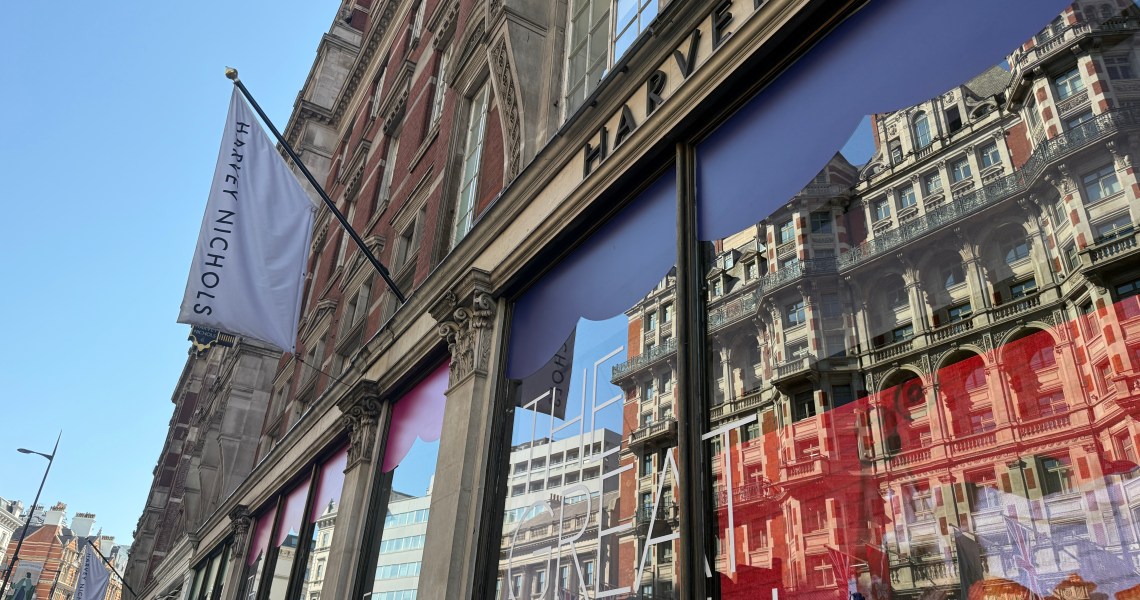
Frasers Group has acquired Harvey Nichols, one of Britain’s best-known luxury department stores, for around $54 million (£40 million), according to the Financial Times. But the purchase price may prove to be the cheap part.
The deal, completed Thursday through a pre-pack administration, where a sale is agreed before a company formally enters administration, includes Harvey Nichols’ six U.K. stores, e-commerce business, inventory, more than 1,000 employees and international franchise agreements. CEO Michael Murray said in a statement that the turnaround would require “tough choices,” even if that means a smaller business in the near term.
Retail consultant Jonathan De Mello, founder and CEO of JDM Retail, estimates that the approximately $81 million (£60 million) of investment previously discussed for Harvey Nichols would only carry the business for around two years.
“Sixty million pounds, I think, will tide them over for a couple of years unless they start to see considerable growth straight away,” De Mello told Glossy. Over five years, he estimates Frasers may instead need to spend much more.
De Mello said the turnaround will require investment across almost every part of Harvey Nichols, citing “wholesale relationships, links with designers, exclusivity arrangements, marketing and, very importantly, online.” “It’s root and branch,” he said. Frasers can quickly find some savings by putting Harvey Nichols onto its logistics and warehousing infrastructure, he added, but “I’d be expecting it to be more like £200 million [$270 million] needed to really, really revitalize the brand and get it back on an even keel.”
To reduce costs, Frasers could streamline the store estate, particularly at weaker regional locations. Murray has already warned that the turnaround could result in a smaller business in the near term.
“Ultimately, they will probably get rid of a couple,” De Mello said. He described Leeds as one of the stronger regional stores, but was more skeptical about Birmingham, Bristol and Edinburgh. Birmingham is located in the Mailbox development, separate from the city’s main shopping district and its heaviest retail foot traffic, making it “one that they should probably look to close,” he said. Some locations could alternatively be converted to other Frasers formats.
But cutting costs will not solve Harvey Nichols’ bigger problem.
“Throwing money at it is not the answer,” retail consultant Richard Hyman, a long-time industry analyst told Glossy. “The company’s biggest issue hasn’t been a lack of money. It has been a lack of sales, a lack of customers.”
Hyman argues that Harvey Nichols has been squeezed from several directions. Harrods and Selfridges, the U.K.’s leading luxury department stores based on turnover, sell many of the same luxury brands and, in his view, “do it better.” Harrods this week reported $1.48 billion (£1.1 billion) in turnover and $114 million (£84.9 million) in pre-tax profit for the year ended February 1, 2026. Selfridges’ latest update showed $1.04 billion (£774.6 million) in revenue and a $21.5 million (£15.9 million) pre-tax loss for the 48 weeks ended January 4, 2025.
“There are miles more competition for Harvey Nichols,” he said. “All of that adds up to an economic model that has to run faster and faster each year to stand still.”
Cozette McCreery, fashion consultant and co-founder of former London Fashion Week label Sibiling, said the retailer makes it challenging for customers to discover something new. She said Harvey Nichols’ refurbished Knightsbridge flagship had been “vastly improved,” but during her most recent visit, “I don’t remember seeing anything specifically contemporary or a brand I hadn’t heard of.”
For McCreery, the opportunity is to restore Harvey Nichols’ former role as a place that introduced shoppers to designers rather than simply selling labels available elsewhere. “If the new owners take that path and offer support and a space for new, then I, for one, would return,” she told Glossy. “Otherwise, frankly, I’ll stick with DSM,” she said, referring to independent fashion retailer Dover Street Market.
Rebuilding Harvey Nichols’ discovery credentials is one challenge. Retaining the established luxury houses that underpin its current assortment is another. Harvey Nichols currently stocks Gucci, Loewe, Saint Laurent, The Row, Moncler, Brunello Cucinelli and Valentino, among others.
Those relationships matter because Harvey Nichols needs both ends of the mix to work: established names that drive spending and credibility, and newer designers that give customers a reason to discover something they cannot easily find elsewhere.
The pre-pack complicates those relationships. Jeremy Goldring, an insolvency expert at Goldring Law, said unpaid suppliers become unsecured creditors when a pre-pack sale is completed. But important suppliers can have considerable negotiating power over what happens next. “If the continued support of any particular supplier is critical to the business, then irrespective of its legal rights, that supplier should be able to dictate the terms on which it will provide that support,” he said.
Glossy reached out to several current Harvey Nichols suppliers, from independent labels to major luxury businesses. Several declined to comment, while others did not respond. They may still be negotiating payments, orders and future commercial terms with the retailer’s new owner.
Frasers’ recent history makes that especially sensitive. The group bought luxury retailer Matches for $70 million (£52 million) in December 2023, and Frasers owner Mike Ashley put it into administration less than three months later. More than 500 unsecured creditors were subsequently owed around $49 million (£36 million), including luxury suppliers.
According to a former senior executive who spoke to Glossy, concerns about a retail account can quickly move beyond sentiment and affect inventory.
“There are three things that can happen,” the executive said. Brands can say they will no longer trade with the retailer; move the account onto cash-on-delivery terms; or say, “No more deliveries until you clear the outstanding balance.”
De Mello similarly expects some supplier relationships to be renegotiated or terminated as Frasers changes the assortment.
“If [Frasers] decides to try and renegotiate too much, or try and drive a ridiculously hard bargain, as they have sometimes done elsewhere with certain brands, that’s not going to go down well with some of these luxury providers,” he said.
The recent Saks Global crisis provides an American parallel. Saks entered Chapter 11 in January with $1.75 billion in committed financing, including liquidity intended to facilitate payments to brand partners and get inventory flowing again. Harvey Nichols is much smaller, and its restructuring is different, but both illustrate how quickly supplier confidence can become a working-capital and inventory problem.
Harvey Nichols also represents something larger for Frasers. The company built its empire around mass-market sporting-goods retailer Sports Direct (similar to Fanatics in the U.S.). But it now owns luxury retailer Flannels and U.S. luxury retailer The Webster, and has built a significant position in Hugo Boss. In June, it made a $2.3 billion (€1.98 billion) offer for the shares it did not own, but Hugo Boss rejected the offer as financially inadequate. Frasers has also built a roughly 4% position in Burberry.
De Mello sees a clear strategy. “[Ashley] is looking at the higher end of things, and I guess he sees that as more resilient longer term,” he said. At the lower end of fashion, Frasers increasingly has to compete with players including Shein and Temu. Luxury offers another route.
He also sees Frasers trying to control more of the retail chain, from brands and suppliers to stores and even the shopping centers in which they operate. The group has bought shopping centers and retail parks including Dundee’s Overgate and Braehead in Scotland, as well as outlet centers in East Midlands and York.
McCreery sees another potential use for Harvey Nichols’ regional footprint. On Thursday, the British Fashion Council announced Fashion Britain, a nationwide program intended to support creative businesses beyond London. The program includes a Simone Rocha x Harvey Nichols activation in London, set for September, alongside events across cities including Manchester, Edinburgh, Bristol and Newcastle. Harvey Nichols could similarly use its regional stores to give emerging designers physical routes to customers, McCreery said, even if doing so does not immediately maximize store profitability.
Frasers was contacted by Glossy with questions about investment, possible store closures, supplier terms, outstanding payments and whether brands had reduced planned business with Harvey Nichols, but a representative did not respond by publication time.
Earnings
- Tapestry reported fiscal 2026 revenue of $8 billion, up 17% on a pro forma, constant-currency basis, as Coach sales increased 23% to $6.9 billion. CEO Joanne Crevoiserat called it a “defining year,” with Coach’s accessible $200-$500 positioning, popular handbag styles and success among Gen Z driving growth, while Kate Spade sales fell 10% to $1.1 billion. Shares dropped around 17% after the company forecast slower growth in fiscal 2027.
Executive moves
- Paolo Riva will leave his role as chief buying officer of Exemplar Luxury Group on September 18 for personal reasons.
- Clara Jeon has joined Centric Brands as svp of public relations, marketing and influence, following a decade as co-founder of Chapter 2 Agency.
News to know
- Prada is facing a $5 million lawsuit over an abandoned Rolls-Royce collaboration. Designer Jonathan Riss alleges that Prada and senior executives wrongfully ended “Prada Strada,” a planned long-term partnership involving customized Rolls-Royce cars.
- Beyoncé has taken full control of her SirDavis whiskey brand. The singer bought LVMH’s stake in the brand, which the two parties launched as a joint venture through Moët Hennessy in 2024; financial terms were not disclosed.
- Bally has entered a court-mediated restructuring process in Switzerland. The procedure follows layoffs and factory closures, though the owner, Regent, said it remains committed to the luxury brand’s long-term turnaround.
Listen in
International reporter Zofia Zwieglinska speaks to fashion editor and broadcaster Natalie Salmon about how Copenhagen became so influential, why its street style matters and whether it can produce another brand with Ganni’s global reach. Salmon was previously digital editor at Vogue Scandinavia and editor-in-chief of Hello! Fashion, and now runs fashion and technology platform The Modems. Listen here.
Read on Glossy
What does it take to succeed as a DTC brand today? As international travel increases, brands are showing up in hotel room closets, room service menus and airport newsstands. Urban Outfitters is launching its first back-to-campus commercial.