In this week’s Luxury Briefing, why Nadine Merabi is doubling down on bridal-adjacent whitewear as it approaches $50 million in annual revenue, how FWRD is investing through the luxury slowdown with Rosie Huntington-Whiteley’s fashion director appointment, and why protein-based biomaterials are gaining traction with luxury brands. Plus, executive moves at Bvlgari, Etro and Neiman Marcus; the release of January Fashion Week calendars; and the strategy behind recent trade policy shifts. For tips or comments, email me at zofia@glossy.co.
As Nadine Merabi marks a decade in business, the brand reveals how bridal-adjacent whitewear, cautious wholesale expansion and tariff-tested operations have helped drive nearly $50 million in annual revenue.
Founder and creative director Nadine Merabi said she’s focusing the brand’s next phase on product discipline, bridal-adjacent whitewear and a deliberately paced expansion strategy. The London-based label closed 2024 with revenue just under $50 million, supported by a growing U.S. customer base and accelerating demand in Europe, following improved cross-border logistics.
“It’s been a very strange year,” Merabi said. “Luxury has gotten a little bit stale, to be honest — a bit complacent.” She pointed to a shift in consumer behavior that has forced brands to refocus on design rather than rely on familiar status items. “People aren’t just buying the same bag in five different colors anymore — you actually have to be more creative.”
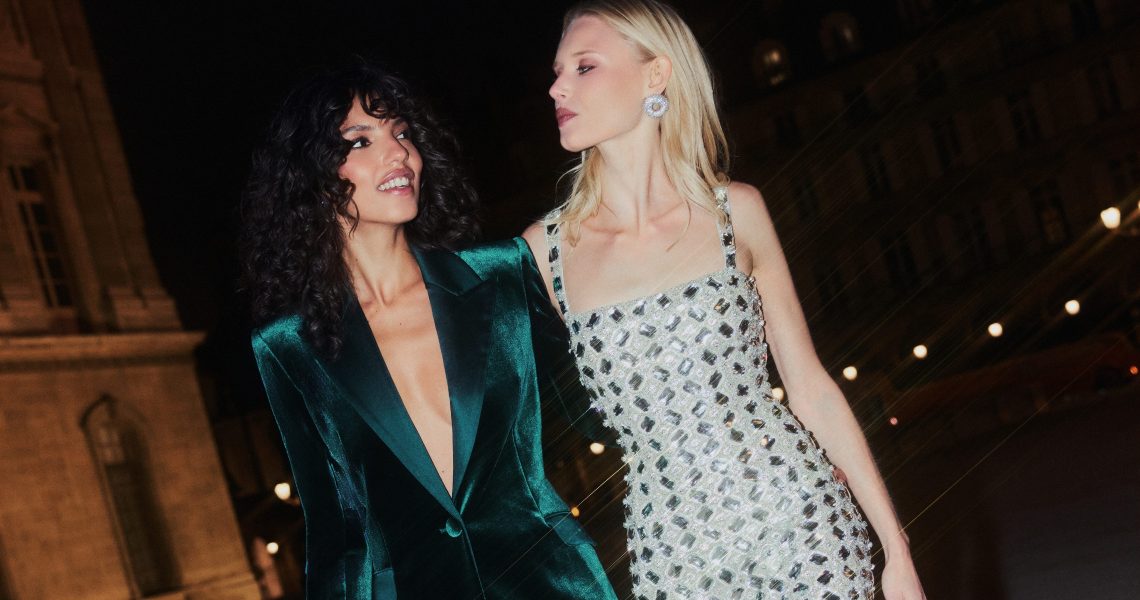
That recalibration has played to Marabi’s strengths as an occasionwear label rooted in tailoring and fit rather than logos. Across the partywear landscape, demand has held up best for pieces that can be worn across multiple moments like weddings, holiday events and milestone celebrations, rather than novelty items designed for a single wear, she said. Merabi said her team has evolved silhouettes accordingly. “It went from a lot of bodycon to more fit-and-flare, tulip shapes and square necklines — shapes that feel strong but timeless,” she said.
One of the clearest expressions of that is in bridal, though not in a traditional sense. Merabi launched the category in 2020 with a focus on registry office looks, second outfits and white tailoring, rather than ceremonial gowns. “What I wanted to create was something you wore outside of that main wedding dress,” she said, and those looks have since become a significant growth engine. White styles now account for about 50% of the brand’s direct-to-consumer sales, driven not only by weddings but also by culturally specific white occasions in the U.S. “In the U.S., people wear white for graduations, for parties — there are so many other occasions,” Merabi said.
Price points help widen the brand’s appeal. Entry-level items start around $225 for Darcie pyjamas or $250 for individual separates, with prices rising to approximately $845 for intricately beaded dresses, placing Marabi squarely in the accessible luxury tier that continues to show resilience amid broader luxury pullback.
In January 2025, the brand appointed Jacobo Hachuel, former chief strategy officer at sustainable fashion innovator Pangaia, as CEO to spearhead global expansion and operational scale. His tenure focused on strengthening retail partnerships and streamlining global operations, building on the momentum from the brand’s double-digit growth. However, after roughly a year in the role, Hachuel stepped down to pursue new opportunities, leaving Merabi to refresh the leadership team as the company enters 2026.
Wholesale has emerged as a newer but fast-growing channel for the brand. After operating primarily direct-to-consumer for almost a decade, Marabi entered U.S. wholesale one year ago and is now stocked by Nordstrom and Revolve, alongside Selfridges in the U.K. The rollout was tested early by tariff disruptions, forcing difficult decisions around fulfillment. “We chose to swallow the cost,” Merabi said. “We’d worked so hard on those relationships, so it didn’t feel right to let partners down.”
Opening branded retail has followed a similarly cautious arc.
A year-long pop-up in New York’s SoHo validated demand for physical retail, but plans for a permanent store were paused amid geopolitical uncertainty. “It was just as the tariffs were being announced,” Merabi said. “We said, ‘Let’s pause. Let’s hold for a minute.’” With logistics now stabilized, the brand is again in talks to open a SoHo store and is planning a second London location.
Underpinning the brand’s growth is a loyal customer base. Marabi’s loyalty program counts 53,000 members globally, including 16,000 in the U.S., reinforcing a repeat-purchase model in a category historically dominated by one-off buys. In a competitive landscape that includes Self-Portrait, Rixo, Rat & Boa, House of CB, and Zimmermann, Marabi’s focus on tailoring, whitewear versatility and operational restraint has helped it stand out.
“We’ve always stayed true to our purpose, which is to empower and celebrate women,” Merabi said. “At the end of the day, it’s women who tell us how amazing they feel wearing our designs, and that’s what’s carried us through the last 10 years.”
FWRD taps Rosie Huntington-Whiteley as fashion director to deepen luxury push
A few days after announcing Rosie Huntington-Whiteley as fashion director, FWRD offered more clarity on how the role fits into its broader growth strategy as luxury e-commerce continues to reset.
Speaking in an interview, Michael Mente, co-founder and CEO of Revolve Group, said the appointment reflects FWRD’s decision to invest while competitors pull back. “It’s been a challenging luxury environment for several years, but our philosophy has always been to invest through the challenging times,” he said. “We’re fortunate that our business is very healthy. It’s growing, it’s profitable, zero debt. So we think this is a great opportunity to invest and gain market share.”
Huntington-Whiteley’s role goes beyond campaign visibility. According to Raissa Gerona, chief brand officer of Revolve Group, she has already been working closely with buying and merchandising teams, influencing assortment and identifying new brand opportunities. “With short-term partnerships, you don’t really even get to see the fruits of your labor,” Gerona said, adding that the goal is long-term impact rather than one-off activations. Huntington-Whiteley will work alongside Kendall Jenner, who remains FWRD’s creative director, with the roles positioned as complementary rather than overlapping.
The timing aligns with continued momentum at FWRD. In the third quarter, the luxury platform delivered top-line growth and a 37% year-over-year increase in gross profit. Its personal shopping program — now a standard for high-value clients — generated more than 100% year-over-year sales growth in the first nine months of the year.
FWRD has also continued to attract luxury brands looking for stable, long-term partners, with recent launches including Phoebe Philo, Dries Van Noten, and Skims x Roberto Cavalli.
Why luxury is betting on protein-based materials
After a year in which much of the biomaterials sector has slowed or stalled, a small group of startups is still gaining traction with luxury brands by focusing on materials that meet aesthetic, technical and supply-chain requirements. This week, Uncaged Innovations and Everbloom offered two clear signals of such momentum.
Uncaged announced that actor and producer Natalie Portman has joined the company as a strategic partner, lending visibility to its push to replace animal leather in luxury fashion. Founded by Stephanie Downs and biomaterials scientist Dr. Xiaokun Wang, Uncaged produces a grain-based leather alternative engineered to replicate collagen’s molecular structure. “Collagen is a protein, and proteins have very long amino acid chains,” Downs said. “Those chains bind together and create the fibril structures that make leather strong but also soft and pliable.” The material is already used by brands including Stow London and Marco DeMaso, with automotive partners such as Hyundai and Jaguar Land Rover validating durability at scale.
On the fiber side, Everbloom launched its proprietary AI platform, Braid.AI, on December 11. The system uses predictive modeling to simulate how discarded protein-based textile waste will perform during fiber processing — with a focus on strength, softness and dyeability — to reduce development timelines from months to weeks. “What took us years before, we can now do in months,” founder Sim Gulati said. Everbloom is working with Italian mill Filati Biagioli Modesto, primarily owned by Prada and Zegna Group, to ensure its cashmere-like fibers integrate into existing luxury production infrastructure
Executive Moves
- Geoffroy van Raemdonck joined AI retail tech company Verneek as an advisory board member and strategic investor. The move follows his from Neiman Marcus Group, where he was CEO, after its December 2024 acquisition by Saks Global.
- Laura Burdese was appointed CEO of Bvlgari, effective July 1, 2026, succeeding Jean-Christophe Babin, who will remain chairman of the board and CEO of the Bvlgari Hotels business unit.
- Etro ownership is changing. Turkish real estate firm Rams Global is set to acquire the Etro family’s stake, leading to the founders’ exit, while L Catterton remains majority owner and new minority investors join via a single vehicle.
Investment Rounds
- As it enters its 15th year, Tissa Fontaneda is laying the groundwork for international expansion, with near-term focus on selective wholesale growth in the U.S. and Japan, alongside longer-term ambitions to open additional boutiques in key global cities. “Our entry as investors and CEO is about restructuring the company toward a modern, professionalised corporate model that can support long-term growth while preserving the brand’s essence,” said Daniel Codes Llamas, CEO of Tissa Fontaneda in a statement.
News to know
- According to schedules announced this week, Paris Fashion Weeks will host 67 men’s brands and 29 couture houses in January. New international entrants from Saudi Arabia, Spain, Greece and Vietnam will join major houses including Hermès, Dior, Louis Vuitton and Chanel.
- For its AI-powered “Try on with Google” shopping tool, Google is running a celeb-studded holiday campaign across digital and social channels from December 17–19. Featured stars include Sarah Jessica Parker, Lindsay Lohan, Ashley Graham, Kirsten Dunst and Gabrielle Union.
- The British Fashion Council unveiled the provisional February 19–23 London Fashion Week schedule, featuring Burberry, Simone Rocha, Erdem, Temperley London and Julien Macdonald; new international and emerging brands; and continued support for designers. Show fees will be waived, and investment in international guests will increase.
- The E.U.–Mercosur agreement would create the world’s largest free-trade area by cutting tariffs between the E.U. and Argentina, Brazil, Paraguay and Uruguay, potentially saving E.U. companies about $4.3 billion a year in export duties. It matters now as European fashion and luxury groups, backed by industry bodies including Confindustria Moda and ANFAO, seek to offset slowing China demand and higher U.S. trade barriers.
Listen in
On the Glossy Podcast, senior fashion reporter Danny Parisi and international reporter Zofia Zwieglinska unpack the week’s biggest fashion stories, including the intensifying smart glasses race, the appointment of Rosie Huntington-Whiteley as fashion director of Revolve-owned FWRD, and the Italian investigation into Swatch and Citizen over alleged pricing practices. Later, they’re joined by editor-in-chief Jill Manoff to examine the turbulence at Versace following Prada’s acquisition and the surprise exit of creative director Dario Vitale. Listen here.
Read on Glossy
How Aerie is betting on sleepwear. Why brands are looking to Roblox for trends. See the winners from this year’s Glossy 50 list here.