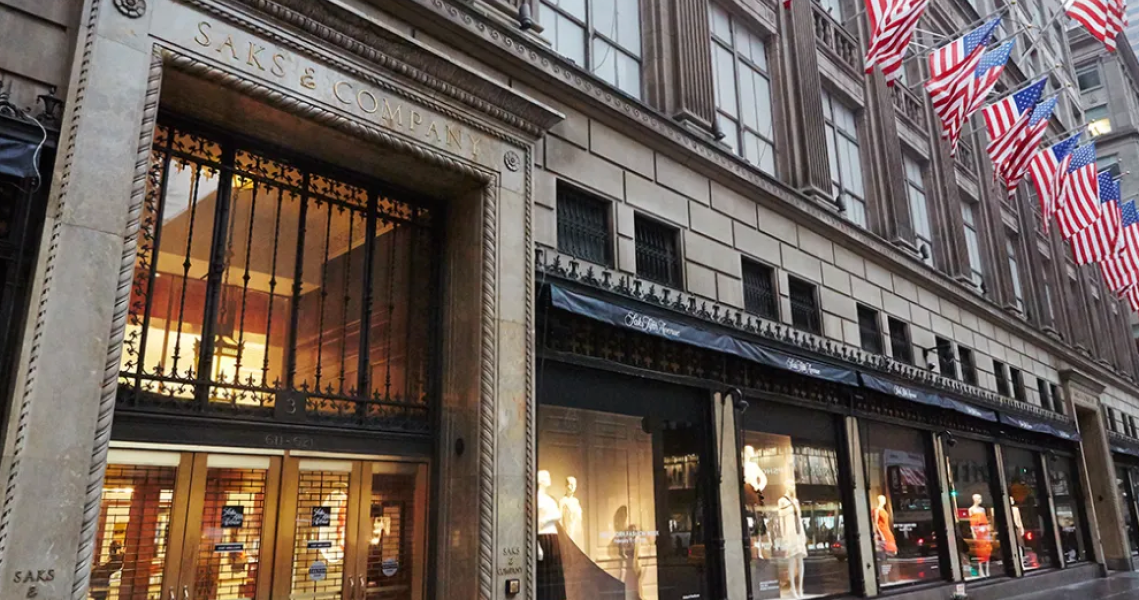
Years before department store relationships became a public flashpoint, designer and independent brand owner Hadley Pollet said she saw the warning signs and chose to leave the distribution channel.
Pollet is the founder of the 25-year-old Hadley Pollet brand, a luxury accessories and apparel brand known for its handcrafted details, proprietary trims and small-batch production. According to Pollet, the brand prioritizes craftsmanship, customization and long-term customer relationships over scale. In 2004, she began selling through Saks Fifth Avenue — a wholesale partnership that, on paper, signaled success — as well as Nordstrom and select independent retailers. She stopped selling at Saks in 2012.
On January 10, Saks Fifth Avenue owner Saks Global filed for Chapter 11 bankruptcy, carrying billions in liabilities and owing more than $700 million to its top 30 luxury brand creditors — including $136 million to Chanel and tens of millions more to the likes of Kering and LVMH, according to reporting by Bloomberg. And many smaller vendors are facing uncertainty about whether they will ever be repaid.
Pollet said working with Saks revealed a problematic system. “The retail buyer relationship is very important for a brand,” Pollet said. “You need almost an intimate knowledge of what the other one wants and needs. But what I was seeing was that buying practices were starting to cannibalize the company’s higher-end brands.”
In fact, at one point, a buyer she met in 2016 to test selling at Saks again told Pollet that she had been tasked with sourcing dupes of high-end brands from independent brands. “I found that disloyal,” Pollet said. “It’s like dating someone. What are the red flags you see? If your retailer is knocking you off, that’s a red flag.” The company did not respond to a request for comment.
Pollet said she takes pride in her products’ details and didn’t want to become a dupe brand for a luxury label. “We design every little ribbon ourselves. Everything is copyrighted, and we spend a lot of time protecting our work,” she said. “The last thing I need is my retail partner doing the same thing that I’m sending cease-and-desists over.”
She described the broader impact of such buying practices as “the infection of sameness.”
“Everything you can buy at the high end, you can also get at the low end,” Pollet said. She added that, when luxury brands dilute craftsmanship to scale, retailers feel licensed to treat brand designs as interchangeable – and to copy them rather than protect them.
Drop-shipping has only accelerated the issue, she said. While Saks significantly expanded the model during the early pandemic years, it had already begun shifting toward an asset-light approach beforehand by listing products online without placing traditional wholesale orders. That model pushed inventory, fulfillment and cash-flow risks onto brands while allowing the retailer to maintain a broad assortment. Pollet exited just before the pandemic, before her brand was fully absorbed into that structure, based on her preference for upfront orders, clear product ownership and predictable payment terms.
She decided to instead focus on DTC sales. “We stuck to our guns,” said Pollet. “We stayed authentic to the people who love our stuff and doubled down on craftsmanship. I keep asking, ‘How many more beautiful details can I add so customers can delight in what they’re buying?’ I think big retailers have lost sight of that.”
Pollet now drives visibility through trunk shows and a small network of specialty retailers that host events, allowing customers to engage with the brand and customize its products.
And, she said, she has no plans to return to a department store — with additional issues emerging in recent years. Behind the scenes, many large retailers now rely heavily on AI-driven buying and forecasting systems to guide product assortment decisions. Tools from companies like Edited, Nextail, Celect, Blue Yonder and SAP’s Integrated Business Planning software analyze historical sales data, sell-through rates, regional performance and online behavior to predict which colors, silhouettes and price points are most likely to perform.
The goal is to reduce risk, but Pollet believes it often reinforces it. “AI picks up on what already happened, not what’s about to happen,” she said. “Creatives know trends before AI does. Ideas flow through you; they don’t come from a computer.”
Her critique isn’t limited to Saks. “I took a walk through Nordstrom recently and thought, ‘Is there any differentiation?’” she said. “I can get the same thing from Temu or from American Eagle or around the corner. I travel a lot, and I see the same stuff everywhere.” Nordstrom posted low-single-digit sales growth in its last reported year before going private last May.
Pollet added, “Department stores have to become destination shops. Right now, they’re not.”
She pointed to small specialty retailers like North Carolina-based Capitol and Connecticut-based Mitchell Stores as the real successes. “They’re building community with events, product customization and experiences,” she said.
Frasers Group’s majority investment in The Webster last October signals growing confidence in high-touch specialty retail. And, as Glossy has reported, luxury brands often treat independent retailers as priority partners because of their curations, storytelling and collaborative partnership.
Walking away from Saks early also helped Pollet avoid financial damage, but she knows others have not been so lucky. “I jumped out of the Saks situation before it became bad,” she said. “I could see it careening in that direction.” She said designers often underestimate the risk of retailer partnerships, especially in the early days.
“If you see a retailer going in the wrong direction, put a lien on your product,” she said. “Otherwise, your inventory becomes part of their bankruptcy, it gets discounted, and you probably never get paid.” A lien is a legal claim on property or goods that gives the brand the right to reclaim or sell its product if a retailer fails to pay, instead of the inventory being absorbed into the retailer’s bankruptcy or liquidation process.
Contract terms, she added, also need a reset — and brands should take charge of their products, at the very least, she said. “If [the store] hasn’t paid for it, the product is mine,” she said. “And markdowns? If you make a poor buying decision, that sovereignty lies with you, not me.”
Pollet is blunt about where responsibility has shifted. “Department stores have been taking advantage of creativity,” she said. “Creativity is not a commodity. Especially now, when AI is spitting out everything else; originality is even more valuable.”
According to Pollet, her business is smaller post-Saks, but has more repeat customers, fewer markdowns and less capital tied up in unsold stock. She describes her brand today as having a more sustainable growth profile.