Since 2023, Glossy has been closely tracking the rise of Gen Alpha’s beauty obsession.
While kids and tweens have always discovered beauty products as they grow up — whether by watching their mothers at home or learning from friends at school — Gen Alpha is among the first cohorts to learn from influencers on TikTok, in real time and in lockstep with the trend cycle. They (famously) became obsessed with Drunk Elephant, at times overwhelming the brand’s in-store displays at Sephora and earning the nickname “Sephora Kids,” a label often intended disparagingly.
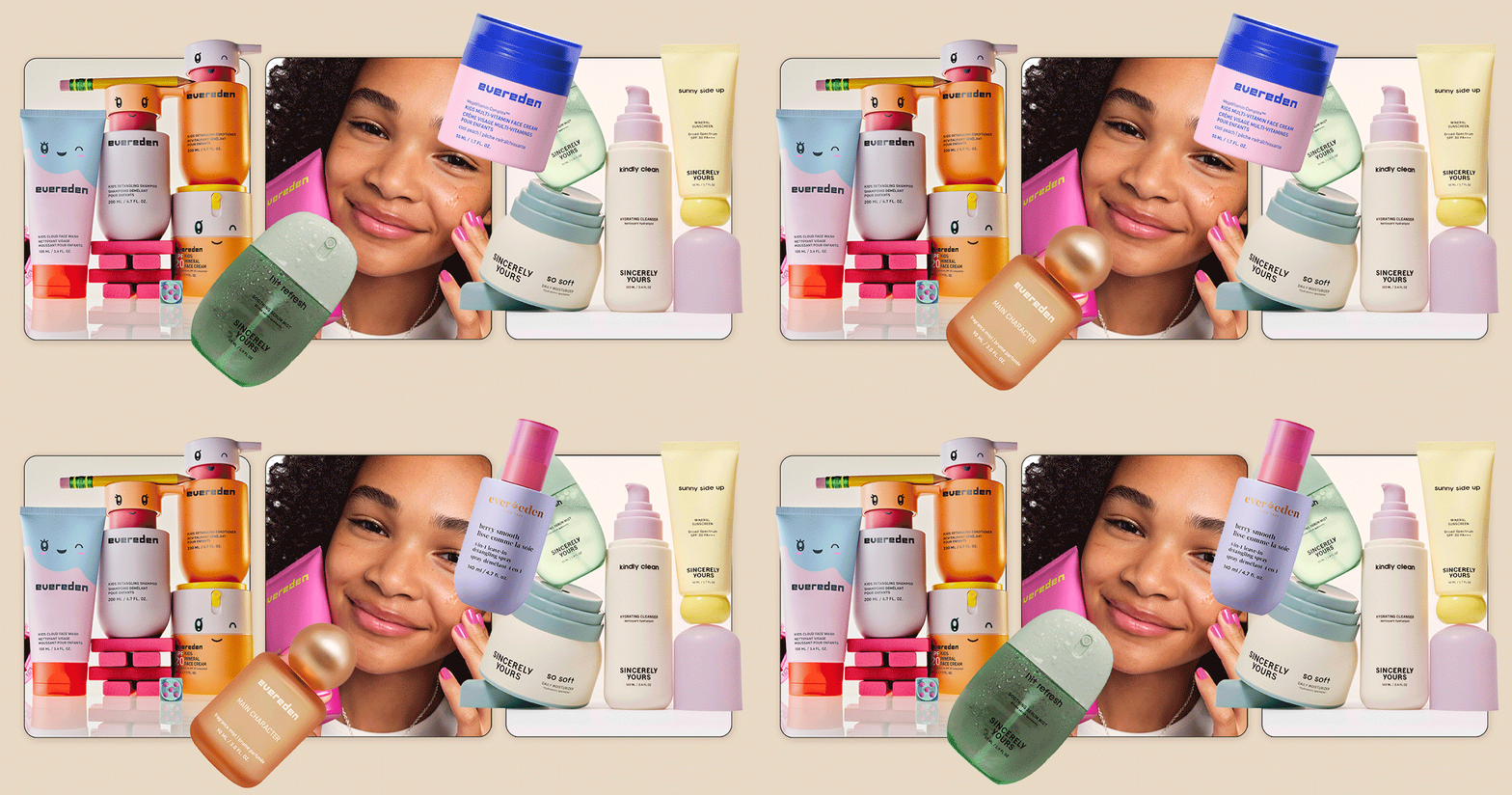
Simultaneously, brands emerged to meet the moment. Among them: Erly, Rile and Saint Crewe. Evereden, which launched in 2018 with products for babies, expanded with a collection of tween-forward skin care in 2021. In 2024, it surpassed $100 million in sales, proving market demand.
In October 2025, Evereden hit Sephora shelves, just a month after the Sephora debut of creator Salish Matter’s tween-focused Sincerely Yours. Together, the launches sent a clear message: Sephora, which declined to comment for this piece, was set on creating a retail atmosphere welcoming to younger shoppers — whether everybody else liked it or not.
These brands represent a broader economic shift, too. “Sephora Kids” are no longer a fleeting trend; they have become a meaningful share of the market and a demographic worth serious investment. Mintel projects that, by 2029, Gen Alpha’s spending power will reach $5.5 trillion. At Evereden, business has already shifted: Eighty-five percent of its revenue now comes from products for Gen Alpha, rather than from its initial products designed for babies.
But the category growth has not come without controversy.
In celebration of its launch, Sincerely Yours held an event at the American Dream mall that drew 87,000 attendees, amplifying the ongoing debate about whether children should use $26 moisturizers at all.
When it launched, Jordan Matter, Salish’s father, told Glossy, “We started talking about the idea that the products that would be good for her [young] skin weren’t particularly fun or cool to use, [in her eyes]. … That was when we started [to think] it would be interesting to develop products that kids would actually want to use, where they’d be more motivated to use products that were good for their skin.”
The backlash was nothing compared to in November, when actor, model and entrepreneur Shay Mitchell announced the launch of her brand Rini, which debuted with sheet masks for kids ages four-12, prompting what quickly escalated into a veritable moral panic. A New York Times headline read: “‘Dystopian’: Skin care for 4-year-olds gets an icy reception.” Mitchell ultimately appeared on “The Today Show” to address the criticism: “Truly, skin care starts from birth,” she said. “We moisturize, we soothe, we comfort their skin as newborns. This is the same thing; it’s just in a different format that’s more fun — and, I feel, very age-appropriate. This [comes] down to it not being a beauty thing. Kids don’t look at masks and think about fixing. They think about it being a cooling sensation and a shared moment.”
Casey Lewis, the writer and consultant behind the Substack After School, was less alarmed by Rini than much of the internet appeared to be. “[I understood] the thought process behind [launching the brand],” she said. “She puts masks on herself, and her kids see the masks on and think ‘That looks fun, that looks glamorous.’ And then she looks at the mask market, and maybe they’re too big for a kid’s face. … I understand it, in terms of a nice little mommy-and-me ritual.”
But Lewis views Sincerely Yours more critically, noting that Salish Matter’s audience skews younger than Matter herself (now 16) — meaning she is influencing children directly, unlike Mitchell, who is potentially influencing parents. The concern, Lewis said, is aspirational pressure. The risk is that kids may think, “Salish is this beautiful girl we look up to. And if we want to have a life like hers, and to have beautiful skin like hers, we need to have this four-step skin care routine we can only buy at Sephora,” Lewis said.
Lewis made a TikTok remarking on the pop-up which was met with comments like, “We need to stop being afraid of shaming these parents. this is crazy,” and “You don’t have to shame the parents but I will. Parents need to learn to say no.”
To successfully connect with the Gen Alpha demographic — the oldest of whom are currently just 14 or 15 years old — brands must appeal to both children and their parents, said Kimberley Ho, founder and CEO of Evereden. “You really have to convince two sets of generations — the millennial parents who are purchasing, as well as the Gen Alphas who need to think you’re cool.” Ho has already convinced Sephora, at least. In March, her brand will expand to all 641 Sephora locations nationwide.
Looking ahead, the question becomes how coolness in beauty, as Gen Alpha sees it, will be defined, who gets to shape it and whether brands designed to entice this demographic will be enough to pull focus away from the brands that older customers use.
For its part, Sincerely Yours benefited from Matter’s existing platform: She creates content with her father, who has 33.7 million YouTube followers; Salish has 4.8 million Instagram followers and 4.9 million TikTok followers.
And she is unlikely to be the last Gen Alpha creator to launch a brand.
Lewis expects that the success of Sincerely Yours will only accelerate growth in the category in 2026 and beyond. “In conversations I’ve had with friends who work in VC, everyone is very, very bullish on this market, and they should be,” she said. “The fanaticism around [Sincerely Yours woke people up to the fact that while] Salish is not a household name, in Gen Alpha households, she is. There are so many [people like that], and we’re going to see more of those people get brand deals and launch their own products.”
But, the growth of the kids’ skin care and beauty market does not need to be all doom and gloom.
While parents should be cognizant of what their kids are using — children do have more sensitive skin — Dr. Amy Wechsler, board-certified dermatologist and psychiatrist and co-founder of the new Upper East Side acne clinic Spotless, echoed a point she first shared with Glossy in 2023: Skin-care routines can be beneficial for children. Of course, setting boundaries is OK, too, she said. “There are grown-up things, and then there are things for kids. And parents are allowed to have their own things, and kids will often aspire to those — that’s what kids do. They want to be like bigger kids, and the bigger kids want to be like young adults, and it’s OK as a parent to say, ‘This is for mom,’ or ‘This is for dad,’ and ‘It’s not good or not safe for you,'” she said.
On the flip side, Wechsler emphasized that establishing foundational skin-care habits is appropriate — and even encouraged — at a young age. “Healthy skin habits are a great idea to form young,” she said. “And the most important one is sun protection, followed by washing and moisturizing your face. It’s a good hygiene habit. It’s good to teach kids how to wash their underarms, in between their toes, …. After all, the skin is the body’s largest organ on the outside.”
Inside our coverage
Inside Sabrina Carpenter’s plan for global fragrance domination
Hailey Bieber on growing Rhode under the E.l.f. Beauty umbrella
What happens to personal style in the age of AI-powered shopping?