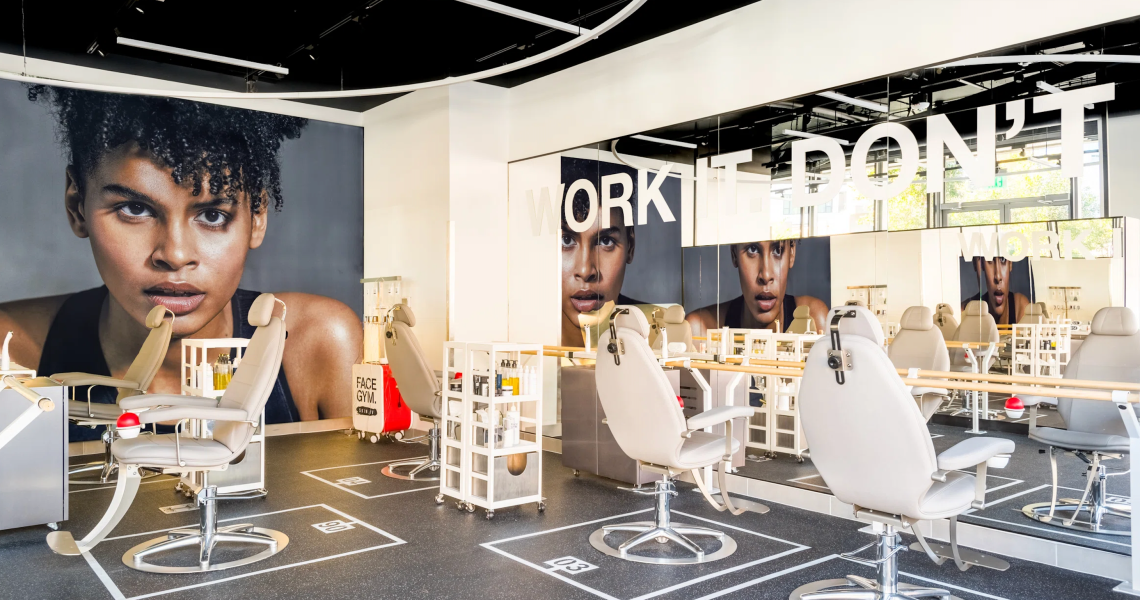
Facial workout company FaceGym is launching its first U.K. franchise model, with studios initially planned for Cambridge, Richmond, Manchester and Liverpool Street in London. The longer-term plan is to open 28 franchised U.K. studios over the next three years, alongside upcoming wholly-owned U.S. openings.
Founded by skin-care specialist Inge Theron in 2014, FaceGym originally set itself apart from traditional facial providers by describing treatments as workouts. Its current services include vigorous movements such as “knuckling” and “whip strokes” to stimulate the face, followed by the use of tools using electrical muscle stimulation or microcurrent to target facial muscles. The brand began in London’s Selfridges and had nine listed U.K. studio locations before the franchise rollout. Its four newly announced franchise studios will bring that total to 13, while a planned Studio City opening will grow its U.S. footprint from seven to eight locations.
“It was born out of service as this very compelling new proposition at the intersection between beauty, wellness and fitness,” CEO Angelo Castello told Glossy in an exclusive interview. Beyond its claims around facial sculpting, FaceGym positions its workouts as a way to reduce puffiness and release facial tension through massage and lymphatic drainage.
During the pandemic, FaceGym slowed its physical expansion and invested in launching skin-care products and at-home tools, which are now sold through retailers including Sephora, Space NK, and the Australian skin-care retailer Mecca. But the majority of FaceGym’s revenue still comes from its studios, according to the company.
FaceGym is expanding its studio footprint as its U.K. business narrows losses. Facegym Ltd reported fiscal 2025 revenue of £7.53 million, or approximately $10.1 million, while its annual loss fell to £1.41 million, or approximately $1.9 million, down from £4.29 million, or approximately $5.8 million, a year earlier. The filing covers the company’s U.K. entity and excludes revenue from FaceGym’s U.S. studios and its new partnership in India. FaceGym declined to disclose consolidated group revenue.
The company is privately held by Facegym Holdings Ltd, whose shareholders include founder Inge Theron, existing investor Three Hills and, following a 2025 minority investment, Reliance Retail. Facegym Holdings raised £1.535 million ($2.1 million) through a share allotment in May 2025, shortly before Reliance announced its investment; the value of Reliance’s stake was not disclosed.
Franchising gives FaceGym a way to open more studios without operating every location itself. Castello said the company spent several years formalizing treatment protocols, training and studio standards before opening the model to partners. Before each new location opens, up to 99 customers will be offered a founding membership at an introductory price for a limited time. Franchise partners will also build local business partnerships and invite local press and talent in to try treatments.
“Ultimately, it’s about consistency to deliver those results,” Castello said. “We brought in membership to make it easier and more convenient for people to stick with your routine and get those results.” Memberships range from £77 ($104) per month to visit a single studio outside London to £88 ($118) per month for all London studios and £95 ($128) per month for nationwide access. Each includes one monthly Signature Sculpt or Signature Hands workout, plus 40% off boosters, 30% off additional workouts, and 20% off tools and skin care. For its new franchise studios, FaceGym is offering founding memberships to the first 99 members: £62 ($83) per month in Cambridge and Manchester, and £70 ($94) per month in Richmond and Broadgate, before moving to standard pricing.
FaceGym is not alone in turning to franchise partners to expand repeat-visit beauty services. In the U.K., luxury nail salon chain Townhouse, which has more than 45 salons across the U.K. and the U.S., is seeking franchise partners for further international growth. FaceGym’s Liverpool Street franchise operator, Acca Group, has previously worked with Townhouse. In the U.S., facial-bar brand Face Foundrié is targeting 100 locations by the end of 2026 through a franchise-led model built around express facials, memberships and skin-care product sales.
FaceGym is also extending its signature routine beyond studios. In March, it launched FaceGym Pro, a £500 ($673) at-home electrical muscle stimulation device intended for 10-minute workouts. According to FaceGym, a 14-day study of 25 participants using the device five times a week showed up to a 35% reduction in lines and wrinkles, a 37% improvement in cheek sagging and a 51% improvement in jawline sagging.
And the company has previously used partnerships to expand its treatment menu. In 2025, FaceGym launched Scalp Lift x Isamaya, a 15-minute scalp-lifting booster designed to relieve tension and enhance facial sculpting beyond the hairline. The treatment uses a Sculpt 01 face-and-scalp tool developed with makeup artist Isamaya Ffrench, alongside Olaplex’s No. 0.5 Scalp Longevity Serum.
“A face just doesn’t finish at your hairline,” Castello said. He added that treatment add-ons, called boosters, allow FaceGym to introduce new benefits without confusing the core facial-workout proposition, and that more partnerships are coming this year.
Competition in at-home facial treatments is growing. NuFace and Foreo sell microcurrent devices for lifting and toning, while Therabody’s TheraFace Pro combines microcurrent, massage, and LED. The £500, or approximately $673, FaceGym Pro sits at the premium end of the at-home facial-toning market. NuFace’s full-face TRINITY+ Starter Kit sells for $395, while Foreo’s full-face Bear 2 is listed at £379, or approximately $510, before current discounts. Both brands market microcurrent devices around facial lifting, sculpting and toning. NuFace, which marketed its microcurrent tools through a “Fitness for Your Face” campaign in 2024, was the No. 1-selling skin-care tool brand in November 2023, according to Circana data previously reported by Glossy.
Market research firm Circana has not publicly broken out sales for microcurrent brands, but it identified that skin-care devices, including red-light LED facial devices, as a standout beauty segment with high growth potential last year.
Beyond the U.K., FaceGym has recently opened its first studio in India through Reliance Retail-owned Tira in Mumbai, following Reliance’s 2025 minority investment in the company. Reliance plans to expand FaceGym in India over five years through standalone studios and spaces within selected Tira stores. And it is a good market to do so – India’s luxury beauty market is expected to grow from $800 million in 2023 to $4 billion by 2035, according to Kearney and LUXASIA data reported by Reuters.
In the U.S., FaceGym currently runs four New York studios and three Los Angeles studios, with an upcoming Studio City opening set to take Los Angeles to four locations. More are to come, following the launch of the U.K. franchise model.