In this week’s Luxury Briefing, I check in with buyers from Harrods and Bloomingdale’s for their takes on this season’s Milan Fashion Week. Plus, Traackr data insights on magazines and the impact of brands appearing on September covers this season. And news to know from Selfridges, Jennifer Meyer and EssilorLuxottica. For tips or comments, email me at zofia@glossy.co.
Gucci’s next store design made its debut on a Milanese runway this season, while Prada offered select clients handbags costing more than $20,000 the day after its show. And at Fendi, a phone-sized Baguette offered a fresh take on a best-seller.
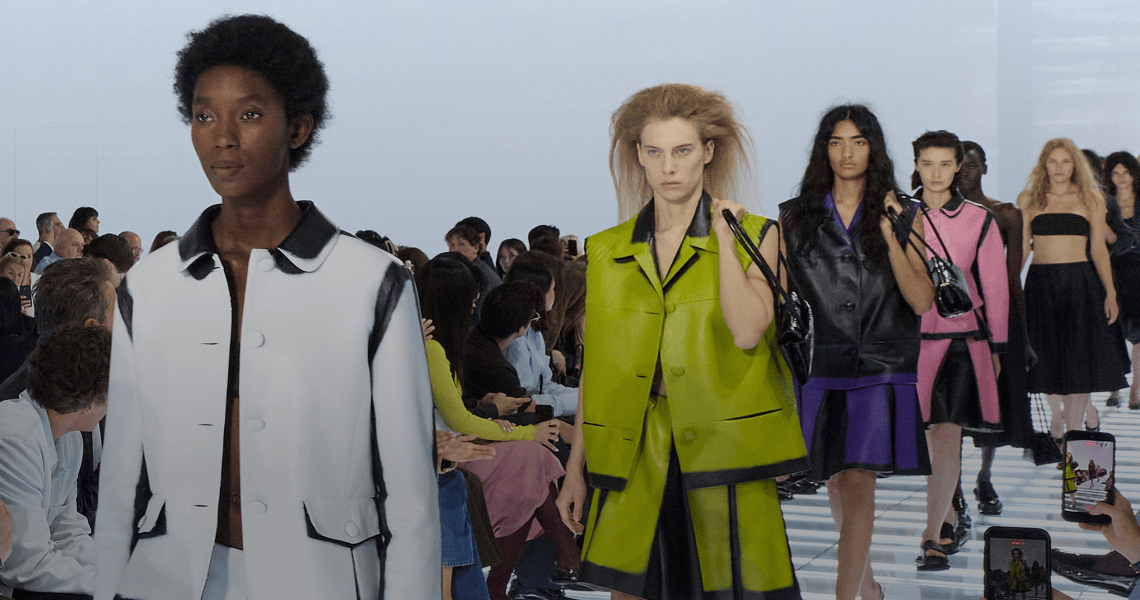
Across Milan’s spring 2027 collections, luxury houses supplied tangible reasons for customers to revisit familiar brands, through new product formats, retail concepts and private shopping opportunities. For buyers at Harrods and Bloomingdale’s, the strongest propositions included embellished Prada skirts, collectible Fendi bags and a Gucci collection with the potential to reach a broader customer.
Gucci made the connection between its creative direction and retail plans unusually explicit. Its September 25 show took place inside a mock boutique previewing Demna’s new store concept, set to launch at the renovated Avenue Montaigne location in Paris in late October before reaching other stores. Products from recent collections surrounded the runway, placing the new looks within an existing assortment.
On the clothes, the horsebit appeared on collars, pockets and fastenings, extending a recognizable house detail across categories. For Marissa Galante Frank, Bloomingdale’s fashion director of accessories and beauty, the collection also expanded the possibilities for who might shop Gucci.
“We saw a positive evolution at Gucci,” she said. “A mix of equestrian prep school energy helps balance out the exaggerated sexiness that we usually see from Demna. This shift allows Gucci to open the door to a wider customer base across both men’s and women’s.”
Prada used fashion week to bring some runway products directly to its biggest spenders. More than 100 top clients traveled to Milan for a program including private cultural visits and dinners. Crocodile handbags with onyx-detailed clasps, inspired by a 1920s design, were offered to those clients the day after the show for just over $20,000. And the brand’s renovated Galleria complex hosted private shopping, on-site tailoring and exclusive jewelry.
The ready-to-wear collection concentrated on a product with considerably more wardrobe flexibility: the skirt. Its variations included crystal-embroidered Velcro fastenings that allowed wearers to adjust shapes and reveal or conceal decoration. Re-Nylon was pleated, cotton was treated to resemble leather or suede, and crinoline was brought to the surface as an outer layer.
For Harrods’ Simon Longland, the season’s must-have was clear: “No contest: a pleated and bejeweled Prada skirt.”
He identified skirts and separates as a stronger message than dresses, with Prada setting a direction that appeared throughout the week. His favorite collections were Bottega Veneta, Prada, Fendi and Loro Piana.
At Bloomingdale’s, Galante Frank highlighted Fendi’s new Baguettes, with embroidery, buckle details and novelty materials.
“The Bloomingdale’s customer loves to invest in pieces that feel special, whether that means a timeless silhouette in a luxurious fabric or an embellished accessory with a ton of personality,” she said.
Alongside those decorative updates, Fendi introduced a version sized to hold a phone. The established bag offered a recognizable foundation for new treatments and formats, giving customers several ways to revisit the design.
Loro Piana similarly expanded familiar accessories, introducing another size of the Loom bag, the Bale Softy and an Extra Softy Backpack. Its collection catered to specific activities, with pieces including a new golf bomber and lightweight beach pajamas.
Longland’s favorite presentation was the house’s installation at the Biblioteca Nazionale Braidense at Palazzo di Brera, a space he had never visited in 30 years of coming to Milan. Visitors could examine textiles and garment finishing and learn about screenprinting, giving the setting a role in explaining the products.
These commercial developments accompanied a substantial increase in online visibility. According to data by Lefty x Karla Otto, Milan Fashion Week generated $311 million in Instagram earned media value, up 27% year over year. Prada led with $61.2 million, followed by Ferragamo at $56.3 million and Gucci at $47.9 million. Prada’s figure increased 34%; Gucci’s rose 51%.
Celebrity activity played a significant role. The report attributed $43.4 million in EMV to Thai actress Faye Peraya’s appearance at Ferragamo and associated posting. EMV estimates advertising-equivalent exposure; it does not establish sales or purchase intent.
Longland, meanwhile, described a season with “beautiful collections, but less drama and anticipation than in recent seasons.” For retailers, the shows’ influence on orders also sits within a process already underway.
“As a Fashion Director, I’m responsible for communicating trend direction to my merchant team well ahead of Fashion Month,” said Galante Frank. Seeing those trends on the runway can validate that work and, she said, “sometimes influence us to go deeper in key items, add another colorway or buy further into a trend.”
Market appointments then determine how the clothes and accessories work beyond the show. Lighting and styling can obscure fabrication, color and shape, she said, while some details change before production. As an illustration, heavy statement earrings may be made in lighter materials so a customer can comfortably wear them for longer.
Neither retailer disclosed an increase in buying budgets. Their endorsements were specific to the collections and products they believe customers will respond to. That makes the next stage of Milan’s season a practical one: Gucci translating its show into stores, Prada pursuing private-client purchases, and merchants deciding which versions of a skirt or handbag deserve more space in the buy.
The cover stars behind luxury’s social buzz
September magazine covers accounted for a substantial share of some luxury brands’ social attention in August, according to U.S. data shared with Glossy by influencer marketing and analytics platform Traackr.
A Kylie Jenner post featuring her Who What Wear cover, on which she wore Gucci, generated 23% of Gucci’s monthly Brand Vitality Score, the platform’s proprietary measure of creator-content performance. Two posts tied to Rihanna’s Elle September cover contributed 29% of Dior’s total. Gucci and Dior ranked first and third, respectively, among the 148 luxury brands tracked. For these brands, editorial shoots provided material for some of their highest-performing social content.
Executive moves
- LVMH has named Louis Vuitton executive Clara Boissonnas CEO of Pucci, effective January 1, 2027. The appointment brings a leather goods executive to the Italian house as it continues its revival under artistic director Camille Miceli.
News to know
- Selfridges is back in the black. The retailer reported a pre-tax profit of approximately $17.2 million (£13 million) for fiscal 2025, compared with a loss of nearly $21.2 million (£16 million) a year earlier. Revenue rose more than 7% to approximately $1.1 billion (£830.8 million) in the 52 weeks ended January 3, 2026, offering an encouraging result for CEO André Maeder’s turnaround strategy.
- Jennifer Meyer has reopened her Pacific Palisades flagship with a redesigned interior as the Los Angeles neighborhood rebuilds. The return restores a physical retail presence for the fine jewelry brand in its home market.
- EssilorLuxottica is giving shoppers more reasons to buy glasses. Its second-generation Nuance Audio hearing-aid eyewear adds improved audio, longer battery life and simpler controls. The update comes alongside partner Meta’s new Ray-Ban glasses and plans to bring its Muse AI agent to the category, expanding the eyewear business into hearing support and everyday computing.
- Revolve is putting print to work at checkout. Its new magazine is a gift with purchase for U.S. customers, with QR codes directing readers to shop Revolve and Fwrd and “Golden Ticket” shopping vouchers tucked into selected copies. Covers feature Teyana Taylor, Kendall Jenner and Alex Consani, with a little Willy Wonka thrown into the sales strategy.
- Patek Philippe is staying in the family. Owner and president Thierry Stern said the watchmaker is not for sale and that he plans to hand it to his two sons, although there is no timetable. Speaking ahead of the company’s Milan exhibition, Stern said independence allows him to set his own strategy without shareholders demanding short-term returns.
Listen in
On last week’s Glossy Fashion Podcast, senior fashion reporter Danny Parisi and I unpacked London Fashion Week’s more commercial turn, including Christopher Kane’s Mulberry debut, McQueen’s return to London and Burberry’s latest collection. We discussed when mining the archives becomes over-reliance, how independent designers make their shows pay off and why the reaction inside a show can differ so much from the verdict online. Listen here.
Read on Glossy
Why the rugby shirt is back on runways and shopping lists. How Van Cleef & Arpels and The Wires are using AI for product discovery and personalization. Plus, Burton’s push into streetwear and China as it turns 50, and Coty’s plans to rebuild marketing support for brands under a new U.S. consumer beauty chief.