This week, we look at the ambitions of Brooks Brothers’ new leaders, who hope a NYFW show and a focus on younger customers can help it become a billion-dollar brand.
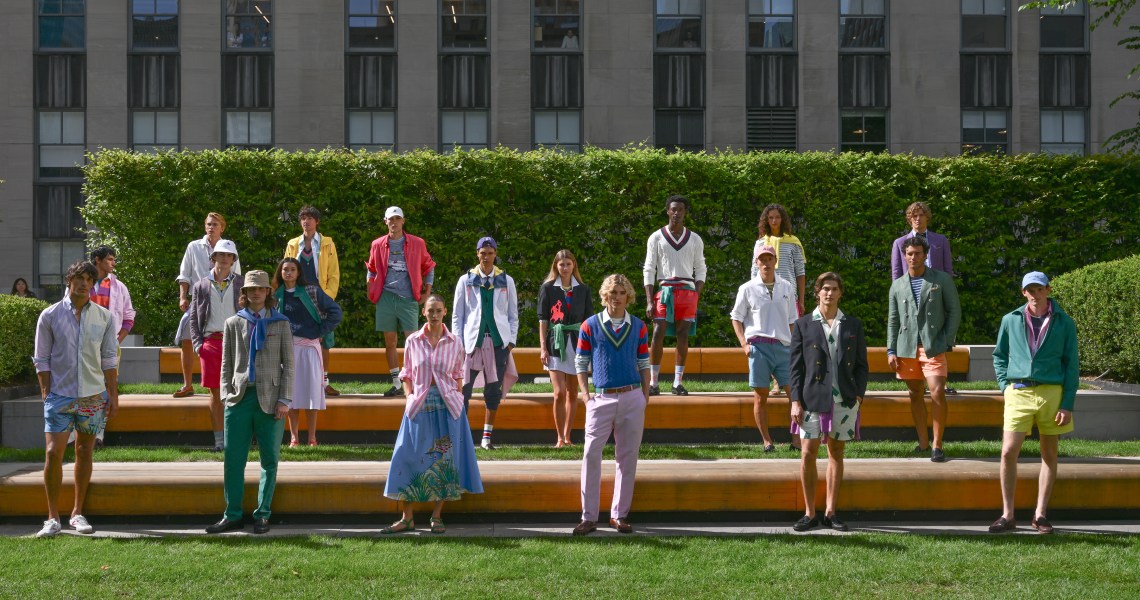
In Radio Park last week, the secluded garden area atop Radio City Music Hall in Manhattan, the sun was brutally hot. As the clouds parted, models for Brooks Brothers’ first New York Fashion Week show in years had to be cooled with ice packs to beat the heat.
But despite the heat, Michael Bastian, the brand’s creative director, was feeling good. The day was an important milestone. Brooks Brothers is in the midst of a significant turnaround since its bankruptcy in 2020. Under new owners Authentic Brands Group, Bastian and CEO Ken Ohashi have been focused on returning Brooks Brothers to its former glory, with ambitions of making it into a billion-dollar brand.
And by all accounts, it’s working. While the company declined to share exact revenue figures, Bastian said it has already brushed up against a billion dollars in annual revenue and is on track to hit that mark more consistently soon. And the NYFW show played a key role in getting Brooks Brothers closer to that goal.
“The ball is already rolling,” Bastian said, referring to Brooks Brothers’ five consecutive years of positive revenue growth since he and Ohashi took over. “We just have to get the word out. And the show is a big part of that. It’s an investment, but the reward can be so big.”
Bastian said previous marketing efforts like the brand’s regular lookbooks and catalogs, while helpful, haven’t made a memorable splash with a younger crowd. Despite Brooks Brothers’ two centuries of existence, he said many consumers, particularly younger ones, may still not be familiar with Brooks Brothers or its history.
Recently, Brooks Brothers has collaborated with streetwear brands like Needles and New Era, and recent campaigns have featured younger talent like comedian Alex Edelman and influencer TyLynn Nguyen. Combined with the show, these efforts are meant to attract customers under 40, whom Bastian identified as the brand’s biggest awareness gap.
Ohashi told Glossy that the brand was in need of a reinvigoration when he first took the reins. In the first week, sales were down 70%. But growth quickly returned and has remained consistent since then. Part of that has come from more utilitarian efforts. For one, Brooks Brothers launched a uniform business two years ago, and currently provides uniforms for more than 66,000 United Airlines employees, which Ohashi said has been great for the business’ stability.
Other new strategies include a limited partnership with Macy’s, bringing a more affordable version of Brooks Brothers suiting to the department store. Ohashi said he was very careful and measured with this partnership, only offering it in around 40 Macy’s doors across the country, so as to balance the brand’s prestige with accessibility.
On the creative side, Bastian has been hard at work bringing some of the iconic pieces Brooks Brothers is known for back to the collection. He said that when he took over, he was surprised that some of the most famous Brooks Brothers pieces, like the Oxford cloth button-down the brand invented and popularized, weren’t better represented across the assortment. The newest collection shown at New York Fashion Week mixes in classic prep staples, like oxfords, harrington jackets and cable-knit sweaters, with stylistic inspiration from places like Monaco and the American Southwest.
As for the future, Bastian said he believes the $1 billion threshold is within reach as long as the brand keeps doing what it’s doing and keeps raising awareness with high-level marketing plays. Both Ohashi and Bastian see stores, of which Brooks Brothers has around 140, as an integral part of Brooks Brothers’ future.
“We opened our New York flagship [in May of last year,] and we’re opening 10 stores over the whole year,” Ohashi said. “We just did Fashion Week, and we’re investing a lot more in top-of-funnel marketing, these brand-enhancing investments. We’ve seen a lot of healthy growth so far. Six consecutive years of comp growth and no deterioration in the full-price wealthy customer.”
5 questions with Tommy Hilfiger
Ahead of his blowout NYFW show last week, the first since 2024, Glossy stopped by the Tommy Hilfiger showroom to speak with the designer about how the brand has evolved over 40 years. Held at the Plaza Hotel in Manhattan, where Hilfiger lived for over a decade, the show opened with Gigi Hadid and, much like Brooks Brothers, aimed to update the classic prep look.
Glossy: How has the brand evolved over the last 40 years?
Tommy Hilfiger: “Well, back then it was a menswear brand, designed in America and made for department stores. But we started expanding into women’s, children’s, fragrance, footwear, every adjacent product you could imagine. And then we went to Europe and were embraced by Europeans. And by now we are truly a global lifestyle brand.”
Glossy: Are there any categories you’re not doing but you’d like to do?
Hilfiger: “Going forward, I’d like to do furniture and more for the home. I’d like to do restaurants. I’d like to do hotels. Those are, I would say, distant dreams at the moment, but I do think they are achievable. Sheets, towels, pillowcases, small rugs, things like that. I want to do tabletop decor, but it has to be with the right partner, and sometimes it takes a while to find that right partner.”
Glossy: You’ve recently been working with more athletes and sports teams like Liverpool. What’s behind that strategy?
Hilfiger: “Liverpool is fairly new. We are very excited about that. The whole team will wear our clothes in the tunnel walks and will appear in our advertisements. Having that connection with the team is really cool. A lot of value there. And we work with Josh Hart from the Knicks, Travis Kelcie is our leading man. Formula 1 we’ve been doing for 30 years, and that remains one of our most exciting sports partnerships. So we think fashion and sport is very important. They go together very well.”
Glossy: Who is the Tommy Hilfiger customer these days?
Hilfiger: “We have a very broad audience today. We have childrenswear, but they’re dependent on their parents to buy the clothes. Gen Z is really important to us. We’re leaning into them, particularly in this fashion show, to show the different options that they could wear if they’re interested in interpreting the classics in a modern way. But we haven’t turned our backs on the millennial or baby boomer customer because they started buying our clothes 30 or 40 years ago, and they depend on the quality and the price and the reliability. So, we’ve tried to be very consistent with the quality and the position of the brand, in terms of price, for those long-term customers.”
Glossy: Are you doing any see-now, buy-now?
Hilfiger: “I won’t say we invented it, but we were one of the first to do it. It was very strong for quite a few years. Now, we are doing something where we put the clothes from the current collection in the front row. The celebrities and influencers at the show are actually wearing the clothes from that collection, and it’s available the minute they see it. We went back and forth on different ways to do it and felt that was the best way.”
News to know
- Dario Vitale, after his short-lived tenure at Versace, has landed a new gig: the new creative director of Emporio Armani.
- CFDA CEO Steven Kolb was placed on leave this week after videos emerged showing him in a physical altercation with PETA protestors who disrupted a Cos show. Kolb has since apologized.
- Authentic Brands Group could go public as early as next year, according to its founder Jamie Salter, who will soon step down to be replaced by his successor Matt Maddox.
Glossy’s fashion coverage
Kendra Scott’s NYFW return is just the start of its fashion ambitions
2 years after launching bridal, wedding attire now makes up half of Tanner Fletcher’s business
The Quencher once made up 80% of Stanley 1913’s business. Now, the brand is building its next act
Brands refocus on physical retail as AI disrupts digital customer acquisition