For the Wellness Briefing, Glossy checked in with Amy Bi, VP global brand of Estée Lauder-owned Deciem, to learn about NIOD’s launch into Sephora. Additionally, Happy Health secures $75 million to scale its FDA-cleared sleep tracker ring, SoulCycle partners with Celsius, and better-for-you period brand Rael takes on growth investment.
Known for its peptide skin care, NIOD enters Sephora with splashy wellness event at L.A. hotspot The Grove
NIOD, the 11-year-old skin-care brand from Estée Lauder-owned Deciem, is leveraging its wellness positioning as it enters retail for the first time through a partnership with Sephora.
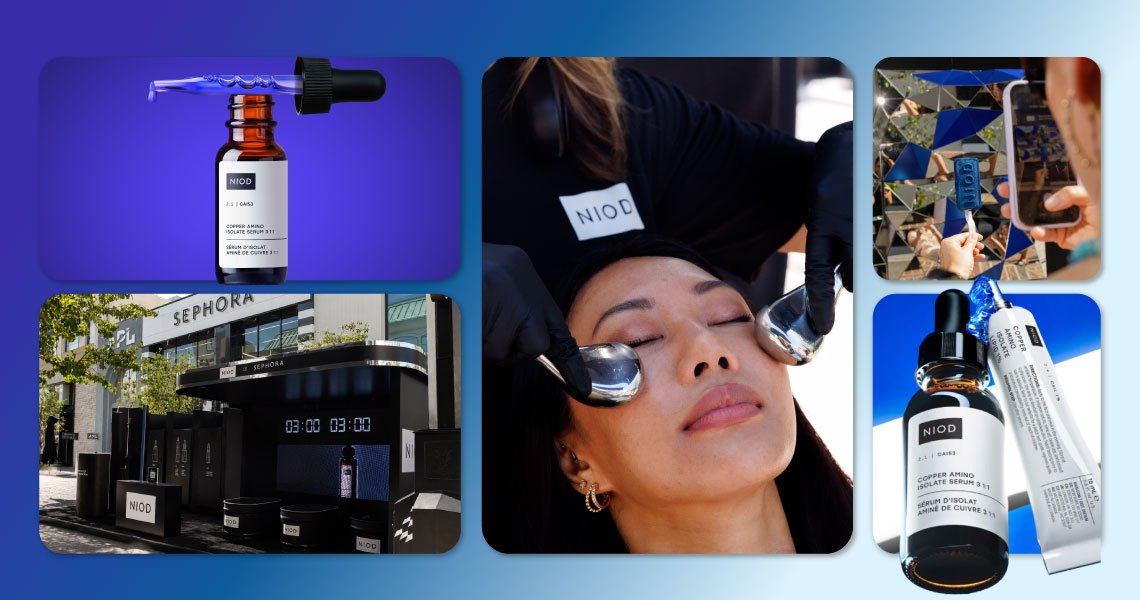
On Monday, the brand hosted a consumer launch activation at Los Angeles Caruso property The Grove that included cold plunges, mini cryotherapy facials, skin assessments, smoothies and sampling, all hosted by American DJ Steve Aoki.
The event was positioned directly in front of Sephora and, according to NIOD, more than 100 people participated in a 3-minute cold plunge, which was guided by Aoki, NIOD’s new brand partner. More than 1,000 people interacted with the pop-up.
“It was a wonderful group of new consumers, cult followers [of NIOD] and Steve [Aoki] followers that all came out in a really interactive way,” said Amy Bi, VP global brand of Estée Lauder-owned Deciem. “The philosophy of NIOD is about long-term health and optimization. … We thought [wellness activations like cryo and cold plunges] were perfect elements to bring into this overall message around long-term health and the overall notion of longevity.”
NIOD, pronounced nee-odd, launched in 2015 as the second brand from Deciem, the beauty incubator behind The Ordinary. Deciem was purchased by Estée Lauder Companies in 2017 for a total investment of $1.7 billion.
The Ordinary, an ingredient-first skin-care brand, entered Sephora in 2017 as an affordable option for “skin-tellectuals,” the science-first consumer segment that closely follows skin-care innovation and ingredient transparency. The Ordinary was also a major pricing disruptor for Sephora with several products ringing in under $10.
“They’re not meant to be seen as sister brands,” Bi told Glossy. “They’re entirely different brands, entirely different brand philosophies and principles. You’re not meant to graduate from The Ordinary to NIOD.”
Instead, NIOD products sell for $24-$101, and are positioned for consumers interested in holistic health, longevity and wellness.
One could argue that Monday’s event was “male-coded,” with dark-colored branding, a prominent male host and cold plunge challenges, which, historically, have been more popular amongst biohacker men than women, although that is shifting as longevity grows in popularity.
“We want to maintain NIOD as an ungendered brand, but I think it’s very exciting to see the uptick and interest in the male audience for beauty and skin care,” Bi said. The company also borrows its innovation pipeline from tech giants like Apple. Instead of only releasing new products, it iterates on existing products to make them better with each release, like an iPhone. “[It’s similar to] the way you get an iOS upgrade in your iPhone, but the phone itself has the same function,” Bi said. “That is exactly what we do with our products.”
For example, its best-seller, Copper Amino Isolate serum, is on its third iteration, which is denoted for consumers as “Copper Amino Isolate 3” in the product name. “This speaks really well to a male consumer who’s looking for simple solutions in that they don’t need to shop around to find the next one,” Bi said. “They know that within NIOD they will always get the most advanced research and the most advanced ingredients within their existing product. I think that’s quite interesting for the overall beauty space.”
NIOD will promote its first retail partnership at Sephora in the coming months through more activations with Aoki. The brand is set to enter Sephora’s e-commerce site plus 200 stores this month before expanding more widely. The company also hosted press and influencer events at wellness hotspots Alter in NYC and Rebase Recovery in London earlier this summer to promote the launch.
The launch is also a coup of sorts for Sephora to expand into wellness without steering from traditional beauty categories. For example, copper peptide products have become an ingredient category that has benefited from the larger online health- and wellness-focused peptide conversation. Bi told Glossy that sales of its copper peptide products have been “through the roof” over the past few years as awareness around peptides grows.
“NIOD has [been] supercharged in the last couple of years because of the overall buzz around peptides, specifically copper peptides,” Bi said. “We’ve been on copper peptides for over 10 years, and to see the community now really be curious and experimental about copper peptides is great.”
News to know:
- Boutique fitness juggernaut SoulCycle has partnered with Celsius energy drinks to sell and promote the beverages across its 60 U.S. and London locations. SoulCycle will raise awareness of the partnership through 20 Celsius-themed rides in markets like New York, Chicago, Los Angeles, and Miami, followed by year-round promotion through dedicated rides, product experiences, community programming, original content and additional activations, according to the company. As previously reported by Glossy, SoulCycle has a dynamic partnerships strategy that includes retail items like Loop Earplugs and amenities partnerships including Uni body care.
- TowerBrook Capital Partners, the private equity firm with investments in consumer brands like Jimmy Choo and health companies like Solis Mammography, has made an undisclosed investment in holistic cycle care brand Rael. The 9-year-old better-for-you menstrual brand will partner with TowerBrook to further expand across channels, continue innovating across its portfolio, and reach more consumers globally while advancing education around holistic cycle care, according to the companies.
- Happy Health, the 4-year-old digital health company, has taken on $75 million in Series A funding to scale its Happy Health sleep tracker ring. The round was led by VC fund Arch Venture Partners and digital health infrastructure provider OpenLoop. Happy Health’s Happy Health ring is the only FDA-cleared ring device for diagnosing and treating sleep apnea.
Stat of the week:
A new report from Acuity Scheduling, an appointment booking software and a scheduling app used by fitness operators, has ranked the 100 most popular cities for pilates. Scottsdale took the top spot with 35.6 pilates studios per 100,000 residents. Behind the Arizona city was Miami, Atlanta, Georgia, Minneapolis, Portland, Orlando, Tampa, Seattle, San Francisco and Sacramento, respectively.
In the headlines:
A new full-body scan, Neko Health, is coming to the US [Allure]. Longtime Solidcore coach launches NYC pilates studio [ATN]. Why more celebrity-led brands are shutting down [ModernRetail]. X creates a new revenue model for creators — but will it actually win them over? [Digiday] The six pillars of healthy, happy, curious longevity [SuperAge]. Eli Lilly is busy policing the market for a drug it hasn’t launched [TFL]. Is mouthwash bad for your oral health? [NYT] What is ‘active recovery’? Skipping this important type of movement may be why you’re not seeing results [Today]. Crosscourt adds $2M for basketball social clubs [Fitt Insider]. Adventures in unplugging [Mother Jones].
Listen in:
Midi Health is betting on topical skin care and body care as it diversifies its telehealth offerings to capture more women. In today’s episode of the Glossy Beauty Podcast, host Lexy Lebsack interviews Dr. Kathleen Jordan, MD, Midi Health chief science officer, about the company’s expansion into skin care and body care.
Need a Glossy recap?
How Boka is winning Amazon with a beauty marketing playbook. Beauty Briefing: Byredo’s growth ambitions are taking it to Sephora. Luxury Briefing: How Ralph Lauren is taking a seasonal approach to its US Open activation. Curology says Walmart shoppers convert to prescription skin care at 5x its online rate. Brands face death by a ‘thousand cuts’ as supply chain pressures and material costs eat into profit margins. Jo Malone and Tom Ford are now ‘billion-dollar brands’ as the Estée Lauder Companies reports return to sales growth.