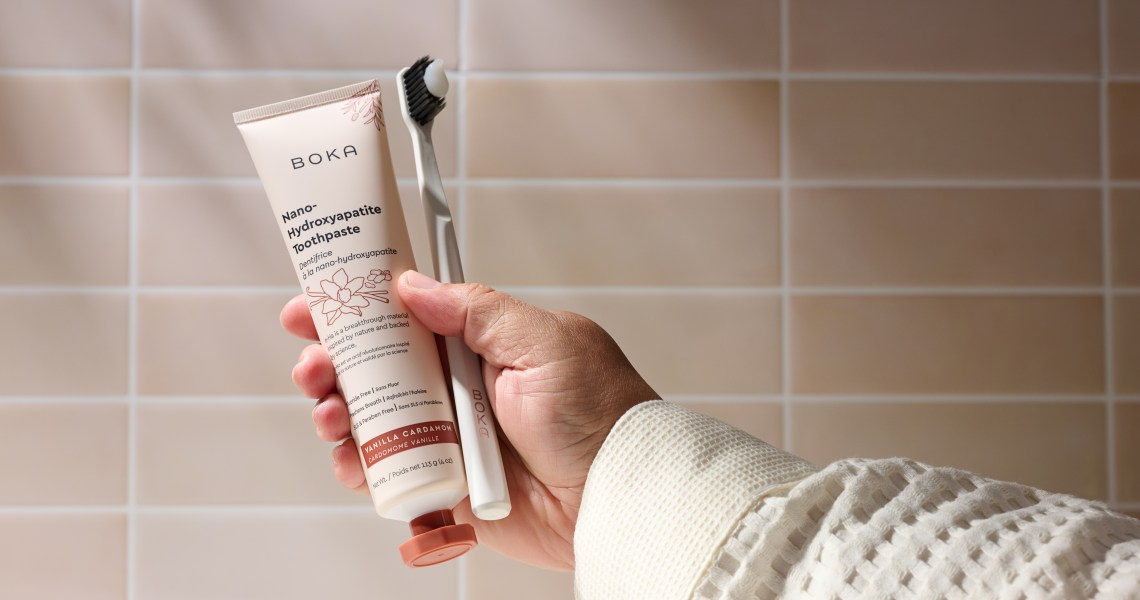
Boka, the 10-year-old oral care brand, is breaking away from the quickly growing pack of disruptors hoping to usurp the category’s longtime incumbents like Crest, Listerine, and Colgate.
“Oral care is a category that has a lot of very big legacy players, but there’s an opportunity to think about oral care in more of the beauty sense,” Sarah Mountcastle Mitchell, general manager of Boka, told Glossy. “For example, we’re relaunching our Whitening Powder. We knew niacinamide was an ingredient that’s very popular and common in skin care, and it also has benefits in oral care. So, [we thought], ‘How do we weave those [skin-care] ingredients into the product?’”
Other skin-care-adjacent ingredients used by Boka include vitamin C, hyaluronic acid and probiotics, which the company pairs with interesting flavors, like Coco Ginger, Lemon Lavender and Cherry Blossom, that read more like gourmand fragrance than toothpaste. “When you turn over a Boka box, we have flavor descriptors of the top note[s] and bottom note[s],” Mitchell said.
The company’s strategy is part of the beautification of oral care — a trend that’s also stretching into sleepy categories like dandruff, allergy care, hearing health, and just about every other CPG or wellness category sold in mass stores today. At its core, the concept is simple: better-for-you ingredients, memorable branding and more appealing packaging.
As previously reported by Glossy, the oral-care category has become more crowded over the past few years as incumbent parent companies like P&G and Unilever struggle to hold onto market share amid a rush of new brands.
By many metrics, Boka is one of their biggest threats. The company started DTC before adding distribution in luxury grocery stores and CVS. Boka entered Target and Walmart in 2025, driving 481% year-over-year retail growth in 2025. It is currently the No. 1 toothpaste on Amazon by sales, according to the company.
“We’re one of the few personal care brands that are available both at Erewhon and Walmart, so I think that speaks to consumers really looking for that everyday luxury wherever they’re shopping,” Mitchell told Glossy.
Boka launched in 2016 and was acquired by Essor Group (formerly Heyday) in 2024. Essor is a digitally native CPG company that accelerates disruptor brands like ZitSticka acne patches, Puracy cleaning products and FreshCap mushroom supplements, among others. The company is backed by VC firms like Khosla Ventures, General Catalyst and BlackRock.
Mitchell has been with Essor Group for just under five years and has worked across Boka, ZitSticka and FreshCap. She took on the GM role at Boka in 2024. Her CV also includes Unilever-owned Living Proof hair care, clean beauty brand Follain, First Aid Beauty and PepsiCo.
“Consumers are on this health and wellness journey [and] thinking about what ingredients are or are not inside [their everyday products],” Mitchell said. “It opened up their aperture to different alternatives.”
For example, Boka is free from controversial ingredients like sodium lauryl sulfate (SLS), parabens, and many colorants and dyes. It’s also fluoride-free, which allows the brand to appeal to consumers avoiding fluoride due to allergies, pregnancy or general wariness tied to health czar Robert F. Kennedy, Jr.’s ongoing anti-fluoride campaign to remove the mineral from drinking water.
Instead, the company uses hydroxyapatite, a buzzy, relatively new ingredient developed by NASA in the 1960s to help repair astronauts’ tooth degradation. Hydroxyapatite has been available in Japan since the 1980s, but Boka was one of the first U.S. brands to leverage the ingredient in the late 2010s.
Between 2004 and 2022, Google searches for hydroxyapatite were almost non-existent, never growing beyond a 4 out of 100 rating. The ingredient experienced hockey-stick growth between 2022 and today, with a 100/100 ranking — noting the most searched time in Google’s history — in April of this year.
“The interesting thing is that natural brands 20-30 years ago were all about the absence of fluoride, but there wasn’t another ingredient to take the place of fluoride,” Mitchell said. “[Now we] can tell that story from [science-backed] standpoint versus just saying you’re ‘fluoride-free,’ which has really helped us a lot with consumers.”
Despite the incumbents and disruptors, Mitchell sees a long and winding runway for the category in the coming years.
“When we entered Erewhon, the price point was in line with the competitor set. When we entered Walmart, our price point was probably three to four times higher than competitors, and we’re blowing all of our targets out of the water,” Mitchell said. “To me, that says that consumers are looking for an alternative. … I imagine there is a ceiling, but I don’t think we’ve seen it.”