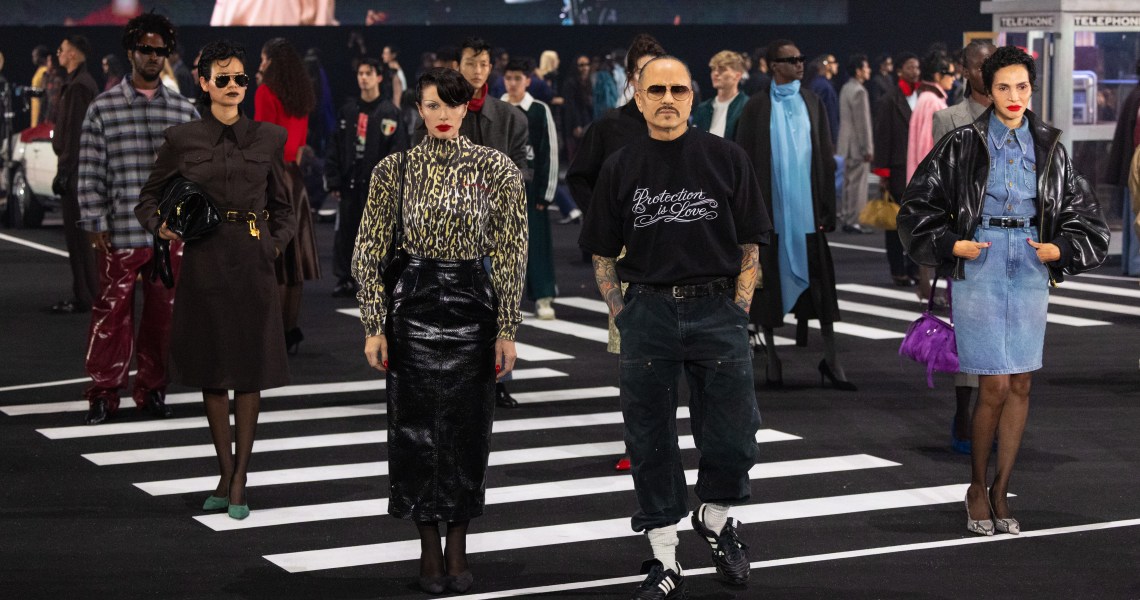
Designer Willy Chavarria may soon be able to talk customers through his collections without actually being there.
The designer is considering adding an AI-generated version of his own voice to his online shopping experience, allowing customers to hear from Chavarria while browsing products and asking questions. “At some point, you may even hear my voice talking,” Chavarria said in an interview. “It would sound just like me and speak just like me.”
Exactly how that would work is still being figured out. Chavarria could record specific messages or provide enough recordings for AI to simulate his voice and respond to customer questions. He said another voice could handle most of the shopping experience, with his own appearing at particular moments.
“It’s very weird,” Chavarria said. “That’s why we haven’t done it yet because I still need to put a lot more thought into it.”
The idea comes as the people behind fashion’s collections are playing a bigger role in how consumers perceive the brands themselves. McKinsey found this year that emotional connection is now the top driver of luxury brand desirability in both the U.S. and China, ahead of traditional markers including craftsmanship and heritage. In the U.S., creativity and cultural relevance are also becoming more important to desirability.
Creative-director moves can translate quickly into consumer interest. When Jonathan Anderson’s departure from Loewe was announced in early 2025, searches for the brand jumped 38% on Lyst. During his tenure, Loewe grew from an estimated $269 million in sales in 2014 to roughly $1.75 billion-$2.34 billion in 2024, based on analyst estimates converted from euros.
AI could take that relationship a step further, making a designer’s point of view, tone and eventually voice available directly within the shopping experience. Ralph Lauren is already experimenting with a version of this idea through Ask Ralph, its AI-powered styling assistant, which gives shoppers personalized recommendations based on the brand’s aesthetic and product assortment. The tool does not currently use Ralph Lauren’s own voice.
Chavarria brought up Lauren as an example of how much more personal that experience could become. He said he could imagine visiting Ralph Lauren’s website and having Lauren himself explain a sweater. “That’s so fun,” he said.
Chavarria has started exploring that possibility through his work with commerce platform Swap. For the June launch of his Adidas World Cup collection, the brand created a separate AI-powered storefront. Shoppers were largely directed there through Willy Chavarria’s owned channels. An AI discovery widget on the brand’s main site also directed shoppers into the experience. Once there, customers could ask product questions, receive recommendations and virtually try on clothing before checking out.
The launch produced a sizable sales bump. “Comparing the Swap launch to the last [collection launch] we did, we saw a 2x increase in revenue with comparable conversion and average order value,” a representative from the brand said.
Over the first six days, the launch generated more than 1,000 orders at a $249 average order value, according to Swap. Overall conversion was 3%, and direct, owned and email traffic drove 81% of revenue.
But some of the most useful information for Chavarria came from what shoppers were actually asking.
Of 802 conversational signals tracked during the launch, 44.8% related to sizing and fit. Shoppers wanted to know which size would work best, whether pieces fit as they did on the model, and whether products ran large or small.
“Up until now, it’s all been based on just literal sales,” Chavarria said. “You don’t really know a lot of detail behind why somebody might return something or why somebody may decide not to purchase something.”
Repeated questions can give the brand a better indication of what information is missing online. A customer may want to understand the weight or stiffness of a fabric, for example, before deciding whether to buy it.
“It enables the customer to ask their own questions that they might be interested in,” Chavarria said. “If a lot of people are asking the same question, then there’s something we can learn from that.”
Only 376 shoppers used virtual try-on, but they were much more likely to buy. Around 20% of VTO sessions resulted in a purchase, compared with a site-wide purchase conversion rate of 0.8%, according to Swap. The group ultimately accounted for around 7% of launch orders.
Juan Pellerano-Rendón, CMO of Swap, said part of the opportunity is tackling the uncertainty that remains in buying clothes online.
With a traditional e-commerce experience, “you don’t get a feel for how it fits on you, how it may look on your skin tone,” he said. “To see the clothing on your person, to say, ‘Do I like this? Do I not?’ I think virtual try-on gives you a really quick read.”
For Chavarria, however, the potential goes beyond fixing fit problems. “Our goal [as fashion designers] is to be as transparent, romantic, personal and emotional as we can be in the storytelling [behind the brand],” he said.
He sees online retail as increasingly important to how consumers encounter a brand, particularly for a company without its own brick-and-mortar network. Willy Chavarria is currently sold through around 150 retail stores, alongside its direct-to-consumer business.
Looking ahead to his next Paris menswear show in January, Chavarria said the fashion show still gives designers tools that a website cannot, from lighting and sound to temperature and the physical environment. But AI, he believes, offers another way to carry some of that feeling into digital retail.
“AI allows you to communicate more personally without being there with your customer,” he said.
The Adidas project has already changed how Chavarria thinks about future launches. Because the Swap storefront exists separately from the brand’s main website, it allowed the team to create a distinct world around the collaboration.
“It enabled us to just kind of build a separate world around that,” he said. He expects to use the format again, particularly for collaborations.
And when asked whether AI could eventually extend into the experience around his runway shows, Chavarria hinted he already has something in mind.