In this week’s Luxury Briefing, I speak with chief of humanistic technology Francesco Bottigliero about Brunello Cucinelli‘s AI software platform, Callimacus, and its new Salesforce partnership. The company is betting that its technology expertise can become a booming business of its own. Elsewhere, Ralph Lauren and Capri Holdings are showing where luxury demand is holding up, while Lyst’s latest data spotlights the brands and cultural forces capturing shoppers’ attention. For tips or comments, email me at zofia@glossy.co.
Most e-commerce platforms essentially give every shopper the same website. Callimacus does not. The AI platform developed inside Brunello Cucinelli assembles webpages in real time, selecting products, editorial content and design components according to what it understands about a visitor’s context, interests, behavior and likelihood of making a purchase.
That distinction is what Brunello Cucinelli now believes it can sell. Callimacus is not a chatbot layered onto a fixed website, but a presentation system that sits above existing commerce infrastructure, including Salesforce Commerce Cloud and Shopify. Brands can use its standard setup or add industry-specific capabilities without replacing the technology that manages their inventory, payments and checkout. Callimacus is being pitched to brands, retailers and other consumer-facing companies that want their websites or apps to respond more closely to each visitor’s intent.
Six months after Brunello Cucinelli introduced the platform on its own e-commerce site, Callimacus became an independent software company. It generated revenue in the seven figures last year, and the company expects to double those sales this year and again next year, according to Francesco Bottigliero, Brunello Cucinelli’s chief of humanistic technology. Three large corporations are already developing projects using it, while around 40 more prospective clients are in discussions with the company.
In July, Salesforce agreed to invest in Callimacus and help bring it to market. The deal creates an unusual new revenue model for a luxury company: Brunello Cucinelli built technology around its own understanding of discovery, storytelling and brand identity, tested it on its customers, and is now selling that expertise as enterprise software.
The relationship began in October 2024, when Bottigliero and his team traveled to San Francisco with an early version of Callimacus. “They were listening to us saying, ‘Hey, what a brave move. Are you sure?’” he said.
Callimacus emerged differently, from a team of engineers, editors, designers and stylists working without a traditional hierarchy. The aim was not to add another feature to a conventional website, but to rethink how a luxury customer should browse online — from the vantage point of insiders from the brand.
That approach reflects Brunello Cucinelli’s broader philosophy around technology. Bottigliero compares AI to the relationship between a pilot and co-pilot, partly because his father was a pilot. “We consider AI a companion of human intelligence,” he said. “We don’t want artificial intelligence taking the roles of human beings, but at the same time, we have to embrace change.”
Callimacus now operates as the presentation layer on Brunello Cucinelli’s website, while Salesforce Commerce Cloud manages transactions underneath. Native integrations with Salesforce Commerce Cloud and Shopify were released at the end of June.
Salesforce’s role extends beyond capital. The companies are working together on the go-to-market strategy, using Salesforce’s customer relationships, marketing organization and global reach to introduce Callimacus to other businesses.
The agreement is not exclusive. Callimacus will remain compatible with different commerce platforms like Shopify and is already targeting sectors beyond retail, including travel, publishing and financial services.
“We want to play as much as possible in the Champions League [of brands],” Bottigliero said. “This thing, of course, could fail, but we think it could have important market traction globally.”
The investment follows six months of testing on Brunello Cucinelli’s own site. Bottigliero said active time roughly doubles once a customer begins interacting with Callimacus. Product views are also higher, while bounce and conversion rates remain positive. Currently, Callimacus is live in geographic markets that collectively account for around 70% of Brunello Cucinelli’s online sales, with further markets set to be added.
The platform’s next major release, planned for the end of September, is called Memories. At present, Callimacus responds mainly to what a visitor is doing during a live session. Memories will allow it to draw on years of anonymized, aggregated behavior stored in tools such as Google Analytics.
“We have years of interaction between users and the platform that have been recorded by Google Analytics, which are not used to trigger anything currently,” Bottigliero said.
That information will form what he calls a “cloud of memories.” An agent called Whisper will feed relevant patterns to Tamyris, Callimacus’s user-experience composer. It may recognize, for example, that a certain product presentation recently worked well for U.S. visitors looking for a particular kind of outfit, and suggest that product presentation to new customers.
The company is also improving Callimacus’s understanding of conversation. If a shopper is shown six blue blazers and asks, “Do you have the one on the top left in a 48?”, the platform must understand both the visual reference and the history of the exchange.
Callimacus can also be adapted by industry. A cruise company, for example, may ask the system to assess a visitor’s familiarity with onboard services or likelihood of booking another trip. “In two-thirds, or even more, of the cases, prospects or brands are attracted, but they want to start with simple experiences,” Bottigliero said.
Still, the pipeline is growing. The first external project is expected to launch in November. The company has 12 employees and expects to more than double its headcount within six months.
Callimacus is also becoming more independent from Brunello Cucinelli. Bottigliero plans to appoint a separate chief executive in the coming months. “It should not be considered a captive company,” he said. “It’s not a captive company of Brunello Cucinelli, and we are not planning to make it a captive company of Salesforce.”
For Bottigliero, the broader issue is that conventional technology platforms often push brands toward the same layouts and customer journeys. “There is the risk you find yourself in a kind of conformity loop where all the websites look the same,” he said.
He illustrated the point with a story from a cycling trip in Umbria. When his heart-rate monitor warned that its battery was low, he stopped at a village bar and chose Duracell batteries over cheaper ones because he trusted the brand to last longer.
Even there, he said, “someone is trying to protect the identity” of the brand.
The same principle applies online. Brunello Cucinelli does not want its cashmere reduced to two lines of chatbot copy and a thumbnail beside a cheaper alternative. “We don’t want these brands to become commodities,” Bottigliero said.
Lyst Q2 2026: Luxury shoppers are becoming product-first
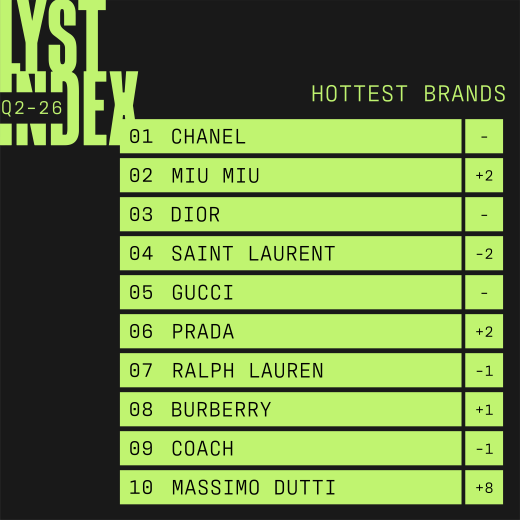
Luxury brands are losing some of their dominance as the starting point for online discovery. Katy Lubin, vp of brand and communications at Lyst, said 58% of searches on the Lyst shopping platform this year have included a brand name, down from around 90% in 2024. “Over the last year, we have seen product-led searches grow around 6% quarter over quarter,” she said, pointing to longer, more descriptive queries encouraged by Lyst’s AI search experience.
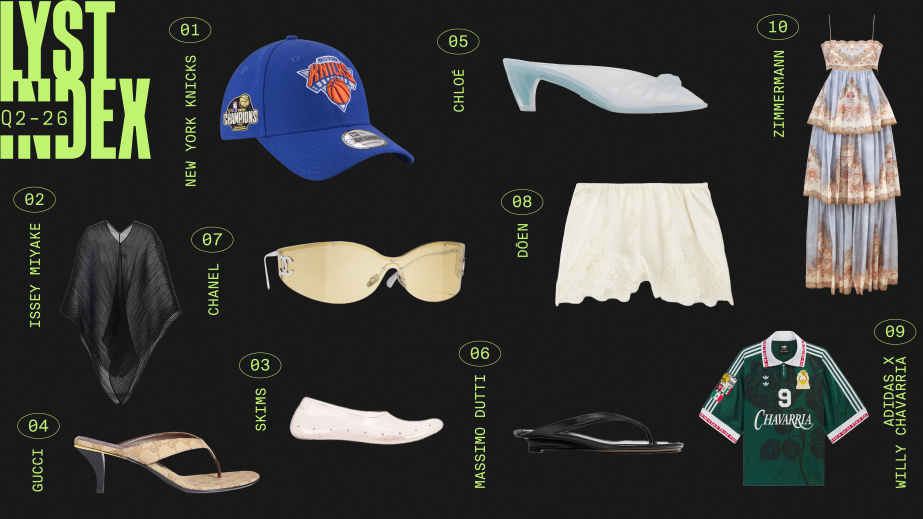
That shift is helping individual products become entry points to luxury brands. Searches for Issey Miyake’s Madame-T Stole rose 501% quarter over quarter after styling videos on TikTok and Instagram highlighted its versatility. Lubin said its accessible price made it “an entry into the brand’s signature design language,” while overall demand for Issey Miyake doubled during the quarter.
Lower-priced products, like ones from Massimo Dutti, are gaining share, but that does not mean shoppers are spending less. Over the past six quarters, Lyst has seen demand rise for luxury items under $500, while its average luxury order value has increased to around $1,085. “Shoes and accessories remain the key gateway for shoppers buying into luxury labels,” Lubin said.
Earnings: What Ralph Lauren gets right that Capri is still chasing
Ralph Lauren and Capri offered two very different snapshots of brand elevation this week. Ralph Lauren’s revenue rose 13%, with DTC comps up 12% and average unit retail up 15%, marking its 37th consecutive quarter of AUR growth. Needham analyst Tom Nikic called the company a “high-quality momentum name” and said its second-half outlook may prove conservative, particularly given continued strength in Asia, where total sales rose 25% and grew more than 40% in China. The bigger takeaway is that Ralph Lauren’s elevation strategy is now producing both higher prices and unit growth, rather than relying on one major cultural moment.
Capri remains much earlier in that process. In a note, Telsey Advisory Group said Michael Kors is still “a work in progress,” following 14 consecutive quarters of sales declines, and cut its price target on Capri to $18 from $21 after a weaker-than-expected second-quarter outlook. The company is reducing markdown inventory, lowering promotional intensity and rebuilding its pricing architecture, including more handbags below $200 at full price and 5-10% price increases in outlets. However, Telsey warned that legacy value-focused customers may need time to adjust to the more premium positioning.
There are early signs that Capri’s changes are working. Michael Kors’ North American wholesale business returned to positive point-of-sale growth for the first time in more than three years, while Jimmy Choo sales increased 10.5%, its third consecutive growth quarter. Telsey pointed to Jimmy Choo’s broader pricing ladder, stronger accessories and casual footwear, and more experiential marketing as evidence of healthier momentum. The contrast is instructive: Ralph Lauren is compounding years of consistent investment in product, pricing and distribution, while Capri is still absorbing the near-term cost of trying to rebuild the same kind of pricing power.
Executive moves
- Pandora appointed André Branch president of North America, effective August 15, with the former R.E.M. Beauty CEO succeeding Luciano Rodembusch and overseeing the jewelry brand’s growth in its largest market.
- Pandora also named Walmart Mexico and Central America CFO Paulo Garcia as its next chief financial officer, with Garcia joining on October 1 and formally succeeding the retiring Anders Boyer on December 1.
- Hugo Boss appointed Daniel Kearns head of design for Boss by Beckham, reuniting the designer with David Beckham and tasking him with overseeing design, merchandising and branding ahead of his first collection for fall 2027.
- Exemplar Luxury Group named Chloe King women’s fashion director for Neiman Marcus and Saks Fifth Avenue, expanding her remit to lead the retailers’ women’s fashion direction following Roopal Patel’s departure in January.
News to know
- Chanel posted double-digit comparable sales growth in the first half of 2026, according to Bloomberg, outperforming much of the wider luxury market as demand strengthened around Matthieu Blazy’s first collections.
- Four former Chanel Hong Kong warehouse employees were sentenced to between four and seven years in prison for conspiring to steal 724 handbags and wallets, valued at about $2.4 million, that had been marked for destruction in 2017.
- Christie’s will auction off costumes and accessories from “The Devil Wears Prada 2” online from September 1-15, with proceeds benefiting the Committee to Protect Journalists and the CFDA. Lots include pieces worn by Meryl Streep, Anne Hathaway and Emily Blunt.
- EBay raised its annual revenue outlook after second-quarter revenue increased 15% to $3.13 billion, supported by growth in authenticated luxury, fashion resale and other focus categories, as well as its $1.4 billion acquisition of Depop.
- A U.S. appeals court overturned a temporary ban preventing Perplexity’s AI shopping agents from accessing Amazon, ruling that the users operating the agents, rather than Perplexity itself, were accessing the platform under federal computer-fraud law.
Listen in
On this week’s Glossy Podcast, senior reporter Danny Parisi speaks with celebrity stylist Micaela Erlanger about the evolution of method dressing, where the line falls between storytelling and costume, and how Zendaya and Law Roach have helped turn red-carpet fashion into an extension of a film’s marketing. Listen here.
Read on Glossy
As private-equity firms pull away from fashion, licensed brand management companies are stepping up acquisitions. Rhode sells $27 million DTC in one day and plots an expansion into 19 countries. Why beauty brands are increasingly acting like entertainment companies.