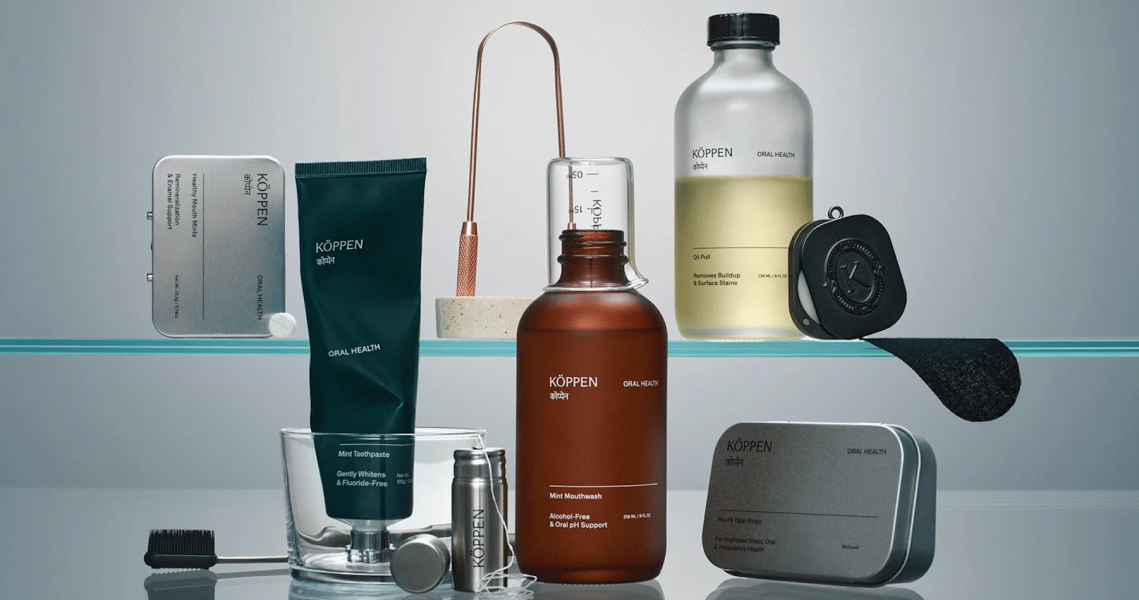
For the Wellness Briefing, Glossy spoke with founders of recently launched oral-care brands looking to disrupt the space, including Köppen, Evenmouth and Bastét, which offer products based on a three-step system, microbiome-focused protocol and novel ingredients, respectively.
Additionally, P&G agrees to acquire supplement maker Thorne for $3.8 billion, Function Health takes on $450 million to acquire new customers, and Crunch Fitness launches a 3.0 gym concept to compete with boutique fitness studios.
New oral-care disruptors are racing to win shoppers with better-for-you ingredients, multi-step systems and novel product categories
The oral-care market has a new class of disruptors looking to redirect consumer spending in the $12 billion domestic oral-care marketplace.
“Most of the oral care [in the U.S.] was designed, and has been dominated, by three main players,” Dr. Eve Lofthus, DDS, co-founder of microbiome-focused Evenmouth, told Glossy. “It’s really hard to get into a market like that, and really disrupt it, because their [cost of goods] are so low. … The ingredients that they use are so cheap.”
The U.S. oral-care market was valued at $12.36 billion in 2026, according to Mordor Intelligence, and is estimated to reach $14.56 billion by 2031. Its leaders include Colgate-Palmolive, maker of Colgate and Tom’s of Maine; Procter & Gamble, which owns Oral B and Crest; Unilever, maker of Pepsodent and Closeup; and Kenvue, owner of Listerine.
Dr. Loftus launched Evenmouth DTC last month with two products: a $18 Dio Biotic toothpaste and $30 Dental Drops, both of which are made to create an environment where good bacteria can thrive in the mouth. In many ways, Evenmouth is a foil to the everyday mouthwash that’s dominated the market for decades.
“A main reason why big heritage companies can’t formulate products like this is that if they did this better-for-you toothpaste, they’re kind of invalidating their hero product toothpastes,” Dr. Lofthus said. “What if they switched their messaging and said, ‘Actually, we don’t want to kill 99.9% of bacteria anymore’. That kind of invalidates what they make.”
She told Glossy that recent gene sequencing of the mouth, and a mountain of studies done in the past 15 years, have completely shifted how we should care for our mouth. In her line, she hopes to accelerate the public’s understanding of the mouth microbiome, and the idea of good bacteria being beneficial and protective of one’s overall health.
But oral care’s biggest incumbents aren’t naive to the shift happening across CPG. During the company’s earnings call last week, P&G CFO Andre Schulten said the company is actively looking to innovate as a response to oral-care sales being down for the quarter. “There’s still work to be done on oral care on the paste side,” he said. “We are actively deciding what we want to do in that space.”
Unilever appears to be in the same boat. “We see opportunities in advancing the efficacy of existing large formats, like toothpaste, while expanding into new formats and devices,” Gaurav Datta, global VP of Unilever’s oral care business, wrote in a blog post in April 2025. “We anticipate that in the coming years, oral hygiene will have a stronger connection to systemic whole-body health in the minds of consumers.”
This gives disruptors a unique opportunity to forgo scale in favor of building a trusted brand ripe for acquisition.
Alexandra Baker, co-founder of Quebec-based Bastét, is another founder in the running. “Our oral care industry has really lacked innovation,” Baker told Glossy. “I think consumers are ready for more.”
Bastét stands out for its luxury positioning and 10% hydroxyapatite, a buzzy new ingredient made from naturally occurring calcium phosphate minerals and currently used by established leaders like Boka, Davids and Guru Nanda.
Bastét launched in June with one product: $22 French Mint Toothpaste with nano-hydroxyapatite. Design studio Wedge created the branding — an elevated take the agency describes as “oral care for the beauty counter.” Wedge’s work includes Coco Kind, another dental disruptor, and Vacation Sunscreen.
Baker, a former buyer at Canadian department store Holt Renfrew, is targeting longevity-focused stores and beauty boutiques, not drugstores and pharmacies. One month in, she has signed Gee Beauty, Shop Good and 15 American retailers, announcing soon, she told Glossy. She told Glossy that beauty and wellness businesses are especially hungry for stylish oral-care innovation: Most interest is inbound thus far.
“We need to reposition oral care as less of a chore that’s [driven by] fear and utility, and more of the way that I saw it [when I started the brand], which is: Taking care of yourself is an act of courage and ambition,” she said. A month in, her most surprising consumer base is men who are also interested in longevity, as well as individuals who buy products for aesthetics.
Köppen is another recent launch that marries science and aesthetics.
“Our consumer is someone who is taking a very active approach and interest in understanding what goes into the products they use every day,” Priya Shah, co-founder of Köppen, told Glossy. “This consumer is open to paying a premium. We’re not your $8 Crest or Colgate toothpaste, and we’re offering a full scope of taking care of the entire mouth.”
Köppen launched with 12 products organized into a three-step system. This includes a copper tongue scraper, oil pull, mouthwash, toothpaste, lip balm and mints, among other products, for $20-$48 each. The full system retails for $265. “We wanted to give oral care a place on the counter,” Shah said.
So far, it’s working: The brand launched in April and has already sold out its entire range five times at buzzy new Los Angeles luxury grocery store Laurel. But Shah doesn’t see her consumers only as affluent or coastal.
“Our data shows there is definitely a heavy coastal presence, and for sure metropolitan, but we do see sales across the country right now,” she said. “It’s fairly evenly spread across the rest of the country. I think part of that is not just our brand, but there is also starting to become this awakening around the importance of oral care [that we’re benefiting from, too].”
But this isn’t oral care’s first class of disruptors. The space has exploded over the past quarters with fresh brands bringing playful branding or affordable pricing, and at least one blueprint for winning social media marketing, care of Guru Nanda.
“This is a tide that rises all boats,” Dr. Lofthus told Glossy. “I would like to see true innovation and products that really have the courage to bring what we know to be true about the mouth [to the dental aisle]. … That will probably be a lot of the job of those big care companies, as well. … I know they must be thinking about it.”
News to know:
- Announced Tuesday, Procter & Gamble will acquire supplement maker Thorne for $3.8 billion. According to the conglomerate, which also owns wellness brands like Align, Wonderbelly and New Chapter, the purchase of Thorne strengthens P&G’s ability to serve growing consumer demand for science-backed, practitioner-trusted wellness solutions. Thorne is a supplement category leader launched in 1984 and acquired by L Catterton equity group in 2023 for approximately $680 million. The brand has more than 300 SKUs.
- As more and more hormone-tracking wearables hit the market, incumbents are shifting their strategies to meet the moment. Announced Tuesday, wearable brand Whoop has integrated Natural Cycles — the FDA-cleared, temperature-powered birth control app — into its in-app offerings. “We’re making one of our biggest investments in women’s health in Whoop history,” CEO Will Ahmed wrote in a post on LinkedIn. “We didn’t want to simply offer another integration. We wanted to make it a seamless part of the Whoop experience. And with the first year included, there’s no additional subscription required.” Natural Cycles is also integrated into Oura’s wearable ring, but comes with an additional annual cost of $149.
- Function Health, a leader in the emerging, vertically-integrated preventative health and wellness space, has taken on $450 million in funding from General Catalyst’s Customer Value Fund to increase customer acquisition. “This financing reflects our belief that Function is one of the defining companies of our generation,” Pranav Singhvi, partner and co-head of CVF, General Catalyst, said in a statement. “Function has created an entirely new approach to health that we have never had before. We believe Function is uniquely positioned to reach millions more people, and we’re proud to support the next phase of its growth.”
- Crunch Fitness, the gym chain with more than 550 global locations, is beta-testing a new franchise gym concept that brings a variety of group fitness concepts under one roof in an effort to better compete with boutique fitness studios. Called Crunch 3.0, the new concept includes group reformer pilates, strength training and boxing, plus recovery modalities like red light therapy, contrast therapy and infrared sauna. For example, one of the first locations, opening in Little Rock, Arkansas this fall, is a $5 million, 50,000-square-foot state-of-the-art fitness facility, according to Crunch.
Stat of the week:
The injectable research peptide pipeline has new legal momentum after clearing one of many hurdles from the Food & Drug Administration last week. However, while interest is rapidly growing, few consumers understand the emerging market. According to a study from New Consumer, just 19% of Gen X consumers say they understand what peptides are, while 41% of survey participants had never heard of peptides. These stats jump a little when surveying Gen X and millennial respondents: 41% say they understand peptides, while 25% had never heard of them.
In the headlines:
Does Erewhon’s $12 Sacred Water hydrate better than tap? [Vogue] From Ozempic to eye creams: Demand for bathroom mini fridges is heating up [Guardian]. Why Marriott is turning hotel rooms into showrooms [Modern Retail]. A new approach to selling travel: wellness [Travel Weekly]. Throne adds $10M for AI toilet sensor [Fitt Insider]. A ’90s cardio kickboxing trend makes a big comeback [ATN]. Kroger’s new CEO, a Walmart veteran, is focused on speed and execution [Digiday].
Need a Glossy recap?
Well-funded innovators rush to define and lead the emerging ‘hair longevity’ category. Glossy Pop Newsletter: How 16-year-old Embreigh Courtlyn turned her friend group into a $2.2 million Target launch. How Ulta Beauty is reaching Gen Zalpha teen boys through first men’s masstige fragrance launch. Beauty Briefing: Why legacy brands are doubling down on hero products. Luggage brands are gunning for a bigger share of the travel gear wardrobe. Retail’s new operating model centers on leaner teams, smarter data and physical community. Luxury Briefing: Luxury’s recovery has a value-for-money problem.