Premium luggage brands are moving beyond the suitcase as more customers seek out a “travel wardrobe”.
After the post-pandemic travel boom, the luggage category is still growing, but the next phase of growth is more complicated than before. Euromonitor data cited by Vogue Business showed the global luggage market grew 4.5% to $19 billion in 2024, driven by consumers’ continued appetite for travel and experiences. But for premium brands, market growth does not erase a structural problem: The better the suitcase, the longer it takes a customer to need another one.
New Circana data supports that shift. For the 12 months ending April 2026, U.S. travel-goods dollar sales declined 2%, while unit sales increased 1%, reflecting a change in what consumers are buying. Travel accessories, including organizers, packing cubes and toiletry bags, were one of the fastest-growing segments and accounted for roughly 85% of the industry’s unit growth over the past year. Backpacks also grew, while traditional luggage and suitcase categories were softer, according to Circana.
In other words, consumers are not necessarily buying more suitcases. They are expanding what Circana described as their “travel gear wardrobe.”
That is pushing brands including Antler, July and Béis to treat the products around the suitcase as acquisition and retention tools, not just add-ons. Antler has pushed further into travel bags, backpacks, packing cubes and its Travel Essentials range; July has leaned into matching sets, seasonal colors and travel bags; and Béis has renovated its bestselling Weekender while using trade-ins and pop-ups to bring existing customers back. Across the category, the goal is to encourage more purchases around each trip, rather than wait for customers to replace a suitcase.
“Durability is a feature many people want from premium luggage brands,” said Neil Saunders, managing director at GlobalData Retail. “If they’re investing a lot, they expect the product to last and to cope with the stresses and strains of travel. This automatically means they won’t expect, or want to, make regular replacement purchases.”
At Antler, the 111-year-old British luggage brand, sales are still rising, but so are sales of accessories like rucksacks. The company’s sales to first-time customers grew more than 50% year over year, and the share of first-time customer spend rose from 12% to 18%. Repeat customer orders increased more than 30%, with existing customers spending 50% more on handbags and rucksacks and 30% more on accessories. Overall, Antler reported gross annual sales of £52 million, or about $70.2 million, for the year ending February 28, 2026, up 17% year over year. The U.S. was its fastest-growing market, with sales up 83%, driven by digital growth and wholesale expansion with retailers including Nordstrom and Bloomingdale’s.
“Luggage remains the core of our business,” Kirsty Glenne, Antler’s managing director, told Glossy. “But travel bags are our fastest-growing category right now, and we’re seeing that shift accelerate.”
Antler still makes most of its money from suitcases. But Glenne wants the brand to be considered across more travel moments, not only when someone needs a case. Customers are increasingly entering through products such as the Essential Weekender, priced from $195; the Essential 2-in-1 Tote Backpack, at $160; and packing-cube sets, from $65.
“Our ambition is to be a travel lifestyle brand,” Glenne said. “When we sell more hoodies than suitcases, that’s when we’ve made it.” Antler’s Travel Essentials range, launched last year, includes a unisex Travel Essential Hoodie priced at $125, alongside products including packing cubes, candles and cashmere scarves.
The hoodie is not the point so much as the purchase frequency. These products sit at a lower price point than a suitcase and are easier to buy around a specific trip, giving Antler more ways to acquire customers before they are ready for a larger luggage purchase.
July, the 7-year-old Australian travel brand, is on a similar mission. Luggage still accounts for around 75% of its sales, while bags and accessories make up the remaining quarter, Athan Didaskalou, July’s co-founder, told Glossy. That share has grown as July has invested in new bag designs over the past year.
Most second purchases happen within two to three weeks of the first, often because customers are preparing for an upcoming trip and return for a matching carry-on or additional piece, Didaskalou said. Returning customers account for about a third of July’s orders. For the brand, the repeat purchase is often tied less to replacement than preparation: customers come back because they are still planning the same trip, not because the first product has worn out.
Circana also pointed to Nordstrom’s Anniversary Sale as an example of how luggage sets are changing. Rather than traditional three-piece suitcase sets, many of the featured sets paired a carry-on with a matching tote or backpack. The shift reflects growing demand for versatility, which increased as a purchase driver year over year in Circana’s consumer research, while price and promotion became less important. Quality remained the top purchase consideration.
According to Saunders, offering different sizes and configurations is one of the clearest opportunities in luggage. “A lot of consumers like matching sets and to have flexibility in terms of the size and configuration of their luggage,” he said. The opportunity is to move a customer “from the weekend bag to the carry-on to the big suitcase.”
July has leaned into that behavior with matching sets, styles in limited-edition colors and seasonal collections. This year, that has included “Colour Theory,” a product range available in Berry, Orchid and Pacific hues, and “In Transit,” with styles in Steel Blue and Bone White. In July, July’s Melbourne flagship previewed the Endless Summer Collection, spanning luggage, bags and accessories.
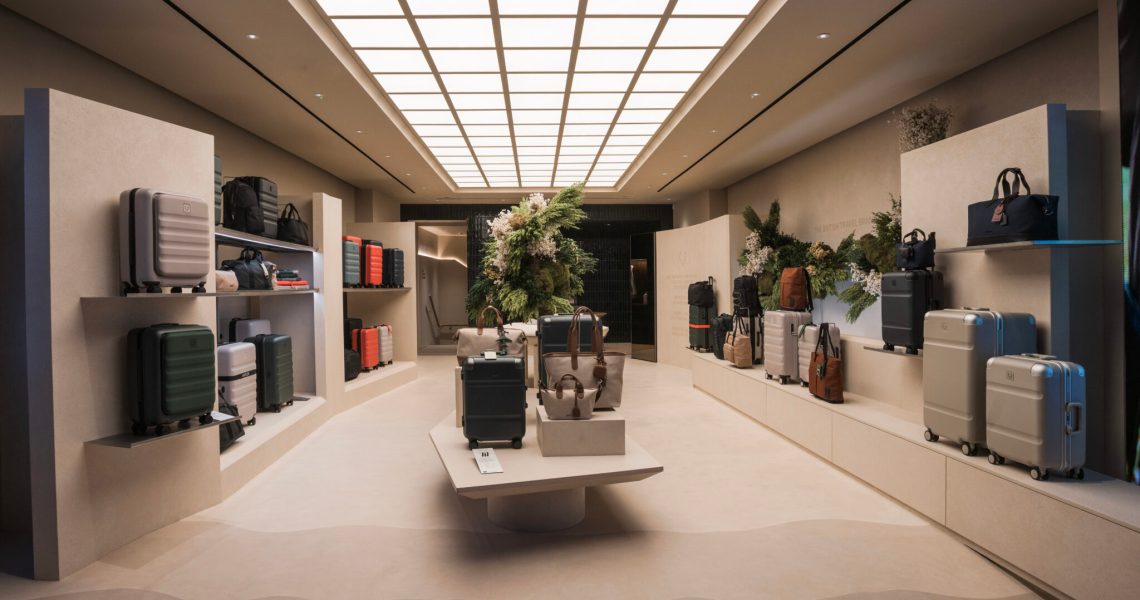
Stores are becoming another way to make those adjacent purchases more visible. Online, a customer may search for a carry-on and check out with one item. In a store, the tote, packing cube or travel wallet can sit directly next to the suitcase.
“Stores are important both for trying things out and for brand presence,” Saunders said. “It’s also easier to showcase complementary items and for store associates to upsell.” The challenge, he added, is that slower replacement cycles make store economics harder, meaning luggage stores often need to be in locations with strong foot traffic.
Antler’s Regent Street flagship, in one of central London’s busiest shopping districts, is built to make the wider travel offer easier to understand. The two-floor store, designed with architect Checkland Kindleysides, offers product interaction, hospitality and events, while displaying travel bags and accessories alongside core luggage styles. It also houses Antler’s monogram collection, including packing cubes, a candle, a cashmere scarf and a throw.
July is using stores in a similar way. Its new Melbourne flagship, opened in July, spans more than 250 square meters and is the brand’s largest retail project to date. Customers often explore the brand online before visiting a store to touch and feel the product, or discover the brand in-store and later return to buy online. Stores outperform e-commerce on both conversion and basket size, Didaskalou said.
American brands are also re-developing their assortments to keep up with customers exposed to a market saturated with choice. This month, the 8-year-old Béis brand, founded by actress Shay Mitchell, relaunched its Core Collection, led by a renovated version of its bestselling Weekender bag, with upgrades informed by consumer feedback, social listening and travel behavior. The rollout included a reconstructive surgery-themed social campaign, an archive-style New York pop-up, and an in-store trade-in program offering customers 20% off a new purchase when they brought in a pre-loved Weekender or Mini Weekender.
“If a brand can use features from its core luggage range in other products — like durability, materials, practicality, problem solving and so forth — then extensions can make sense,” Saunders said. “But those extensions need to be aligned with the main brand messaging and not just random bolt-ons.”
The brands best placed to expand are those that can make a packing cube, weekender or store visit feel like part of the same promise that sold the customer on the suitcase.