This week, we talk to some of the fashion and tech executives in attendance at Cannes Lions, rounding up some of the biggest announcements, trends and marketing strategies driving the conversation right now.
The Cannes Lions advertising festival is happening this week in the south of France, and fashion brands are among the many businesses in attendance. The event showcases the latest technologies and creative strategies in advertising. This year, new AI tools, a focus on cultural collaborations and strategies for further engaging with the creator economy are all at the center of the conversation.
Glossy spoke with several executives in attendance about what they’re showing and what they’re seeing at Cannes this year. Here’s a roundup of the Cannes buzz that’s most relevant to the fashion industry.
Coach goes all-in on Spotify
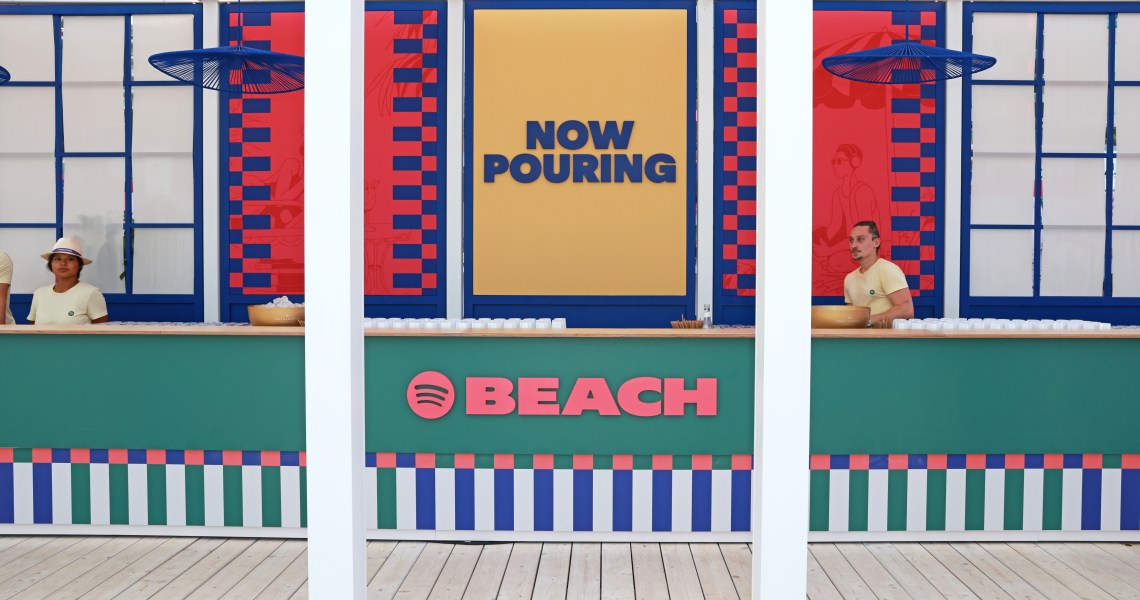
At Spotify Beach, a Spotify-hosted activation at Cannes showcasing a number of music and audio-related trends, Coach announced a “global cultural partnership” with Spotify that will begin this fall.
The announcement was light on details, but it characterized the partnership as focusing on Gen Z and going beyond simple paid ads. Instead, Coach will work to build campaigns directly into Spotify.
We’ve already seen examples of Spotify allowing deeper integration with brands for limited campaigns. Gap, for example, created a series of branded playlists on Spotify this month, curated by top artists like Katseye and Tyla.
“At Coach, self-expression lives in style,” Coach CMO Joon Silverstein said on stage at Spotify Beach on Tuesday. “At Spotify, it lives in music. Together, we’re going to be building something that goes beyond both, turning those things into real connections, including experiences people can share together in real life.”
Coach has increasingly turned its marketing focus toward Gen Z. At the beginning of June, Coach launched a recurring ad campaign called &Coach featuring a rotating series of Gen-Z-favorite celebrities like musicians Charli xcx and PinkPantheress, actress Lola Tung, and basketball players Paige Bueckers and Angel Reese.
At this point, participating in popular culture is an obvious priority for fashion brands. But Bridget Evans, global head of business marketing at Spotify, told Glossy that the biggest challenge facing brands right now is how to do so “without it feeling forced.”
“Everyone is fighting for attention in a landscape that’s moving very quickly,” Evans said. “The most successful brands are actively participating in culture and showing up inside moments fans already care about.”
Gap’s AI push
AI has been a major topic of discussion at Cannes. Gap Inc. used the opportunity to announce a new AI-led marketing strategy. The company announced several new AI partnerships with various tech companies, all aimed at streamlining its marketing strategy, moving faster and removing silos across the marketing business.
Gap’s new AI partners include Zeta Global, an AI marketing cloud company, which will help Gap build a new AI-powered data view to help inform decision-making; Publicis Sapient, which will support AI-powered IT operations; and Google, which will provide tools for AI generation of content, imagery and text for Gap’s marketing.
In a press release timed to the announcement, Gap said the new partnerships are part of the “broader work to become a high-performing house of iconic American brands that shape culture.” Gap hit $4.2 billion in quarterly sales last quarter, up 2% from the year before, and is now trying to capitalize on that growth with new AI investments.
Meta’s new creator tools
Meta also used Cannes as an opportunity to unveil new AI tools. A suite of new tools for Meta’s Ad Manager includes a new shared analytics space for both media and creative teams, the ability to train Meta’s AI image generation on a brand’s unique creatives to maintain consistency and the ability to generate legible text in an image.
The company is also unifying several of its ad-managing tools. Businesses can now search for and connect with content creators on both Facebook and Instagram in a single platform, whereas before the two were kept separate. Meta is also combining its Creator Marketplace and Partnership Ads Hub, two tools that let brands turn user-generated content into paid ads, into a single tool called Meta Creator Marketing Hub.
Nicola Mendelssohn, head of Meta’s global business group, told Glossy that while the technology is changing, the challenge of getting advertising in front of the right customers in the most cost-efficient way remains the biggest problem for brands. Meta claims that for every dollar a brand spends advertising with Meta, the brand generates over $4 in revenue on average, a 25% increase since 2022.
A focus on deeper collaborations
A common theme across these announcements is a focus on going deeper. It’s become easier than ever to buy up loads of programmatic ads or hook up an API on the back end to automate marketing.
But fashion brands are increasingly focused on deeper partnerships with social platforms and creators that are unique, to help stand out from the crowd. This was a theme noticed by Pacsun CEO Brieane Olson. Olson told Glossy that the biggest challenge facing brands isn’t getting attention; it’s “earning relevance and trust in a culture that moves faster than ever.”
“For fashion brands, the traditional playbook is becoming less effective,” Olson said. “A campaign can’t just be something you launch. It has to be something consumers can see themselves in and participate in. We don’t believe the future of marketing is speaking to consumers. It’s building with them.”
Olson cited Pacsun’s own initiatives, such as its Youth Advisory Council, an advisory group of young teens formed late last year, as examples of the deeper collaboration she’s talking about. Meta’s options for deeper creator partnerships or Gap working with musicians to curate Spotify playlists all play into a similar trend, she said.
Meta’s Mendelssohn told Glossy that there are a number of fashion creators in attendance at Cannes this year and that fashion is at the forefront of new ways of connecting with creators.
“[The fashion creators] are very choiceful about the brands they choose to partner and work with,” Mendelssohn said. “They talk about the fact that the more freedom they have with the brand brief they are given, the greater the return in terms of the engagement consideration and ultimate conversion they can have.”
News to know
- Julien Dossena, the fashion designer who has been at Rabanne for the last 13 years, is leaving the company, the brand announced on Wednesday.
- Also on Wednesday, Versace CEO Emmanuel Gintzburger resigned after three years at the company. Gintzburger led the brand through its acquisition by Prada last year.
- Apparel brands like Adidas, Uniqlo and Calvin Klein all had ads banned in the U.K. this week after being unable to prove claims around using “recycled materials.” U.K. regulators have been increasing their scrutiny of such claims in the apparel space.