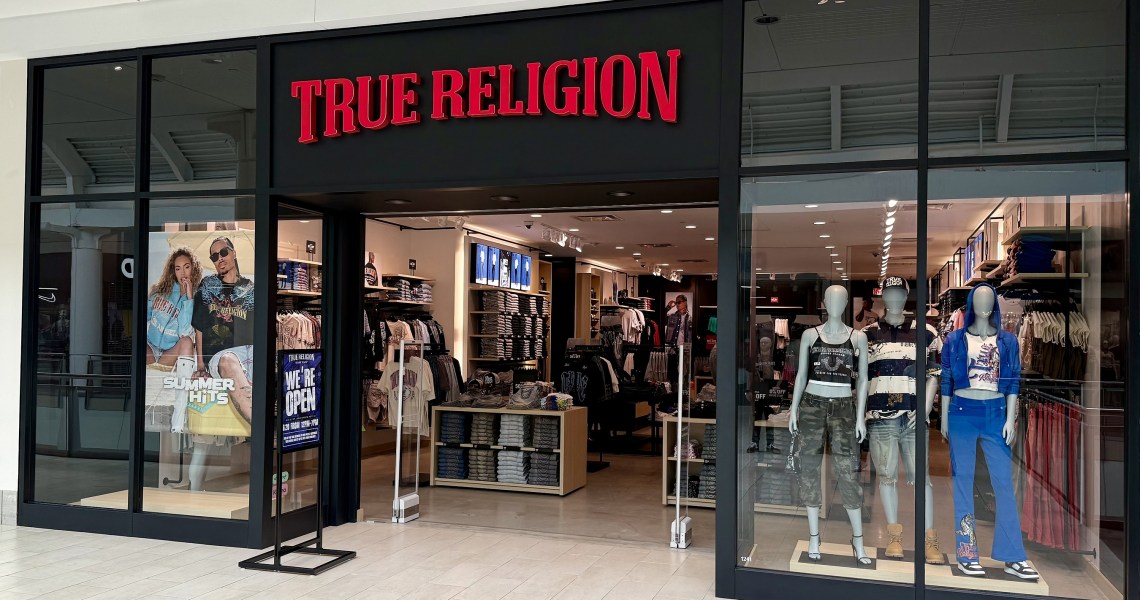
The cult urban denim brand True Religion has ambitious plans to reach $1 billion in revenue in the next five years. According to CEO Michael Burkley, the brand’s growing physical retail fleet will be key to meeting that goal.
True Religion announced on Monday the planned addition of at least four physical stores opening in markets like Indiana, New Jersey and California this year. The brand already has over 60 stores in the U.S. and plans to open 90 more, to reach 150, in the next four years.
Burkley said that recent store openings in markets have already proven wildly profitable for True Religion, with an average EBITDA profit margin of over 45%. The Boston and Orlando stores have been particularly profitable, he said. Direct sales, which make up about 65% of the business, are now roughly evenly split between online and in-store, while the rest of True Religion’s revenue comes from wholesale partners like Nordstrom in the U.S. and third-party-operated stores in Europe.
Burkley said a few key factors have made True Religion’s stores a success. First, they’ve opened in markets with proven True Religion customer bases, and the brand has often doubled up in lucrative markets, including Florida and New York. Second, each store is relatively small, at around 250 square feet, but each is treated like a flagship. That means every store carries the full breadth of True Religion’s men’s, women’s and kids’ clothing collections, along with items from each of its 12 categories of accessories and fragrance.
“Our average unit price is $30-$80,” Burkley said. “And when [a shopper] comes into the store, they’re there to transact. Stores are great for brand-building and customer acquisition, but ultimately, the customers want to shop, and we want the stores to be revenue drivers.”
Burkley said True Religion has new products arriving at each store every week, including monthly drops that roll out week by week, as well as larger seasonal collections and one-off collaborations. That gives the customer more reasons to continue returning to the store regularly.
Increasingly, fashion and apparel brands are realizing that younger shoppers like to shop in-store. Last week, Knix entered over 350 Target stores with its teen brand KT by Knix, specifically because more younger consumers are shopping in malls, shopping centers and shopping neighborhoods, according to Knix chief commercial officer Nicole Tapscott.
Earlier this week, True Religion announced Kristen Jones, a former Skechers, Target and Levi’s exec, as its new vp of retail to help continue the march toward 150 retail stores. Jones described True Religion as a brand “in a stage of growth with lots of whitespace opportunity ahead.” Since 2025, that growth has also been spurred by an aggressive marketing strategy involving big-name musical artists like Megan Thee Stallion and Anitta. True Religion spends over 10% of its revenue on marketing, Burkley said.
Last year, the company’s revenue was around $470 million. This year, it is on track to hit around $550 million. Since 2025, True Religion has been owned by private equity firms ACON Investments and SB360 Capital Partners.
“We are growing every year both domestically and in our international wholesale business,” Burkley said. “Our medium-term goal, in the next five years, is to hit a billion. But it’s a very big, large urban casual consumer market we’re addressing. We believe, long-term, we’ll be a multi-billion dollar brand.”