In this week’s Luxury Briefing, we dig into recent AI moves by Ralph Lauren, as well as Net-a-Porter and Mytheresa owner LuxExperience. Also, a new luxury rental source for stylists, and executive moves at Authentic Brands Group and Banana Republic. For tips or comments, email me at zofia@glossy.co.
Ralph Lauren and LuxExperience reported earnings this week, with each company highlighting AI as an increasingly important part of how it serves higher-value luxury shoppers.
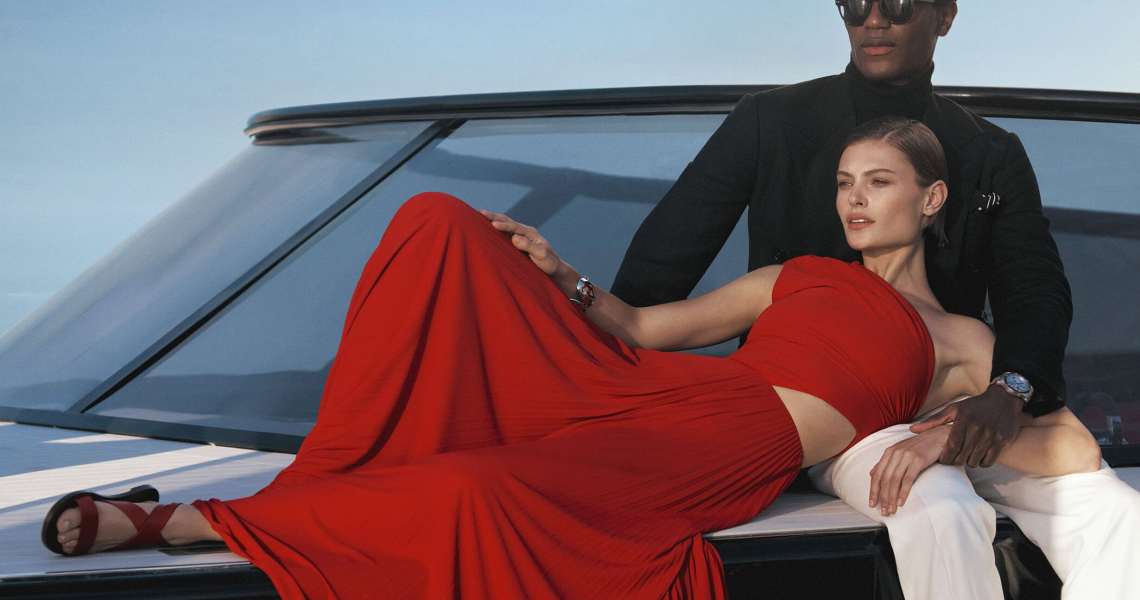
On Thursday, Ralph Lauren reported that it ended its 2026 fiscal year with full-year revenue above $8 billion for the first time. In the fourth quarter, revenue rose 12% on a constant currency basis, ahead of the company’s mid-single-digit outlook. Retail sales across in-store and digital rose 17%, led by Ralph Lauren stores and digital commerce, while average unit retail increased 16%. During the earnings call, CEO and President Patrice Louvet said the AUR gain was driven by stronger full-price selling, reduced discounting, targeted pricing, and a favorable product and channel mix.
The results were also helped by continued full-price momentum. Telsey Advisory Group analyst Dana Telsey said in a post-earnings note that Ralph Lauren’s AUR growth “continued its impressive run of expansion,” demonstrating “the success” of the company’s brand investments and “its ability to sell through its products at full price.”
On Tuesday, LuxExperience — the parent company of Mytheresa, Net-a-Porter, Mr Porter and Yoox — also reported its third-quarter fiscal-year earnings, revealing roughly $668 million in net sales. The company expects its full-year net sales to reach around $2.7 billion. Group gross merchandise value rose 0.3% at constant currency in the third quarter, while adjusted EBITDA margin reached 0.9%, marking the company’s second profitable quarter in a row. Mytheresa remained the group’s strongest business, with net sales up 9.9% at constant currency. In the U.S., Mytheresa’s net sales rose 33.8%.
Among luxury’s more active AI adopters, both Ralph Lauren and LuxExperience are pushing harder into AI to drive full-price selling and better personalization.
At Ralph Lauren, the work has included Ask Ralph, the brand’s AI-powered styling experience launched in September. But on the earnings call, president and CEO Patrice Louvet made clear that AI is now moving into more parts of the business. He said Ralph Lauren has made progress across “advanced technology, AI and analytics,” using those tools to enhance “creativity, productivity and customer engagement.”
That includes both internal and customer-facing applications. Louvet said the brand had “accelerated the iteration of core icons in the design process,” integrated automation into its global distribution centers, and “enabled brand discovery across agentic search and commerce.” The reference to core icons is notable for Ralph Lauren, whose growth strategy continues to center on repeatable products like sweaters, rugby shirts, outerwear and handbags, rather than chasing trend cycles.
AI is also informing Ralph Lauren’s investment decisions. Louvet said the company’s advanced data and analytics are delivering brand activation insights, giving it more confidence to increase marketing investment. Marketing reached 7.9% of sales for the year and is expected to rise to around 8% in fiscal 2027.
At LuxExperience, the AI work is more embedded in the platform. LuxExperience’s current generative AI work builds on a longer-running use of predictive AI at Mytheresa. As early as 2021, Mytheresa was publicly discussing how it used AI to identify customers with higher future value and decide where to direct marketing spend. In a 2021 BoF article, Kliger said the company’s customer targeting was “purely AI,” aimed at identifying which first-time shoppers were most likely to become high-value customers. The model looked at signals including first purchase behavior, browsing activity, responses to marketing messages and payment method.
“For a long time, we have used intelligent algorithms to optimize our customer targeting and marketing spend based on predictive models for customer value estimates,” said Michael Kliger, CEO of LuxExperience, on the earnings call this week.
That has now expanded beyond acquisition and marketing. “With the revolution of generative AI, we have expanded widely the usage of algorithms to improve the customer experience with better and more personalized, real-time content,” Kliger said on the earnings call. He cited improvements to on-site and newsletter product recommendations, on-site search, on-site merchandising, product copy and imagery.
In practice, that means LuxExperience is using AI at multiple points in the luxury shopping journey: to decide which customers are worth investing in, what products and content they see, how search results are served and how product information is created.
Many of the AI-enabled customer-facing features have been made possible through the company’s Google Vertex AI partnership, which started in 2021. These commerce AI tools support personalized product recommendations by using product data and user events, such as clicks, purchases and add-to-cart behavior, to return ranked product results for individual users.
LuxExperience is not alone in turning to Google’s AI stack for fashion commerce. Gap Inc. partnered with Google Cloud last October to use tools including Vertex AI to expedite product development, improve personalization and streamline store operations, and Victoria’s Secret & Co. has used Google Cloud AI and generative AI to facilitate more personalized shopping experiences since 2024.
LuxExperience is also applying generative AI behind the scenes. Kliger said the company is seeing “huge benefits in software development” as it works through the tech transformation of Net-a-Porter and Mr Porter since the acquisition last April. The company is “constantly expanding the use case scenarios” of AI, he said, with a focus on “improving the quality and accuracy of our customer experience.”
The members-only platform offering access to luxury-packed closets
Louvelle is entering a growing luxury rental market, but with a more curated, high-touch approach.
The invite-only, peer-to-peer platform, founded by Tanya Tamer, lets members borrow and lend pieces from each other’s wardrobes, from current-season designer items to archival vintage. Tamer said the platform includes pieces like “Dior Galliano era dresses, Gucci by Tom Ford and Chanel from the ’90s,” as well as newer luxury items. Since launching in November, Louvelle has had 6,000 people apply to its waitlist, according to Tamer. April was its biggest community growth month to date, with the platform tripling its community compared to prior months, owed to increased awareness.
Louvelle, which lists thousands of community-supplied pieces, does not charge a membership fee. Five-day rentals are typically priced at 10-20% of retail, with $12 round-trip two-day shipping. Self-managed lenders keep 80% of the rental fee, and concierge-managed lenders keep 60%.
The basic consumer pitch is access at a lower cost than buying. In one example, celebrity and editorial stylist Meagan Campbell said she rented a Stella McCartney suit through Louvelle for less than $200; the jacket alone retailed for around $2,400, while the pants were around $1,200. For shoppers facing weddings, galas or fashion events, that kind of math is the appeal: The look lands, without the full purchase price.
There are already similar models in the market. In the U.K., Hurr and By Rotation have helped popularize peer-to-peer fashion rental, while Tulerie has done something similar in the U.S. Louvelle’s point of difference is its focus on invite-only access, rare luxury and a managed service layer around lending. That trust layer is important in a category where sellers and lenders can be nervous about sending rare or high-value pieces into third-party systems. In luxury resale, authentication has already proved to be a flashpoint: The RealReal agreed in 2021 to pay $11 million to settle an investor class-action lawsuit centered on its authentication claims, while denying wrongdoing, according to Retail Dive.
But Louvelle’s more interesting use case may be among fashion insiders. Tamer said stylists have become one of the platform’s biggest opportunities because they often sit on large closets of gifted, purchased or pulled pieces, while also needing fast access to looks for clients. “They want to see these items in circularity; they want to see them being worn,” she said. “And it’s another revenue stream for them, as well.”
For Campbell, whose clients include Hilaria Baldwin and influencers, Louvelle functions as both a closet monetization tool and an alternative sourcing network. She has used the platform to pull Alaïa, Miu Miu, Magda Butrym, Schiaparelli jewelry and a YSL Tom Ford-era top for clients and herself. “Having access to some archival pieces as well as some vintage pieces makes my vision come to life,” Campbell said.
That matters because the traditional brand lending process is not always built for speed or for influencer clients. Campbell said brands often want talent pre-approved before lending samples, and approvals can depend on profile, audience, size and expected return. “If Beyoncé asks you for something and that’s not sample size, they’re going to jump to get it,” Campbell said. “But for some more, you know, smaller celebrities, people who aren’t necessarily as brand-pre-approved, it’s more of a struggle.”
The stylist angle also has precedent at the top of the market. Law Roach told British Vogue last year that he and Zendaya began pulling vintage because, early in her career, brands would not lend to her. Today, he said, they buy from vintage dealers rather than borrow, both to support small businesses and to preserve the integrity of archival pieces. Louvelle is operating in a more accessible lane, but the same logic applies: Fashion insiders are looking beyond traditional brand lending for rare pieces, faster access and more control.
In one example, Campbell pulled a look through Louvelle for an influencer client doing a Rolling Stone social series. The client had a New York appearance with only a few days’ notice, while the usual brand approval process could have taken too long. Louvelle had the suit in the right size, allowing Campbell to move quickly and still create an in-season designer moment. In that sense, Louvelle is not replacing brand relationships. It is filling the gaps they leave.
Executive Moves
- Authentic Brands Group founder Jamie Salter is moving to executive chairman as Matt Maddox becomes CEO and Authentic weighs a potential IPO within 12 months.
- PVH named Adelyn Cheong, president of PVH China, as CEO of PVH Americas, succeeding Donald Kohler. Kohler leaves June 30 to become Banana Republic CEO.
- Also at PVH, Joel Samaha, currently a partner in Boston Consulting Group’s global consumer and fashion practice, joins in July in a new global licensing, partnerships and expansion role. Jonathan Bottomley, currently Calvin Klein’s global chief marketing officer, expands his remit to group consumer and brand strategy.
News to know
- Marquee Brands — which owns Martha Stewart and Laura Ashley, among other brands — is buying control of Roberto Cavalli from DAMAC Group, the Dubai-based luxury real estate developer, for an undisclosed amount. DAMAC will retain a stake and Cavalli’s branded real estate rights.
- Global Blue data shows tax-free shopping in Europe rose 5% in 2025, led by watches and jewelry. Spending in those categories increased 14%, driven by U.S., Middle Eastern and Latin American shoppers, Gen-Z growth and ultra-high-net-worth customers. The last group accounted for more than 60% of category spend despite representing 9% of shoppers.
- More than 1,000 Kering employees in Italy went on strike over planned layoffs at McQueen affecting 54 of the brand’s 181 employees. The unions accused Kering of failing to discuss redeployment options, while Kering said the cuts predated its ReconKering plan and were part of McQueen’s move to restore sustainable profitability.
- On May 19, Chanel said its 2025 revenue rose 3% to $19.3 billion after a decline in 2024, with operating profit up 5.2% to $4.7 billion and 2026 sales growing in the high single digits. CEO Leena Nair credited momentum across divisions, renewed brand heat under Matthieu Blazy, and continued investment in manufacturing, boutiques and beauty e-commerce.
Listen in
This week on the Glossy Fashion Podcast, WatchGuys founder and CEO Robertino Altieri joins senior fashion reporter Danny Parisi to discuss the Swatch x Audemars Piguet “Royal Pop,” a buzzy collaboration that drew collector hype before its reveal as a pocket watch rather than a traditional wristwatch. The collaboration raised questions about whether AP is courting serious watch buyers or using the novelty format to reach a more casual, first-time luxury watch consumer. Listen here.
Read on Glossy
Fashion resale is ready for primetime. Everlane’s sale to Shein is exposing cracks in sustainability-led brands. Jonathan Simkhai is leaning into AI-led ecommerce and styling.