In this week’s Luxury Briefing, we look at Burberry’s earnings and new categories, and why Dior put its 2026 Cruise show on BeReal. Also, executive moves at Rent the Runway, and news to know about Derek Lam 10 Crosby, Ferragamo and Amazon. For tips or comments, email me at zofia@glossy.co.
Burberry’s turnaround efforts are reading more like a Coach-style playbook: make the brand’s most recognizable codes easier to shop, easier to understand and more culturally visible.
The company reported its full-year earnings on Thursday. For the year ending on March 28, Burberry reported revenue of £2.42 billion, or about $3.29 billion, roughly flat on a constant-currency basis. Comparable store sales were up 2% for the year and 5% in the fourth quarter, helped by 10% growth in both Greater China and the Americas. Bernstein analyst Luca Solca said in a May 14 note that Burberry’s fourth-quarter comparable retail sales were in line with consensus, while the Americas and Greater China outperformed expectations. Gross margin also came in ahead of expectations, at 67.9%, versus 66.3%.
On the earnings call, CEO Joshua Schulman’s clearest point was about the store floor. Burberry is taking the categories customers already understand — trench coats, scarves, polos and cashmere — and turning them into dedicated shopping moments, including scarf bars, polo galleries and, next, trench and cashmere destinations.
“Our strategy is about prominence, productivity and profitability,” Schulman said. “This year, we made progress on driving our productivity and profitability in part due to our category destinations.”
The company has now rolled out more than 200 scarf bars, which Schulman said have become “focal points” in stores and are “exceeding their plan and driving store productivity.” Polo galleries started launching in the fourth quarter, with around 100 expected by Father’s Day in June. The brand’s Eddie polo is now available in 23 colors.
Burberry will launch its first trench destinations this year, with an interactive concept meant to help customers find the right style, and dedicated cashmere shops in the second half. By the end of the fiscal year, the company expects to have nearly 400 category destinations across its store network.
Ahead of the earnings release, Solca said Burberry’s focus is now on “improving sales productivity through better retail metrics,” including conversion and units per transaction. He also said the brand’s core categories, outerwear and scarves, have been performing well, while its fiscal 2027 will bring “a greater focus on wardrobing” across ready-to-wear and handbags. But he flagged one challenge: “Industry feedback we have received suggests that Burberry may well need to add more ‘spice’ to its products.”
That is where the Coach comparison becomes useful. Like Coach, Burberry is trying to make heritage feel current, understandable and highly shoppable. It seems like the strategy is all about taking familiar brand assets and turning them into repeatable retail moments. Schulman is familiar with this strategy from his time at Coach before he joined the British luxury giant.
Pricing is part of that. Schulman said Burberry is trying to offer “value for money in a luxury context.” In trench coats, the brand’s offer ranges from a nylon Kensington at just over £1,000, or about $1,360, to a leather nubuck Castleford trench at almost £7,000, or about $9,520. Scarves range from £195, or about $265, for a skinny silk scarf to £2,500, or about $3,400, for a cashmere cape.
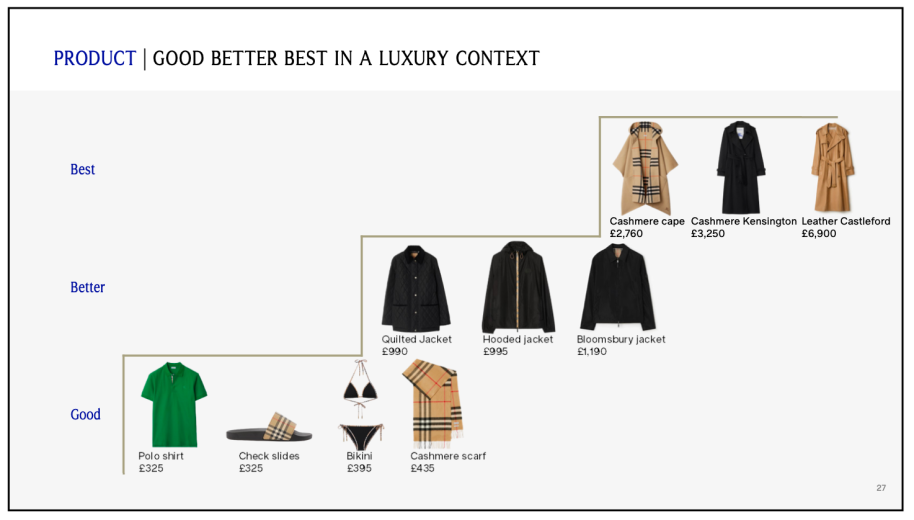
“The items on this page, whether they’re in the good or the best category, are some of the most important recruitment items in our business,” Schulman said, pointing to the slide above spelling out the brand’s product price scale.
Collaborations and category extensions are also becoming part of the playbook.
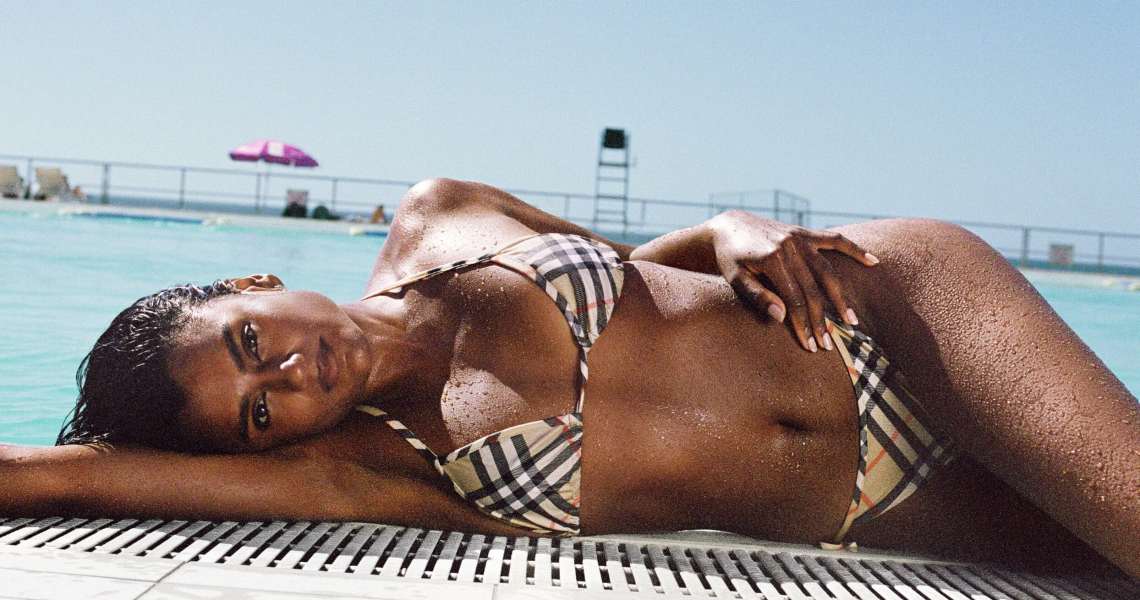
Burberry’s High Summer campaign, featuring actress Simone Ashley and actor Tom Blyth, includes a new Hunza G swimwear collaboration. Schulman said the tie-up brings Hunza G’s stretch fabric together with Burberry colors and check, “combining heritage and size inclusivity.” The capsule launched “just a few weeks ago,” he said, adding that Burberry was “extremely happy with the sell-throughs” and that key wholesale accounts had asked for more stock.
Burberry is also testing new entry points into categories beyond swimwear. This week, the brand posted about its activewear line on Instagram. The image featured rower Cameron Buchan (@buchancamerontakes; 1,700 followers on Instagram) on the water, and the caption stated, “Row with it,” going on to describe Burberry Activewear as “made to move with you.” According to Launchmetrics, the activewear launch generated $450,000 in media impact value in its first 48 hours and drove a nearly 90% increase in overall media impact one day after launch.
The line was not discussed on the earnings call, but it fits the broader strategy Schulman did outline: using familiar Burberry codes to create more shopping occasions beyond the trench coat.
Burberry has used collaborations before. In 2017 and 2018, it worked with designer Gosha Rubchinskiy on pieces that reworked the Burberry check, trench coats and outerwear through a streetwear lens. In 2018, under Riccardo Tisci, Burberry teamed with designer Vivienne Westwood on a limited-edition collection that brought together Burberry’s heritage with Westwood’s British punk codes, with a portion of proceeds supporting Cool Earth. In 2022, Burberry collaborated with streetwear brand Supreme on a broader streetwear-heavy collection, including trench coats, rugby shirts, denim, hoodies, skate decks and box logo pieces.
The difference now is that Burberry is using these launches to widen the role its heritage codes can play. Hunza G gives the brand a warmer-weather expression of Britishness through swimwear, check bikinis and raffia bags. Activewear pushes it further into movement, sport and the outdoors. In stores, scarf bars, polo galleries and upcoming trench and cashmere destinations serve the same purpose: turning familiar Burberry categories into clearer shopping moments.
Burberry is also bringing more data into that model. Schulman said the company piloted more sophisticated customer segmentation and AI-enabled recommendations for store associates’ use in the second half, and that the tool had a positive impact on Q4.
Dior brings its Cruise show to BeReal as luxury looks beyond algorithmic feeds
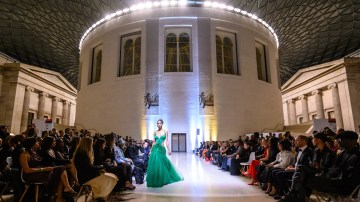
For its latest Cruise show, in Los Angeles on May 13, French luxury house Dior turned to BeReal to add a more immediate layer to its social coverage, using the platform for pre-show teasers, livestream promotion and backstage posts.
According to Ben Moore, BeReal’s global head of brand partnerships, Dior has been posting organically on the platform for the past couple of years, amassing more than 1 million followers. For the L.A. show, it used three content formats. That included a RealCard, BeReal’s pop-up ad format that appears when users open the app, which promoted the brand’s YouTube livestream of the show. In addition, it leveraged organic posts teasing the event and sent users a custom notification three hours before the show. During the event, Dior posted around six or seven times, with some posts before the livestream even started, including backstage content and shots of looks before they appeared on the runway.
“[Dior] really understands that BeReal is different,” Moore said. “It’s not about the follower count. It’s not so much about the engagement metrics or the vanity metrics, but much more about the level of engagement.”
Likewise, rather than “media plans, ad units,” Moore said the Dior activation was based on “what authenticity means for luxury right now.” Other fashion and beauty advertisers have also tested the platform, including Polène, L’Oréal-owned brands and Calvin Klein. But Moore described Dior as BeReal’s “No. 1” luxury partner.
For luxury brands, Moore said, BeReal’s appeal is partly what the platform keeps out: uploads, edits, algorithmically inserted posts from strangers and AI-generated content. That gives brands a more controlled, human-feeling environment. “They’re looking for context, not just reach anymore,” he said.
As the Dior Cruise campaign is still in flight, BeReal could not share final performance figures. But the brand’s play points to a larger challenge for luxury brands: They are looking for ways to make major fashion moments feel less dependent on an algorithmic feed.
Executive moves
- Jennifer Hyman is stepping down as Rent the Runway’s CEO, president and board member on Friday, with board member and former Nordstrom merchandising chief Teri Bariquit named interim CEO as the company searches for a permanent successor.
News to know
- LVMH is selling Marc Jacobs to brand management firm WHP Global for an undisclosed sum, with Marc Jacobs remaining creative director. In a statement, he said, “I remain committed in my role as Creative Director, and look forward to this bright new chapter.”
- NYC Alliance acquired the brand assets of Derek Lam 10 Crosby from Public Clothing Co. on April 30, with plans to expand the advanced contemporary label across wholesale, retail, e-commerce and licensing categories, with the first new apparel collection set for retail in 2027.
- Ferragamo’s first quarter revenue fell 1.2% at constant exchange to €209 million, or about $244 million, slightly below consensus. A 19% wholesale decline offset 5.5% DTC growth, showing the company prioritizing distribution control over near-term volume.
- Amazon is replacing Rufus with Alexa for Shopping, an AI-powered search experience that will appear by default for U.S. users and generate product comparisons, suggestions and personalized shopping prompts directly in the Amazon search bar.
Listen in
On this week’s Glossy Podcast, senior fashion reporter Danny Parisi speaks with Keith Fraley, professor of fashion business management, about what it takes to break into fashion now. As layoffs hit major companies across retail and tech, entry-level candidates are facing a tougher market, fewer training opportunities and higher expectations from employers. Fraley explains why new hires are now expected to understand the business faster, contribute sooner and prove they can make an impact from day one. Listen here.
Read on Glossy
Canadian fashion brands are navigating tariffs. Larroude’s CEO built his own AI system for fashion. Running brand On crossed the $1 billion mark in earnings.