On’s apparel business is still small compared to its footwear engine. But in the first quarter of 2026, it became the clearest signal of where the Swiss sportswear brand wants to go next.
On reported record first-quarter earnings on Tuesday, with revenue up 14.5% year over year to 831.9 million Swiss francs ($1.02 billion), marking the first time the company has crossed CHF 800 million in quarterly sales. Constant-currency growth was 26.4%. Net income rose 82.2% to 103.3 million Swiss francs ($127 million), while gross profit margin expanded to 64.2%, up from 59.9% a year earlier, despite tariff pressure. Dollar conversions are approximate, based on 1 Swiss franc at $1.23.
The quarter also marked a leadership handoff. Martin Hoffmann, who had been with On for 13 years and had served as CEO or co-CEO for more than five years, stepped down on May 1. He had also been serving as CFO, a role now held by Frank Sluis. David Allemann, On’s co-founder and new co-CEO, framed the change as a founder-led continuation rather than a strategic reset, saying Hoffmann had “decided to step out” after a long tenure helping scale the company.
“It’s our obligation as founders to continue what we have done the last 16 years and continue to bring On into the future,” Allemann said. “We defined the strategy together. This strategy continues to roll out, so it’s a message of continuity.”
Footwear remains the core business, with shoe sales up 12.2% to 763.7 million Swiss francs ($939 million). But apparel was the standout, growing 45.1% to 55.3 million Swiss francs ($68 million). On a constant-currency basis, apparel sales rose 57.5%.
For Allemann, the category’s importance is no longer theoretical.
“Apparel is, for the first time, above 10% of our business in our direct channels, which is fantastic,” Allemann told Glossy ahead of the earnings. “You also see that a very young cohort of 18- to 34-year-old consumers is often coming into our direct-to-consumer channels, apparel first. So they’re coming for apparel before they come for footwear.”
That marks a notable evolution for a brand that built its credibility through running shoes and performance innovation. Allemann described On’s ambition as growing “toe to head,” moving from a utility-driven footwear brand into something closer to a lifestyle brand.
“We don’t just matter for pure innovation functionality [in one category], but for [the brand] becoming your identity,” he said.
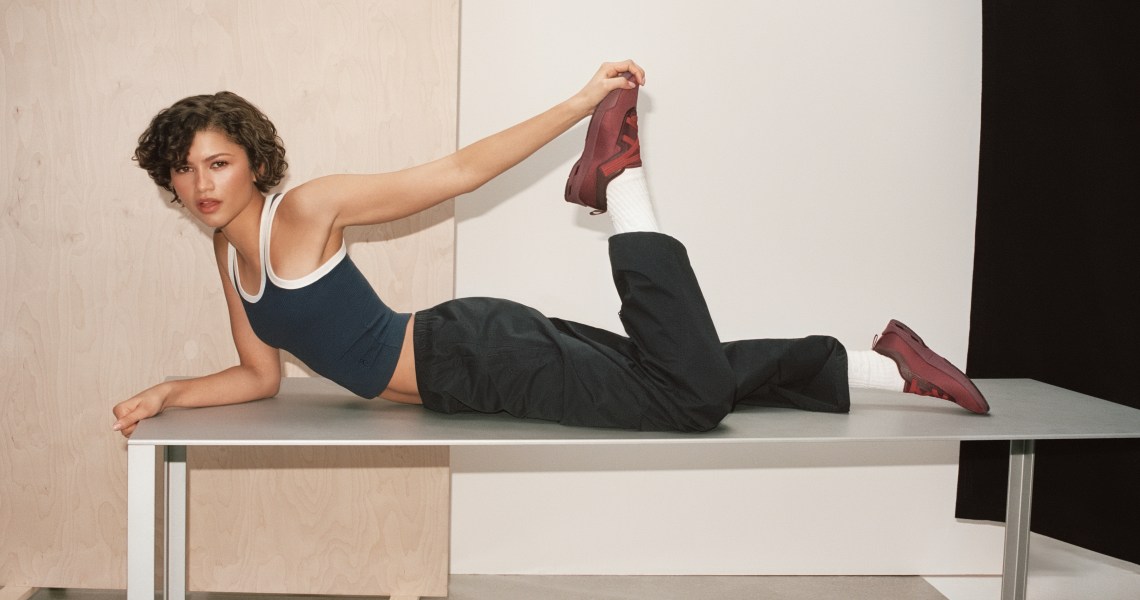
The clearest example so far is On’s work with Zendaya, whose co-created collection with the brand leaned into a softer, more fashion-coded vision of performance dressing. The April 16 drop included apparel such as tanks, jackets, skirts and parachute pants, alongside the Cloudnova Moon sneaker. It was supported by a Spike Jonze-directed film, a move Allemann said was intentionally more story-led than the short-form content often used to drive product launches. According to the brand, the campaign generated over 20 million engaged U.S. views.
“It pretty much evaporated as we dropped it,” he said. “We had a massive moment and a lot of visibility. I think it was a courageous move, as well, to not just go to very short-form clips and content, but to really tell a story. We feel that we’re a brand about stories.”
The collection also brought in a younger consumer, often through apparel first, he said. According to the earnings call, the brand’s focus on younger consumers is already showing up in its customer data. On said 18- to 24-year-olds significantly increased their share of the brand’s DTC customer base in Q1, maring the largest increase since the company began tracking the data, with the trend accelerating into early Q2. That is key to On’s next phase: using lifestyle products to broaden the brand’s relevance, not as a replacement for performance.
Allemann framed the opportunity around what he called the “movement class,” a consumer group focused less on traditional status symbols and more on wellness, vitality, longevity and self-investment.
“Sports have already moved to the very center of society,” he said. “It’s not just about having gear that you use at the weekend for your sport, but it has very much become part of your identity.”
On is now building two sides of the business at once. One is performance-led. That includes its development of LightSpray, a spray-on footwear production technology, designed to enable lighter, faster racing shoes with fewer traditional components. The other is lifestyle-led, built around products and partnerships that make On feel more like a brand people style into their everyday wardrobes. That includes its Zendaya co-created collection, its work with FKA Twigs and its comfort-focused Cloudtilt sneaker franchise, which Allemann said is now the No. 1-selling style at Foot Locker Europe.
“Twenty years ago, being a performance innovation brand and being, let’s say, a fashion brand, these were polarities,” he said. “That has completely changed.”
On now has 70 stores globally and is planning openings in Stockholm, São Paulo, Sydney and San Francisco. In APAC, where sales grew 44.4% to 174 million Swiss francs ($214 million), demand is especially strong. Allemann said On opened a second Tokyo store in Ginza after seeing long lines at its Tokyo Cat Street location.
“The result of it is now that we have two stores with long lines,” he said.
Accessories, including bags and backpacks, are also showing early momentum, though from a small base, with sales up 70.7% to 12.9 million Swiss francs, or about $16 million. Allemann said these products are part of the same “toe to head” ambition.
“As an identity brand and not just a utility brand, you of course want to offer a consumer [the opportunity] to really express herself or himself through a full identity,” he said.
The challenge now is control. Wholesale remains On’s biggest channel, with sales up 13.3% to 509.6 million Swiss francs ($627 million), while DTC sales rose 16.4% to 322.3 million Swiss francs ($396 million). Allemann said On is still only in around half of the doors of its most important wholesale partners.
“We’re filling this incredible demand in a very disciplined way,” he said. “We want to build a lasting premium brand for the decades. And I think that’s what a founder-led brand does.”