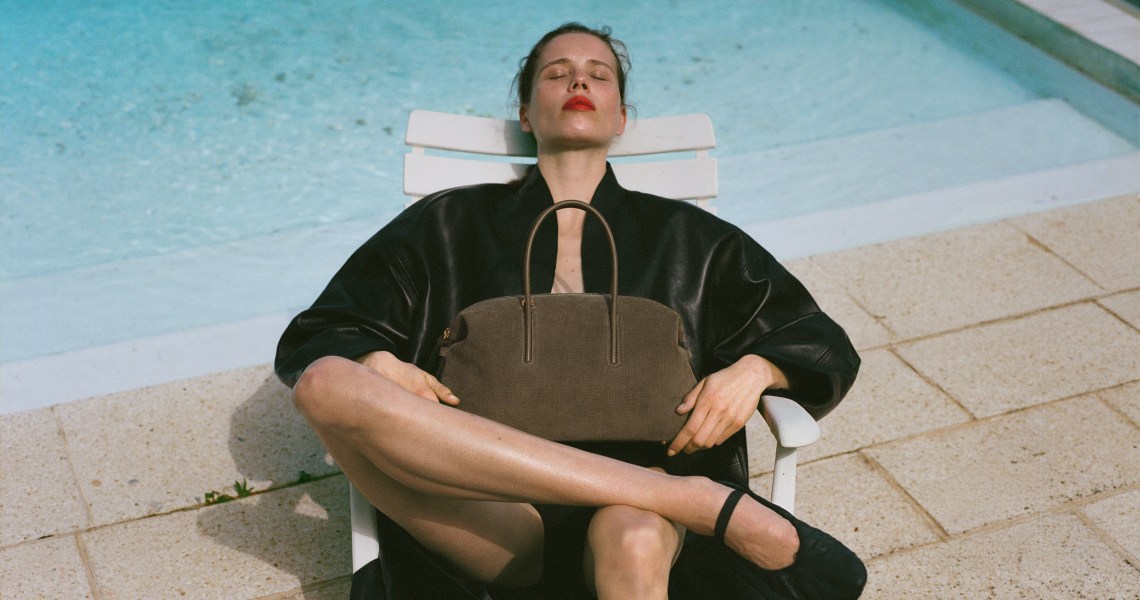
For this week’s Luxury Briefing, I spoke with DeMellier founder Mireia Llusia-Lindh about how the cult U.K. bag brand is leaning into craftsmanship and alternative materials to build loyalty in a tougher luxury market. Also, why Anya Hindmarch partnered with Sweet’N Low, and interesting takes from EssilorLuxottica and Moncler earnings. For tips or comments, email me at zofia@glossy.co
As growth slows across the luxury sector and aspirational shoppers pull back, brands are under increasing pressure to justify their price points through product, not positioning. For 9-year-old London-based DeMellier, that has meant focusing on craftsmanship and controlled growth, with sustainability functioning as proof of quality rather than a standalone hook.
The strategy is translating into demand. According to new data from Lyst, searches for DeMellier are up 97% year over year, with the New York Midi Leather tote emerging as its top-performing style.
“Our work has always been grounded in three pillars: ethically and sustainably made products, empowering women, and giving back,” said founder, owner and creative director Mireia Llusia-Lindh. “Those principles were there from the beginning. It wasn’t about whether the market responded; it was about building the brand in the right way.” It’s a strategy similar to that of sustainability-focused brands like Eileen Fisher and Another Tomorrow.
That foundation shows up most clearly in the product. DeMellier produces its bags in family-run factories across Italy and Spain, using Leather Working Group-certified tanneries and developing materials like plastic-free raffia and traceable cotton linings. Each bag can involve up to 35 artisans and more than 50 individual components.
For Llusia-Lindh, the emphasis is on durability as much as sourcing. “Sustainability for us is also about longevity,” she said. “There’s no point creating something responsibly if it doesn’t last. Our goal is to make pieces that people use for years.”
At Kering, under its new leadership, sustainability is increasingly being treated as infrastructure rather than messaging. “Sustainability cannot be a standalone topic. It must guide every business decision — in the studio, in the manufacturing, in merchandising, in operations, sourcing, in retail and in how we allocate capital,” CEO Luca de Meo said during the group’s April 2026 Capital Markets Day. And players including Bottega Veneta are leaning into craft-led storytelling, as seen in its 2025 “Craft is Our Language” campaign.
At the same time, the pressure on product value is becoming more explicit. According to a 2025 Bain & Company report, the luxury industry lost roughly 70 million customers over the prior two years as shoppers reassessed the relationship between price and product. Bain & Company partner and global head of luxury Federica Levato said consumers are increasingly frustrated because “they don’t see anymore the equation between the creativity that these brands offer, the value that is intrinsic in the product and the price that they’re paying.”
That disconnect is forcing brands to refocus on what Levato described as “rebuilding the ethics and rebuilding the connection with the customer,” as the industry loses millions of aspirational shoppers.
For DeMellier, whose bags typically retail between $400 and $700, that positioning is important. DeMellier generated around $54.7 million in revenue last year, according to reporting from The Telegraph. The brand has also attracted a high-profile following, including Catherine, Princess of Wales, who has been seen carrying its bags on multiple occasions.
In addition, the brand is focused on ethics through its “A Bag, A Life” program, through which it funds vaccines and medical treatments for children in need, working with SOS Children’s Villages charity and local healthcare partners. To date, the initiative has supported more than 2 million treatments.
“Our customer research has shown us that while sustainability matters, it is rarely the primary driver of purchase,” Llusia-Lindh said, talking about the brand’s customer surveys. “Design, quality and price remain front of mind. But for our most loyal customers, sustainability becomes part of why they stay.”
DeMellier has maintained a tightly controlled distribution model, with roughly 80% of its revenue generated through direct-to-consumer channels and 20% through wholesale partners. Its partners include Net-a-Porter, Saks Fifth Avenue, Bloomingdale’s, Selfridges and Harrods.
“We’ve always had a very conscious wholesale strategy,” Llusia-Lindh said. “We work with a small number of partners in each market that really represent the brand and reinforce our positioning.” That approach has also limited exposure to recent volatility in the department store sector, especially with Saks Global. The brand paused its relationship with Saks ahead of Saks’ restructuring, while continuing to invest in its own channels.
The next phase of growth will center on owned retail. DeMellier is preparing to open its first flagship store in London later this year, with further expansion planned in key markets. “We’ve built the business with online and wholesale, but retail is the next step,” Llusia-Lindh said. “It’s about being able to fully express the brand — the craftsmanship, the values, the product — in a physical space.”
Notably, the company is not pursuing aggressive category expansion, remaining focused on handbags. “We can sell a lot more bags before we move into other categories,” Llusia-Lindh said. “It’s about doing one thing really well and being known for that.”
That restraint extends to product development, where the brand continues to prioritize functional, design-led silhouettes over trend-driven additions. “If we do something, it has to be thoughtful and built to last,” she said. “We don’t want to create things that are used briefly and then discarded.”
Anya Hindmarch partners with Sweet’N Low
British designer Anya Hindmarch is extending her “Anya Brands” strategy with a new capsule built around the decades-old sweetener Sweet’N Low, owned by Cumberland Packing Corp. The drop turns the brand’s pink packet into raffia totes, leather charms and small accessories priced $270-$990.
The collaboration builds on a model Hindmarch has scaled into a consistent traffic and sales driver, according to the brand. Anya Brands drops, spanning Coca-Cola, Band-Aid and Pringles, operate as limited, nostalgia-led releases designed to drive attention and collectibility. At the same time, core products like the brand’s Universal Tote — which recently collaborated with posh U.K. farm shop Daylesford — anchor volume, giving the business a mix of recurring revenue and high-impact launches.
“Our philosophy is combining impeccable craftsmanship and creativity with a strong sense of fun,” Hindmarch told Glossy. “Anya Brands takes familiar, nostalgic brands and elevates them into artful accessories.” The Sweet’N Low packaging, “in that iconic shade of pink,” made it a natural fit, according to Hindmarch. “It’s about making people feel something. If it brings a smile, that is a job well done.”
For Sweet’N Low, the partnership is about extending beyond its core category. “We want to remind consumers that Sweet’N Low isn’t just a sweetener, it’s an icon,” said Sara Hoskow, senior marketing communications manager at Cumberland Packing Corp. The brand is leaning on its visual identity as a transferable asset. “Similar to how fashion thinks about its design and monogram, the Sweet’N Low brand has history and loyalty that translates everywhere.” Internally, the collaboration’s success is tied to “engagement, sentiment and cultural traction,” with a focus on reaching new audiences and reframing the nearly 70-year-old brand, Hoskow said.
Earnings
- On its April 22 earnings call, EssilorLuxottica reported a Q1 revenue increase of 10.8% at constant currency (around €6.3 billion, or roughly $6.8 billion), showing how quickly AI glasses are becoming a real growth driver. Smart glasses already delivered a “mid-single-digit contribution” as Ray-Ban Meta products “tripled” in sales growth, according to executives. Post-call, Bernstein analysts said the company is “treading a fine line between steady core business growth and controlled expansion of wearables,” where faster smart glasses momentum could raise “margin dilution concerns,” while slower growth would risk “disappointing on the long-term potential of the category.” The category is also moving upmarket, with prices reaching $799, while prescription is key to adoption: Varilux lenses now make up “in excess of 30%” of Ray-Ban Meta revenue. At the same time, the company is expanding into healthcare, opening its first in-store surgical site at LensCrafters, “the first important milestone on our Med-Tech journey,” CFO Stefano Grassi said on the call.
- And Moncler on Tuesday reported Q1 revenue of €881 million (about $960 million), up 12% at constant currency, as it continues to build momentum beyond its core winter business. Growth is being supported by higher-value products, said chief corporate and supply officer Luciano Santel, as well as by a broader product assortment. At the same time, the company is investing in becoming a year-round brand. “For the first time ever, we wanted to be very intentional about this current season,” Santel said of spring-summer, adding that expectations are “mostly brand expectations” as Moncler works to reduce its reliance on Q1 and Q4 over time. However, Moncler’s strong Q1 was partly activation-driven, with Bernstein analysts noting it was “boosted by ‘100 days of activations,’” referring to the company’s three-month run of global marketing and brand events designed to drive visibility and demand. They included the Aspen Grenoble showcase, Milan installations and Olympics tie-ins. Analysts also said that “momentum had started to fade during March, post-CNY,” or Chinese New Year.
Executive moves
- Pitti Immagine, the Florence-based organizer of menswear fair Pitti Uomo, named Ivano Cauli CEO, succeeding Raffaello Napoleone after 31 years. Napoleone remains on the board overseeing international and institutional affairs.
- Ferragamo Finanziaria SpA appointed Fabrizio Freda as special strategic adviser to support long-term strategy and CEO selection at Salvatore Ferragamo.
- Kering will propose adding former Chanel executive Marie-Hélène Chenut and ex-Christian Dior CEO Laurent Kleitman to its board at its May 28 Annual General Meeting, as part of CEO Luca de Meo’s ongoing turnaround plan.
News to know
- At Milan Design Week (April 15–21), fashion and accessories brands including Bottega Veneta, Hermès, Marni, Rimowa and Stone Island rolled out installations, collaborations and limited-edition launches to tap the event’s global design audience. The activations focused on everything from homeware and furniture to art projects and immersive brand experiences.
- LVMH CEO Bernard Arnault said the company’s recovery prospects depend on the Middle East crisis, which has already cut at least 1% from Q1 sales and reduced European tourist flows. He warned that outcomes range from a return to growth if resolved quickly to unpredictability if it escalates.
- Shay Mitchell, Quavo and Aryna Sabalenka invested in OneOff, which has raised $4 million to date as it builds a “Spotify of fashion” model for AI-driven, shoppable style discovery.
Listen in
Wearable tech is gaining traction, with Meta expanding retail for its Ray-Ban smart glasses and Apple and Google developing competing products, even as past efforts like Google Glass and Vision Pro struggled to reach mainstream adoption. On the Glossy Podcast, Danny Parisi, Zofia Zwieglinska and Jill Manoff spoke with wearable tech expert Janey Park about why some devices resonate while others fall short. Listen here.
Read on Glossy
Why Rolex is discontinuing its popular models. Asics and Ecco jump on Nike Boston Marathon billboard backlash. Uniqlo is betting on neighbourhood stores to scale U.S growth.