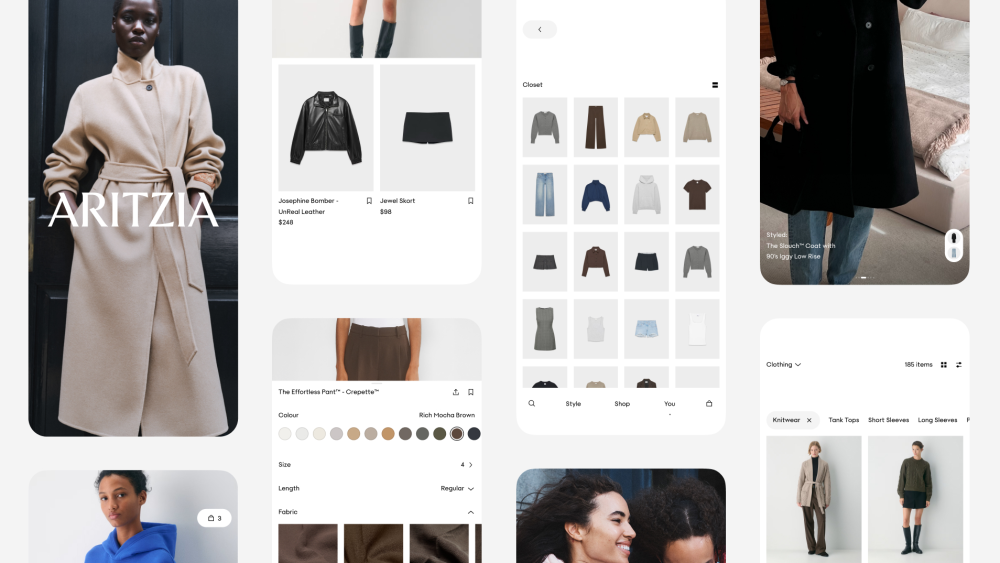
Aritzia’s launch of an app has quickly become one of the most influential digital moves the retailer has made. The app is already reshaping how the company gathers insights and communicates with its customer community, which increasingly oscillates between inspiration and shopping.
Since launch, on October 28, the app has surpassed 1 million downloads, split evenly between the U.S. and Canada. It was the most-downloaded shopping app in the App Store on its first day, according to the brand. With the app, Aritzia aims to establish a closed, brand-owned environment where shoppers can browse, style, learn and purchase without leaving the ecosystem.
“The ways clients discover, engage and experience brands are evolving, and we’re meeting them where they are, including in digital spaces,” Margot Johnson, Aritzia’s chief digital officer, told Glossy. “The app is not just another shopping channel. It is a destination where clients can get styling guidance, discover new pieces and access exclusive drops before anyone else.”
Aritzia intended to make the mobile world feel as deliberately crafted as its boutiques, Johnson said, adding, “At its core, the app is ‘Everyday Luxury’ expressed digitally. It is elevated, curated, and focused on helping our clients look and feel their best.” For Aritzia, “Everyday Luxury” is shorthand for its signature formula of elevated essentials, modern silhouettes and premium fabrications.
The feed combines creator styling, where influencers show how they wear Aritzia in real life, with boutique-level advice from in house stylists and deeper editorial-style looks into hero products and how to wear them, all shoppable. Johnson said this reflects how Aritzia’s clients prefer to browse. “We know our clients come to us for styling inspiration, so we made that a core focus. It blends entertainment and discovery with shoppable styling guidance,” said Johnson. Brand-affiliated creators and content collaborators called “App Muses” are featured.
Another feature called the Closet aggregates a user’s Aritzia purchases from its stores, website and the app itself. “It is such an easy way to see what you have and build your wardrobe with intention,” said Johnson.
Early numbers support the appetite for inspiration-led shopping. One-third of users are returning to the app multiple times a week, and App Muse content from creators like The Cut’s fashion director, Jessica Willis (41,000 Instagram followers), and stylist Elly McGaw (41,000 Instagram followers) outperforms other assets by around 1.5 times.
The value of first-party data is rising as brands lose visibility across traditional search and social ecosystems. Google has been steering users toward AI-powered summaries rather than keyword results since earlier this year, and platforms like ChatGPT are increasingly intermediating product discovery through conversational interfaces. Those systems do not provide detailed search intent, leaving brands with only partial insight into how consumers move from awareness to purchase.
A brand-owned app closes that loop. Every tap, save, scroll, Closet add, and content interaction becomes part of a data set that is both privacy-governed and exclusive. Compared to what a company can see through TikTok or Google Analytics, an app reveals far more about what triggers discovery, what creates friction and what leads to loyalty. It also builds resilience in a world where third party cookies are disappearing and affiliate traffic is becoming more expensive.
Johnson acknowledged this strategic dimension, though she described it less as a data landgrab and more as a way to refine the Aritzia experience. “Fashion is guided by art and shaped by data, and the app brings those together in a beautiful way,” she said. “We are learning how clients engage with our content, our brand and our products. Data helps us see where to double down, where to refine in real time and how to ensure every interaction aligns with our Everyday Luxury experience.” She added that transparency remains important. “Trust is foundational. Personalization should never come at the expense of privacy. We are clear about how data is collected and used, and give clients control over their choices.”
Aritzia’s launch arrives at a time when more fashion brands are reconsidering their mobile strategies. As Glossy reported, this year’s fashion app launches include iterations by Cult Gaia, Ralph Lauren and Beni. And, this fall, ShopMy rolled out its new app built around human-led recommendation circles. In addition, Zara relaunched its mobile experience with an expanded AI styling engine, Alo Yoga upgraded its app with new wellness commerce functions, and Farfetch introduced a rebuilt app to strengthen customer relationships after restructuring.
Together, these launches signal how aggressively brands are working to reclaim ownership of discovery, loyalty and data. “Clients want to discover, be inspired and connect wherever they are,” Johnson said. “Technology helps make those connections effortless while keeping the human touch central to everything we do.”
In Aritzia’s second quarter, reported on October 9, the retailer delivered net revenue of $812.1 million Canadian dollars ($589 million USD), up 31.9% year over year, with retail accounting for 70.4% of sales and e-commerce representing 29.6%. Net income rose 263.4% to $66.3 million ($48 million USD).