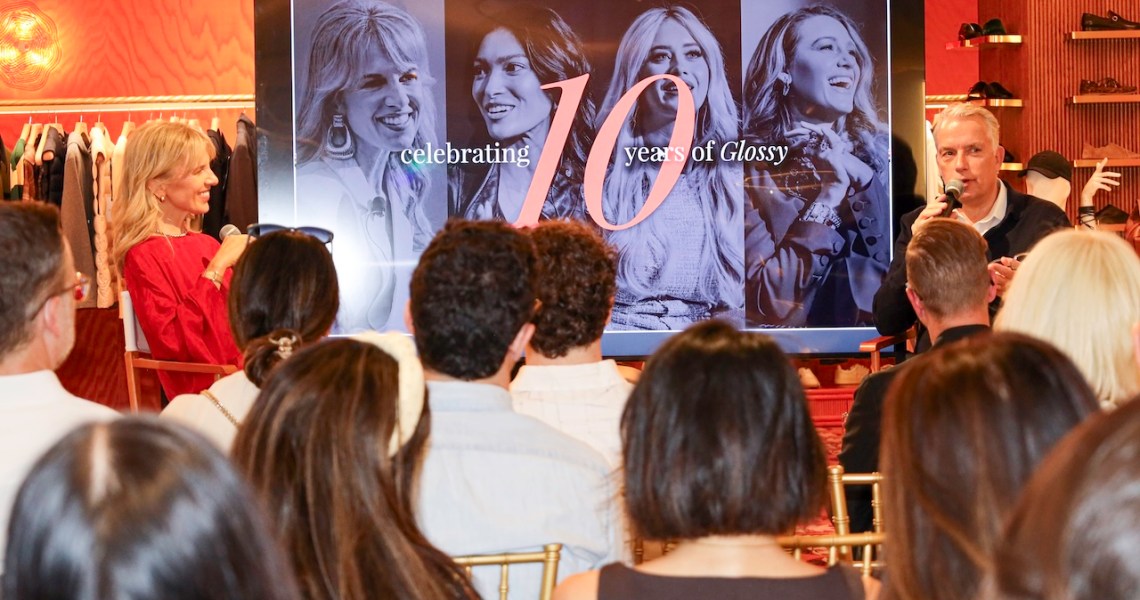
In its early days in France, where it opened its first store in 1865, Printemps was “revolutionary,” said Thierry Prevost, CEO of Printemps America, during a fireside chat at a Glossy+ member event at Printemps New York on Thursday. For example, it was one of the first retailers on the Left Bank to open on the Right Bank, plus it was among the first department stores to have an escalator and electricity.
Now, amid its U.S. expansion, Printemps continues to go against the grain. For example, Prevost prefers to refer to its local retail concept as an “apartment store,” rather than a department store, thanks to its more free-flowing setup, which allows various styles, brands and price points to live in single displays.
Two months after celebrating Printemps New York’s one-year anniversary, Prevost spoke with Glossy about the challenges the business is facing, the way he’s thinking about growth accordingly and the luxury brands that are still primed for success.
Do you have plans to expand your store footprint in the U.S. to match that in France, where you have about 20 stores?
“When you open a store like this, you attract the attention of the landlords — so, we have a lot of offers. But for us, we feel [opening another store now] would be too early. We’re still weak; we really need to build a strong foundation with this store before we expand to L.A., to Miami, to Texas. We are not under pressure. We have time, and we want to do it right. First, let’s do this one right. We had a good first year, and now we need to transform that into long-term success, and we’re facing a lot of challenges.”
How do you retain your French DNA while building a business in the U.S.?
“We’re not trying to be a French brand here, because our target [shopper] is American. We have to be very careful to strike a balance between new brands and also brands that are important for the market. What is a very good thing we have here in New York, especially in this store, is that there is less price resistance than in some other countries — like in France, for example. Every time we open a store, we do a lot of surveying, a lot of focus groups — and the story is always the same: ‘We want new brands,’ ‘We want brands we can’t find anywhere else.’ So we try to do that. But usually people buy what they know and what they like. Here, we have 35-40% exclusive brands. Most of them are very successful. [Another] good thing with this market is people are really open to something new.”
How are you differentiating from local competitors in New York?
“We have a very strong buying team between Paris and Italy, and we have a very creative offering. The way we present the brands is different [from other multi-brand retailers] because the way we do business is also very different. We buy the products — so, it is not a mostly consignment business, it’s an owned-by business. We buy the products, we have to sell them, and if we don’t sell them, we have to mark them down. So, completely, the risk is on us, not the brand — that is the first thing. The second thing is — as you have seen in the store, if you’re here for the first time — we present a brand not by brand, but we present a brand either by color, by material or by a story we’re telling, this type of thing. … We try to present a different aspect, to give the customer and visitor the chance to see the fashion differently. And also, we don’t present only by price; you could have one high-luxury product next to something very affordable, if they work together. So, it’s really more like a vestiaire, like a mix-and-match.”
And brands are OK with this?
“When the team is buying products, a brand may say, ‘This has to be next to this because it makes sense.’ Buyers know [where they can test the limits] because they have the relationship with the brand — and because we have a lot of store visits from brands, saying: ‘This is good,’ ‘This is not good,’ ‘Please change that.’ But for brands, [our approach] is also something new, and it’s a way for them to test something completely different and to accept more and more a mix-and-match approach rather than a whole-outfit [approach].”
How do you maintain interest and foot traffic after the first year and beyond?
“[We think about] how the store can attract people, because nobody needs anything. So, why would anybody come here? It’s a hospitality concept. The store has been designed by a woman — a very talented designer and artist, [Laura Gonzalez]. Plus, we have beautiful, talented chefs for all the restaurants and many F&B outlets. We wanted to blend the fashion with the hospitality, with the F&B, with the beauty. … We need to give an experience money can’t buy, and this is very difficult. We may, for example, invite 12 customers to meet a designer.”
Is Printemps investing in your digital presence in the U.S., as well?
“For us, online shopping is doing well, but we are very modest [in our approach], as well. We started [our e-commerce site] in October, with only some exclusive products and only at full price. The online business is a way to attract people to the store, because we try to offer the same experience online as in the store: You discover new products, or you discover a story about a designer, about a brand. We try to have as many customers as possible, of course. We want to increase sales, of course. And for that, we want to connect with people. And in a way, with digitalization — where you can have anything you find online — what is missing is connection. The younger generation — 20, 22, 23 years old — are finding it hard to meet the person they want to share their lives with, because we are too online. Something is missing.”
How do you attract and retain suitable workers who will connect with customers in line with your vision?
“For all of our staff, we have to train them, motivate them and incentivize them, for them to be as welcoming as possible and best serve [the customer] every day. They have an open training every day — all of our brands are [providing] training twice a year, online or in the store. So, every day at 9:15, there are 30-45 minutes of training. All of our staff are welcome, because we encourage them to follow customers [in the store]; they can enter a discussion with a customer in one area and follow them to another area [to help them] shop. If a staff member from the beauty [area] sells a Balenciaga bag, the Balenciaga sale will be to the beauty area. We [track sales] by area — not by people, not by brand.”
Why will Printmps be the exception to the rule when it comes to surviving in Lower Manhattan as a retailer?
“We still have to survive. We just opened, so we have one year of experience. When we’re here for five years, we can speak about survival secrets. We had a good year last year, but this April was below expectations, then May was really good. The [Financial District] is a difficult area. It’s maybe a bit early [to be here], but we feel it is the right time. There is a lot of change in this area, and, in terms of buying power, FiDi is third in New York, after the Upper East Side and Tribeca — so money is here. The population has also doubled in the last few years. So, we see young people living here, and young generations are interested in wellness, fashion, good food and good drinks — so we feel it’s the right moment.”
What’s the future of luxury retail?
“Luxury brands need to come back with less marketing, more authenticity. I won’t name any one brand, but if you look at who is really successful, it’s always about history, authenticity and craftsmanship. It’s not about quantity; it’s about quality. It’s not about being ‘in,’ it’s about having something where you can really feel the difference. When you buy a Bottega bag, it’s not a bling-bling bag, but it’s something you know you need and may have forever. Luxury has to come back to longevity, history, craftsmanship and design.”