AI may be changing the creator economy, but it’s also fueling it.
That’s according to executives at the National Retail Foundation’s Retail’s Big Show Conference this week, who described their current approach to Influencer marketing as a full-funnel strategy. At the same time, they’re engaging a broad spectrum of talent, from nano-creators to mega-celebrities, they said, while prioritizing the influencers’ organic voices over prescriptive brand messaging.
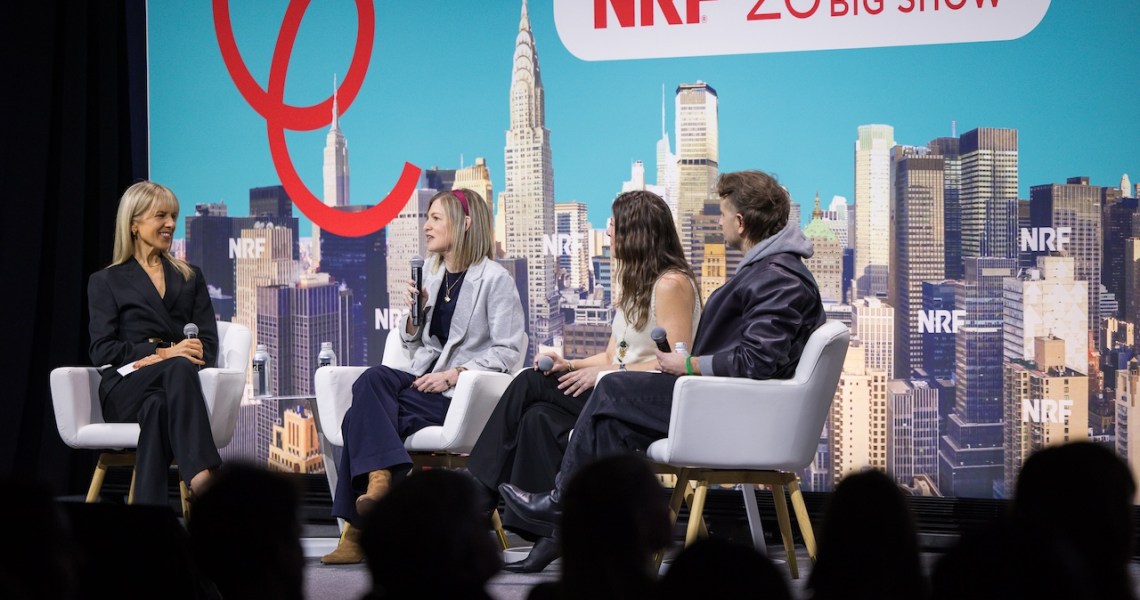
The importance of authentic voices for resonating with consumers was a hot topic throughout the event, including a panel discussion featuring Berns & Co’s Gen-Z advisory board dubbed The Z Suite. High school senior Sofia Sahai stressed the value of reviews by “real people,” while 20-something Clay Lute said he deliberately side-steps the messaging being served to him to get information he can trust. “I don’t make a purchase unless I check Reddit first,” he said.
Different talent tiers are serving unique purposes, according to marketers. For example, celebrities and mega-ambassadors are being leveraged to drive awareness, reach and “brand heat,” Meera Bhatia, president and COO of Fabletics, told Glossy — the activewear brand has partnered with Khloé Kardashian and Kevin Hart, among others. Likewise, on a panel on “retail creators” on Monday, Noah Gonzalez, head of brand PR and talent relations at H&M Americas, noted the amplification power of the company’s “top-tier talent,” which has included everyone from Beyonce to Lady Gaga — and, more recently, Charli XCX and Tyla. American Eagle, meanwhile, enlisted Martha Stewart for a campaign to bridge generational gaps and reach older demographics during the key holiday shopping season, said the brand’s marketing vp, Ashley Shapiro, during the panel discussion.
Then there are the middle-tier and micro-influencers, who are increasingly being leveraged by brands for authenticity and credibility. Christiane Pendarvis, co-CEO of Tracee Ellis Ross-founded Pattern Beauty, told Glossy that the company works with a network of micro-influencers to demonstrate product effectiveness across a diverse range of hair textures to combat consumer skepticism. Likewise, during an offsite meeting this week, Cassandra Thurswell, founder and CEO of the hair-care brand Kitsch, noted a brand strategy of partnering with creators with a variety of hair textures to provide proof points for more consumers, especially as the company expands into the shampoo and conditioner categories.
Of course, there are times when the brand founder and the celebrity are one and the same, as in the case of the Nutrl skin-care line recently launched by actor Jesse Metcalfe (1.1 million Instagram followers). In another off-site meeting this week, Metcalfe broke down for Glossy his brand’s two-year development process and signature ingredients, including Acetyl Hexapeptide-8, known as “nature’s Botox,” and Matrixyl 3000, said to be a collagen-boosting peptide blend — serving as a reminder that a well-versed celebrity can pull double duty, in terms of fulfilling marketing objectives. Nutrl’s sales have so far exceeded projections, Metcalfe said, fueled by his appearances introducing the brand on morning shows, among other channels.
Lastly, affiliate partners — a newer opportunity — have become a significant piece of the influencer pie. These partners are primarily responsible for driving action, including traffic and conversions. For its part, Walmart manages “tens of thousands” of these relationships through its proprietary “Walmart Creator” platform and third-party networks like LTK, Sarah Henry, the company’s head of content, influencer and commerce, said on Monday’s panel.
“With the creator economy ballooning, and with more people ditching the notion of a nine-to-five and wanting to become content creators full-time, it makes for a really interesting equation that’s going to unfold over the next couple of years,” she said.
On a related note, Kitsch’s Thurswell discussed the potential for affiliate creators to become their home’s breadwinners. As she onboards affiliate partners — ensuring authenticity by focusing on creators who have tagged the brand — she is also hosting training sessions on earning affiliate commissions, regardless of brand, to set community members up for success.
But American Eagle’s Shapiro said she views “anyone with a phone” — including office employees — as a potential creator. As such, she has enlisted AE employees to quickly capture and respond to emerging trends, rather than orchestrate a professional studio shoot.
Along with prioritizing a broader range of creator partners, marketers are developing strategies to ensure the messaging these partners deliver reads as their own, not the brand’s. Walmart, for example, found that being too prescriptive “handcuffed” influencers and was not in the best interest of performance, Henry said. The company now provides its creator partners with content ideas and trending data compiled through social listening, but allows them to speak in their own voice to maintain community trust. Similarly, Fabletics avoids forcing specific language on influencers, having learned that audiences can see through non-genuine content, Bhatia said.
As marketers see it, creators serve as an all-important “content engine,” freeing brands from relying on their own marketing assets while enabling them to meet new content demands across channels. Even on its e-commerce site, Fabletics incorporates influencer video content — both on its homepage and its product detail pages — to show products on a variety of body types and drive higher conversion, Bhatia said. “Seeing [the product] on as many bodies as [possible] and people speaking about it authentically is really important,” she said. Walmart, meanwhile, uses creator content to make its site feel more “fun,” Henry said, while also inspiring product discovery.
Additionally, H&M and Walmart are increasingly using creator-made content in paid social ads, emails and even out-of-home advertising.
“Creator content outperforms branded assets every single time — and not by a little, by a lot,” H&M’s Gonzalez said. “There’s always going to be a place and importance for branded assets, but people innately want to see the people they have followed and championed work with big brands and get their pay. That makes them very excited, and that spillover helps us.”
While Meta and TikTok remain the dominant influencer marketing channels, executives said they’ve expanded their focus to more channels, which is paying off in engagement.
Gonzalez called Substack the current “hot word” among marketers, due to its highly engaged, paying communities. The platform also enables long-form storytelling, unlike other platforms that capture just 3-5 seconds of viewers’ attention.
Meanwhile, Shapiro called Pinterest a “bright spot” in American Eagle’s marketing mix. Gonzales agreed, saying the platform is where creators are setting their strategy and brands are targeting aspirational, full-price customers.
The demand — and opportunity — for regularly posting content across these platforms is one area where AI is proving especially impactful for brands. “Today, media is all automated, and [AI] is doing all that work that [marketers] have been trying to do for all these years around personalization,” Shapiro said. “And the reality is that content is currency, and you just need so much of it. I don’t care how big your team is — you have to go outside of your four walls [and leverage technology]. [Fulfilling content needs] is just not possible anymore.”
The rise of TikTok Shop and integrated shopping tools is blurring the funnel, turning social media from a place for entertainment into a direct revenue driver. As brands get on board, the success metrics for their influencer marketing efforts are evolving.
The executives from Pattern Beauty and H&M said they look beyond hard KPIs to analyze consumer sentiment and the quality of the conversation sparked by a creator.
AE’s Shapiro, meanwhile, said she uses a “3 Rs” model — focused on reach, resonance and reaction — to evaluate performance.
“‘Reach’ is about reaching the right people,” she said. “Then you have ‘resonance’: ‘Did my message resonate with those customers?’ ‘Did they engage with it?’ ‘What did that look like?’ And then ‘reaction’ would be everything that pays our bills, like traffic and conversions. Obviously, an affiliate — someone you’re partnering with on an LTK or ShopMy — is going to drive more of that reaction. [In contrast] a celebrity is going to do more for reach and acquisition: Did that bring in a new customer?”
And these metrics are shaping brands’ influencer efforts, which show no signs of slowing down.
Quoted
The future of the e-commerce store as agenetic AI takes off
“The online store is always going to be important. If you ask the million of stores on Shopify, [the online store] is their online home. That’s where they have their products, but that’s also where they have their news page, that’s where they have their media. Whereas the brick-and-mortar store used to be the hub, and the online store was a spoke, for all these modern brands — like Gymshark and like Skims — their hub is really the online store. So, I don’t think it goes away. I just think you have alternative channels. [For example] Shopify powers commerce on Roblox. And so, in that case, for some merchants, some of the time, using the Roblox channel is amazing — but that doesn’t work for everyone. So what we’re trying to do is, whether it’s Roblox or it’s YouTube Shopping, or it’s Instagram, or it’s agentic, or it’s the brick-and-mortar store, or it’s wholesale — wherever you have consumers who maybe want to purchase from you, we make that really easy.” –Harley Finkelstein, president of Shopify
Hot topic
Leveraging physical retail to drive subscriber growth
Across conversations, Glossy noted multiple brands hyping their strategy of leveraging physical retail to acquire high-LTV subscribers.
For example, Fabletics’s Meera Bhatia called stores a primary driver of the company’s membership-based business model: Fifty percent of customers who walk into a Fabletics store sign up for the company’s VIP membership, she said. In turn, Fabletics plans to open 40 stores this year, with 20 being in international markets including Mexico, Guatemala and Dubai.
Meanwhile, although 90% of “clean” diaper brand Coterie’s sales are direct-to-consumer, 12% of new customers to its subscription program first try the brand via a retail purchase. “It’s a nice funnel back to our subscription model,” said the brand’s CEO, Jess Jacobs. The brand currently sells in Whole Foods — where it accounts for 86% of category sales — as well as Wegmans and Erewhon.
More from NRF
Limited inventory and thoughtful partnerships: How brands at NRF are making the most of TikTok Shop [Glossy]
TikTok was a hot topic of conversation at the National Retail Federation’s Big Show in Manhattan this week. Multiple executives in attendance spoke about the double-edged sword of TikTok driving massive demand and the need to be prepared for it.
How The North Face, Vans and Timberland are trying to transform their businesses in 2026 [Modern Retail]
Leaders from The North Face, Vans and Timberland discussed their growth playbooks for 2026 at the NRF conference on Tuesday. They involve everything from zeroing in on core categories to courting young shoppers.
How brands like Vuori, Rothy’s and Away have adapted to the new DTC landscape [Modern Retail]
At NRF’s annual Big Show, executives from Away, Vuori and Rothy’s discussed the ways the DTC model has been upended since its golden era.