LVMH closed 2025 with revenue of “just over €80 billion” (approximately $87 billion) and operating free cash flow of €11.3 billion ($12.3 billion), up 8% year over year, despite slightly negative organic growth and a sharp currency headwind. “The results of the group are solid in a rather challenging, disrupted climate,” chairman and CEO Bernard Arnault said on the company’s January 27 earnings call. “2026 won’t be simple either,” he added.
“LVMH seems to make the most of the difficult market environment [by getting] the house in order,” said Luca Solca, lead luxury analyst at Bernstein, pointing to stronger-than-expected profitability despite continued pressure on organic growth.
LVMH’s fashion and leather goods division posted a 3% organic sales decline in 2025, but operating margins held at a robust 35%. “The core LVMH profit engine [of fashion and leather goods] has been losing steam, but the segment grouping masks the relative resilience at Louis Vuitton,” Solca said, emphasizing that brand-level performance matters more than division-level averages.
While much of the market conversation has focused on luxury’s uneven recovery, LVMH used the call to reinforce that the company is prioritizing long-term brand value over short-term acceleration. Two brands, in particular, emerged as central to that strategy: Tiffany & Co. and Loro Piana.
As for Tiffany, executives framed the business as mid a transformation that is already delivering tangible results, even as the bulk of the work remains unfinished. “Tiffany was hugely focused on silver products, and we’re now pushing gold, we are pushing high jewelry,” a company executive said. It’s a tough market, with the price of gold shooting up: This week, it was reported that an ounce of gold now costs $5,000 for the first time ever. According to the executive, Tiffany & Co.’s high jewelry business has tripled over the past four years, since LVMH acquired the company. Silver, meanwhile, has declined by over one-third.
That shift is being reinforced by a gradual overhaul of Tiffany’s store network. By the end of 2025, the new store concept represented about one-third of locations, which accounted for roughly 42% of sales, management said. The performance gap between renovated and legacy stores is significant, with executives citing a difference of “between some 15 and 20 points.”
Tiffany & Co.’s renovated Fifth Avenue flagship was highlighted as a key example. After reopening in 2023, the store achieved record sales, with December sales nearly double the fleet’s average. “We are right in the middle of the transformation plan that started in 2021,” said Stéphane Bianchi, LVMH group managing director, underscoring that the new store rollout is far from complete.
Arnault positioned Tiffany as a long-duration growth asset rather than a short-term recovery story. If the strategy continues to prove successful, he said, “in five to 10 years, [Tiffany could] become the world’s leading jewelry brand.” However, he cautioned that the company plan is far from complete.
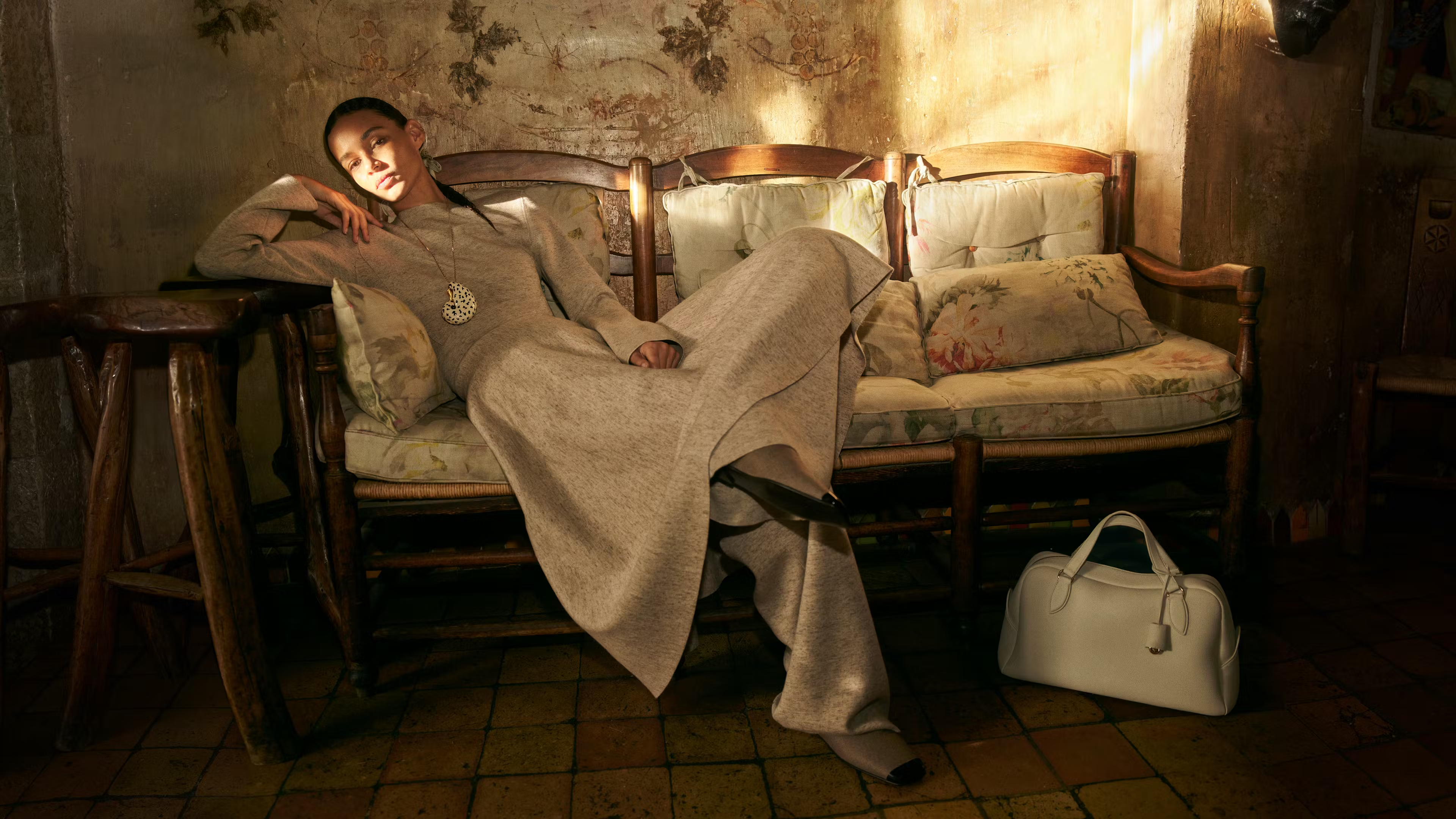
Loro Piana, meanwhile, was presented as a case study in restraint. Arnault said the brand’s growth has been intentionally moderated to protect craftsmanship and supply quality. “We don’t want to go too fast because the quality of products must be maintained,” he said.
According to Solca, “A market driven by established high-end consumers favors high-end niche brands.” He noted that labels such as Loro Piana are benefiting as very wealthy clients “with very well-stuffed wardrobes” become more selective and less interested in mega-brand uniformity.
During the year, LVMH increased its ownership in Loro Piana to roughly 85%, while retaining the founding family as minority partners. In 2018, it bought 80% of the brand, according to industry reporting. In an unusually candid moment, Arnault disclosed the brand’s implied valuation. “When we acquired the company, I think we paid around €2 billion (about $2.2 billion),” he said. “Today, it’s worth about €10 billion (roughly $10.9 billion).”
As for costs, the group emphasized discipline rather than sweeping cuts. CFO Cécile Cabanis said the group’s operating expenses fell 4% in 2025, while capital expenditure remained steady at 5.7% of sales, in line with historical averages. LVMH did not announce new group-wide layoffs on the call, but the company has already been restructuring in pockets. In May of last year, LVMH confirmed job cuts at Moët Hennessy, with more than 10% of roles slated for elimination as tariffs and slowing demand weighed on the wines and spirits division.
Looking ahead, Arnault struck a cautious but confident tone.
Short-term forecasting, he said, remains difficult amid geopolitical volatility, tariffs and tax pressure. But the group’s long-term conviction is unchanged. “One of the advantages of the group is that we’re a family group,” Arnault said. “We invest for the medium term, we create products for the long term, and we’re not mesmerized by what’s going to happen in the coming quarter.”